'Encryption is useless'
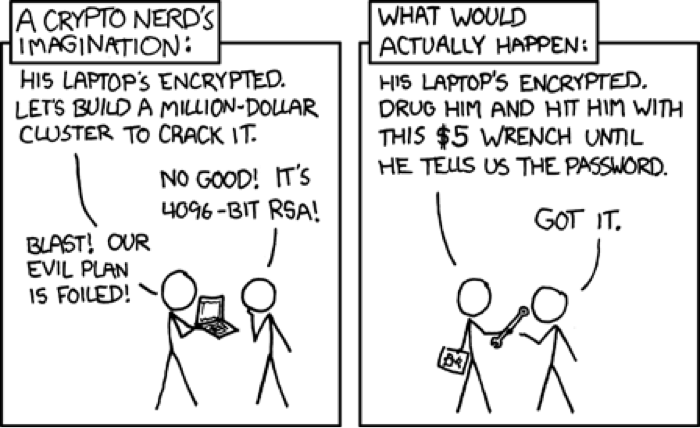
I touched on this story in my article, Firefox Configuration Guide for Privacy Freaks and Performance Buffs, but i wanted to give it a dedicated page and expand on it because i keep coming across bits of information which seem to verify something i was told long ago regarding encryption.
Somewhere around 2002 i sold a PC to a very nice, older fella who said he had worked for the government either directly or as a contractor. I don't recall which and he didn't state what department he worked for. He said he had a security clearance and, as i recall, it was a crypto clearance. He left me with the strong impression that he wasn't going to provide a lot of detail as to what exactly he did, however i had no reason to disbelieve anything he said since he seemed genuine and very matter-of-fact. Our time together was short because he had to be somewhere, but we chatted a while and he touched upon some very interesting topics that i wanted to know more about and so i suggested we continue our conversation through encrypted email. He looked at me and responded with, "Encryption is useless.". Those words stuck with me ever since.
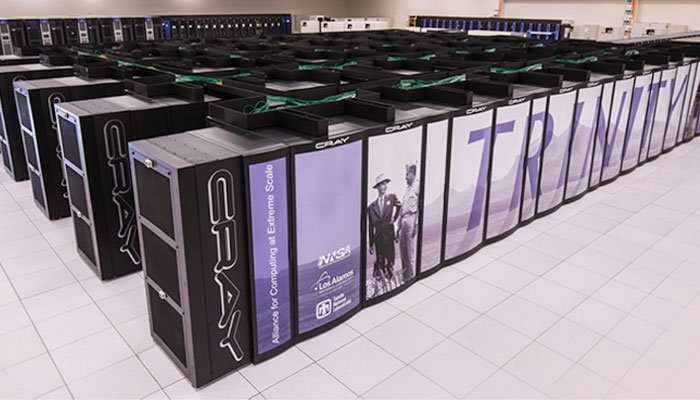
Whether encryption is useless or not depends upon the threat we want to mitigate. For example, if you wanted to download copyrighted content whilst avoiding having your ISP send you nasty-grams, then encryption is certainly not useless. However given what i have read and heard over the years, i strongly suspect that encryption is not effective if, for example, it is the NSA that decides to target you and i think that multiple statements and documents released by Edward Snowden and Bill Binney strongly suggest this. There is perhaps another possibility here though. What if, as some suspect, Snowden was allowed to leak what he did, sort of as a limited hangout. Personally i think Snowden is genuine, but that doesn't mean that the information in the documents he released wasn't intended to be released. Furthermore, there is certainly classified and compartmentalized technology that Snowden knows absolutely nothing about. What if the U.S. intelligence community wanted to quell a potential uprising by 'we the people'? It is apparently a historic fact that one way to accomplish this is to make people think they are being surveilled which, in turn, compromises their ability to communicate effectively due to self-censorship.
While i think it is smart to assume that everything we say or do over a network, or while in the presence of electronic devices capable of recording us such as a smartphone or smart assistants, even if the encrypted data we send and receive were secure, that data can be stored indefinitely until some time in the future when the encryption can be broken. One may assume that the immediate problem with storing that amount of data is processing it and developing coherent intelligence, however this is seemingly quite doable with advanced technology such as quantum computing and artificial intelligence (AI). Both Binney and Snowden have stated that the massive, ongoing and patently illegal and unconstitutional data collection practices as employed by intelligence communities are not effective in preventing threats because of the wide net cast by the programs, but i'm not sure they considered AI or other advancements in technology, or even know about some the hardware which may be in play.
In the 2015 interview with Bill Binney (video below, NSA Whistleblower William Binney The Future of Freedom), Richard Grove of Tragedy and Hope asks Binney what people can do to mitigate the risks posed by mass surveillance. Binney answered with the following:
If you're a target i don't believe there's any way you can eliminate the risk. I mean in fact i don't think there's anything you can do to stop it. If they're after you they're going to get you one way or the other. I mean there's so many...if they can't get it through the internet, through the tapping of the lines, or anything like that through a commercial means, and they're unsure about you, they can get it by close access means, uh coming in and actually bugging your house or bugging your, um, or putting monitors in your system...in your house or on your computer, they can use your computer video to look back at you, or they can monitor um, within a certain distance the keystrokes your making on your computer or what you're putting on your computer screen and if that's not enough they can come in through the firewall you think you have but don't and go through your operating system that you think protects you but doesn't and read your uh, encrypted email that you thought was secure but isn't, or, they can simply wait for you to do decrypts if you've done that and pull them off and use your unused CPU while you're on the computer to drain it. It's called active attack. So if you're a target there's virtually nothing you can do. And if they fail in their electronic means they can always send the FBI at you to do a sneak-and-peak and take your photograph or do whatever they want.
Another Achilles heel regarding encryption is that, even if the algorithm were bullet proof, it wouldn't matter in the least if there are backdoors in the code. Again this was talked about by both Binney and Snowden who stated that this is indeed a problem. In the 2013 article, NSA and GCHQ have broken internet encryption, created backdoors that anyone could use by Extremetech, we read:
New documents released by Edward Snowden show that the NSA and its British equivalent, GCHQ (pictured above), have cracked VPNs, SSL, and TLS -- the encryption technologies that keep your data secure on the internet. The NSA program, dubbed Bullrun, took 10 years to crack the web's encryption technologies, before finally reaching a breakthrough in 2010 that made "vast amounts" of previously unreadable data accessible. Perhaps more worryingly, the NSA has an ongoing program to place backdoors in commercial products (websites, routers, encryption programs, etc.) to enable easy snooping on encrypted communications. The documents, which contain some choice phrases such as, "work has predominantly been focused this quarter on Google due to new access opportunities being developed," almost completely undermines the very basis of the internet, obliterating the concept of trust online.
The documents outline a three-pronged plan to ensure the NSA can access the bulk of the internet's encrypted traffic: Influencing the development of new encryption standards to introduce weaknesses, using supercomputers to break encryption, and collaborating with ISPs and tech companies to gain backdoor access.
Despite the threats we face we must never be dissuaded from communicating. We must have dialog because without it, as Binney states, society stagnates and self-destructive behavior is one of the results.
Video: NSA Whistleblower William Binney The Future of Freedom
Video: NSA Whistleblower: Government Collecting Everything You Do
Resources used to write this article
- Researchers crack the world's toughest encryption by listening to the tiny sounds made by your computer's CPU | ExtremeTech
- How secure is today's encryption against quantum computers? | betanews
- Revealed: how US and UK spy agencies defeat internet privacy and security | The Guardian
- The NSA Can Beat Almost Any Type of Encryption | Gizmodo
- N.S.A. Able to Foil Basic Safeguards of Privacy on Web | The New York Times
- The Clock Is Ticking for Encryption | Computerworld
- NSA Utah Data Center - Serving Our Nation's Intelligence Community | NSA
- Had a copyright letter from your ISP? Do tell... | The Guardian
- NSA and GCHQ have broken internet encryption, created backdoors that anyone could use | Extremetech
- NSA Whistleblower William Binney The Future of Freedom | Tragedy and Hope
- NSA Whistleblower: Government Collecting Everything You Do | Abby Martin, Empire Files