Excerpts from 'The Private Science of Louis Pasteur'
"Here we deal not with mere acquiescence in the formulaic genre of scientific papers and the associated "inductivist" image of science, but with discrepancies between Pasteur's public and private science in cases where the word "deception" no longer seems so inappropriate, and even "fraud" does not seem entirely out of line in the case of one or two major episodes."
Louis Pasteur (1822-1895) was a French chemist, pharmacist and microbiologist who is widely regarded as the father of immunology (vaccines) and microbiology. Pasteur is also known for discovering pasteurization, a heating process which compromises the nutritional value of raw foods such as milk and cheese.
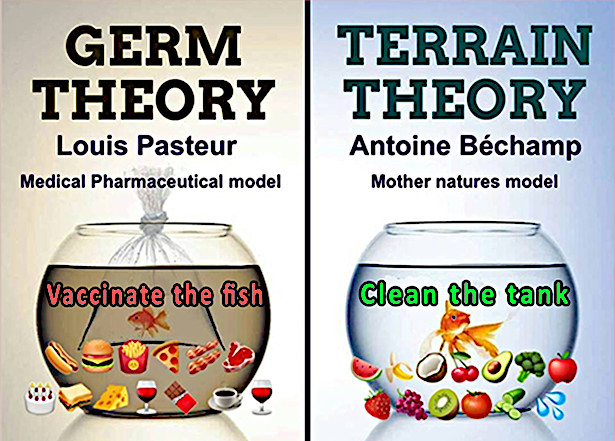
During his career Pasteur kept approximately 100 of his laboratory journals secret, never wanting them disclosed, not even after his death. The pseudoscience of virology was constructed upon the foundation established largely by Robert Kock, who is known for creating Koch's Postulates, a criteria for identifying a virus which no one has ever managed to satisfy, and the fraudulent work of Louis Pasteur which, along with his political connections, led to the creation of germ theory, the scientifically untenable theory that germs (pathogenic microbes) are transmissible and are responsible for causing disease. Unfortunately Pasture's unpublished laboratory notebooks weren't disclosed until it was far too late, thus germ theory overtook the more logical and scientifically sound science of terrain theory which suggests that disease is caused by factors such as a lack of proper nutrition, environmental toxins and other factors.
Following are excerpts from the book, The Private Science of Louis Pasteur by Gerald Lynn Geison. It became immediately apparent, as i began reading, that Geison spends an inordinate amount of time fawning over "master" Pasteur and making excuse after excuse for some of his unethical and unscientific behaviors and methods whilst demonizing anyone critical of his work. Still, Geison does point out some of the serious problems with Pasteur's work and deserves credit for doing so.
Throughout the book Geison of course makes the same fatal mistake that virologists, public health institutions, governments, the media and the general public have made for all these decades, which is to assume that the existence of pathogenic microbes has been proven through well established science when in fact this is not the case. Simply put, what virologists identify as "viruses" is nothing more than cellular debris and/or exosomes which result from cellular decay. This was again demonstrated recently by Stefan Lanka, a German biologist and former virologist who, unlike virologists who do not follow the scientific method, performed control experiments and observed the same "cytopathic effect" that is witnessed by virologists (see: Dr. Stefan Lanka & Dr. Tom Cowan: How We Got Into This Mess - The History of Virology & Deep Medical Deceptions (archived copy)).
I wasn't able to locate a pristine digital copy of the book that was free of scanning/OCR errors and so many typos were corrected to the best of my ability.
IN 1878, WHEN he was fifty-five years old and already a French national hero, Louis Pasteur told his family never to show anyone his private laboratory notebooks. For most of a century those instructions were honored. Pasteur's notebooks--like the rest of the manuscripts he left behind at his death in 1895--remained in the hands of his immediate family and descendants until 1964. In that year, Pasteur's grandson and last surviving direct male descendant, Dr. Pasteur Vallery-Radot, donated the vast majority of the family's collection to the Bibliotheque Nationale in Paris, but access to this material was generally restricted until Vallery-Radot's death in 1971, and there was no printed catalog of the collection until 1985.
[...]
The choice of this phrase for the very title of this book deserves a preliminary discussion and justification, if only because some readers may consider it a contradiction in terms. If, as many assume, the very definition of science implies a public (usually published) product--if, as Charles Gillispie has written, "science is nothing until reported," or if, in Gerard Piels words, "without publication, science is dead"--whatever can "private science" mean?
The notion of private science is indeed problematic, and not only in the sense that these commentators probably have in mind.
[...]
"Private science" becomes a still more problematic category when the research involves assistants and collaborators, as it did throughout much of Pasteur's career (and as it does in most modern laboratory research). Even Pasteur, despite his secrecy and "Olympian silence" about the direction of his research, could not always conceal his work or thoughts from his closest collaborators. And a few of them did not always and forever honor Pasteur's stricture that the research carried out in his laboratory should remain a totally private affair within the Pasteurian circle unless and until he chose to disclose the results himself or specifically authorized others to do so. True, Pasteur's collaborators did honor this demand to a degree that may seem astonishing in our less discreet world, and nearly all of them continued to do so even after the masters death. But there is evidence to suggest that these severe restrictions on public disclosure did not always sit well with some of Pasteur's assistants and co-workers. By 1880, for example, Emile Roux, his major collaborator in research on anthrax, rabies, and other diseases, was warning Pasteur that outsiders had begun to regard his laboratory at the Ecole Normale as a "mysterious sanctuary". Eventually, the veil of secrecy was pulled back in part, most notably in the anecdotal reminiscences of Pasteur's own nephew and sometime personal research assistant, Adrien Loir, who did, however, wait half a century to publish his revelations in a widely ignored series of essays that carried the apt title, "In the Shadow of Pasteur".
[...]
The most private of the manuscript materials Pasteur left behind are the 144 holographic notebooks that his grandson donated to the Bibliotheque Nationale in 1964. Of these 144 notebooks, 42 fall outside the category of laboratory notebooks, consisting instead of collections of newspaper clippings, draft sketches of projected books that never appeared, lecture outlines, and reading and lecture notes. The remaining 102 notebooks represent the most precious documents in the Papiers Pasteur. They consist of careful and detailed records of experiments carried out by Pasteur and his collaborators during forty years of active, almost daily research. They are the central repository for the private science of Louis Pasteur, the documents he once asked his family to keep forever out of public view. During his lifetime, he carefully guarded them from others, including his closest collaborators. Even when he left Paris for trips or holidays, Pasteur took the most current of the laboratory notebooks with him. His co-workers sometimes experienced inconvenience or worse because of his insistence on total control of the notebooks. In late November 1886, for example, while Pasteur was resting at a villa on the Italian Riviera for the sake of his fading health, his collaborators in Paris were suddenly faced with a legal problem connected with the death of a boy who had undergone the Pasteurian rabies treatment (a story to which we shall return in Chapter Nine). As we know from his retrospective personal testimony, Pasteur's nephew-assistant Adrien Loir had to be dispatched quickly to Italy in order to retrieve important details about the boy's treatment--information that was recorded only in a laboratory notebook the master had taken with him to the Italian villa. Earlier, in July 1883, when Emile Roux wanted to gather together some of the results of his important work on rabies for his doctoral thesis, he had to seek Pasteur' permission to use information recorded in the laboratory notebooks. To ensure the master's assent, Roux promised to expose only those results already made known in a general way in Pasteur's published papers, submitted a draft version to the master for his corrections and revisions, and "inscribed your [i.e., Pasteur's] name on the first page of this exposition of studies that belong to you".
[...]
Let me emphasize at once that I have no intention of denying Pasteur's greatness as a scientist. To be sure, my definition or conception of a "great scientist" may differ somewhat from the conventional. For me, there is no reason to suppose that a great scientist must also display personal humility, selfless behavior, ethical superiority, or political and religious neutrality.
[...]
In the spectacular case of Pasteur, we are fortunate to have a complete set of his unpublished laboratory notebooks--those one-hundred-odd tidy and meticulously preserved records of his day-to-day research. By exploring his laboratory notebooks in the full context of his life, work, and social setting, we can gain unusual insight into the construction of scientific knowledge at the concrete level of an extraordinarily creative individual scientist.
This book can only begin the task, and for the most part these more general concerns will only emerge implicitly. Yet it should gradually become clear that some of Pasteur's most important work often failed to conform to ordinary notions of proper Scientific Method. In particular, it will become clear that Pasteur sometimes clung tenaciously to "preconceived ideas" even in the face of powerful evidence against them. And it should also eventually become clear just how far the direction of his research and his published accounts of it were shaped by personal ambition and political and religious concerns.
[...]
But now an additional focus begins to take center stage, and it relates directly to the second and very different category of discrepancies between Pasteur's public and private science. Here we deal not with mere acquiescence in the formulaic genre of scientific papers and the associated "iductivist" image of science, but with discrepancies between Pasteur's public and private science in cases where the word "deception" no longer seems so inappropriate, and even "fraud" does not seem entirely out of line in the case of one or two major episodes.
[...]
At a more prosaic level, Pasteur's success certainly did depend crucially on financial support from the government. He sometimes complained bitterly of the neglect of science by the French state, and he resented the need to make constant appeals to the bureaucracy for research expenses, describing the process as "antipathetic to a scientist worthy of the name". Yet appeal he did, and rarely did he fail. Especially once his concern with practical problems became manifest, he enjoyed truly remarkable success at getting whatever he sought--a new or expanded laboratory, additional personnel, a larger research budget, even national railroad passes for himself and his assistants. Among the governmental sources he tapped were the Ministries of State, Agriculture, Public Instruction, Public Works, and even the Imperial House itself, where the more pragmatic aspects of his work on wine and disease received personal support and encouragement from Emperor Louis Napoleon and Empress Eugenie. Nor did the emperor's abdication and the coming of the Third Republic do anything to interrupt the flow of government funds. The work on vaccines was especially well funded. Some German scientists, including Robert Koch, may have fared just as well, but the support given Pasteur was spectacularly generous by French standards. By the early 1880s, when the vaccines against chicken cholera and anthrax emerged from his laboratory, Pasteur may have been the recipient of 10 percent or more of the annual governmental outlay for all scientific research in France.
[...]
But Pasteur was no mere political opportunist. He continued to acknowledge his association with and indebtedness to the imperial household even after the abdication--even in the face of advice that it could be politically imprudent to do so. In 1875 Pasteur was asked by friends in his hometown of Arbois to run for the Senate. Saying that he had no right to a political opinion because he had never studied politics, he nonetheless agreed to run as a conservative.
[...]
ON THE AFTERNOON of Thursday, 2 June 1881, Pasteur stepped off a train in Melun, 40 kilometers southeast of Paris. Escorted by his three leading collaborators and various dignitaries, he made his way to the nearby commune of Pouilly-le-Fort and to the large farm of Hippolyte Rossignol, a local veterinary surgeon. Rossignol's large farmyard easily accommodated an expectant crowd of more than two hundred government officials, local politicians, veterinarians, farmers, agriculturists, even calvary officers and newspaper reporters.
[...]
A major killer of sheep, anthrax had become a source of grave concern to French agriculturists, whose annual losses from the disease in recent years were estimated at 20-30 million francs. The size and composition of the crowd in Rossignol's farmyard was a reflection of the economic significance of the disease--and of Pasteur's efforts to combat it.
The crowd had gathered to observe the fortunes of fifty sheep, half of which had been marked with a hole in their ears and "vaccinated" by Pasteur's collaborators in two stages. The first "protective injection" had been made on 5 May; the second, on 17 May. The other twenty-five sheep had received no injections until 31 May, when both they and their twenty-five vaccinated counterparts were injected with a culture of virulent anthrax bacilli. In a bold prophecy given wide public circulation, Pasteur had predicted that the vaccinated sheep would all survive, while the unvaccinated sheep would all succumb to anthrax. He had set today, 2 June, as the date by which it should have become clear whether or not his vaccine had been a success. Quite apart from the economic significance of the outcome, Pasteur had aroused great excitement by predicting such decisive results in what was, after all, the world's first public trial of a laboratory vaccine.
As Pasteur and his collaborators entered the farmyard at 2 PM, the crowd burst into applause and congratulations. All of the vaccinated sheep were alive and all but one ewe were seemingly healthy. Most of the unvaccinated sheep were already dead and the survivors were obviously not long for this world. It was a moment of high drama in an uncommonly dramatic scientific career.
[...]
Pasteur himself never disclosed in print the real nature of the vaccine deployed at Pouilly-le-Fort. Indeed, his published accounts conveyed the impression that the Pouilly-le-Fort vaccine had been prepared by a method entirely and significantly different from the one actually used.
[...]
In public, then, Pasteur spoke of the Pouilly-le-Fort trial as if it were part and parcel of his more general quest for oxygen-attenuated vaccines against microbial diseases. He never published a different--or more explicit--account of the modus jasciendi of the anthrax vaccine used at Pouilly-le-Fort. Small wonder that the best informed and most interested scientists of Pasteur's time assumed that the Pouilly-le-Fort vaccine had been prepared by the method of oxygen attenuation. Small wonder that virtually all subsequent studies of Pasteur have adopted the same assumption. And small wonder, too, that these studies ignored or dismissed the very different, indeed opposing, testimony of one sympathetic and firsthand observer of Pasteur's work on anthrax vaccines.
In 1937, forty years after Pasteur's death, his nephew and sometime research assistant, Adnen Loir, published a series of recollective essays under the general (and apt) title, "In the Shadow of Pasteur". In one of these anecdotal but revealing essays, Loir gave passing attention to Pasteur's search for an anthrax vaccine and the famous Pouilly-le-Fort trial. Although vague and sometimes mistaken about the precise details and sequence of events, Loir's account is perfectly clear in its claim that the vaccine used at Pouilly-le-Fort had been prepared not by atmospheric attenuation, but rather by the "antiseptic" action of potassium bichromate.
[...]
It is only by turning to Pasteur's laboratory notebooks that we are able to establish conclusively the nature of the vaccine actually used at Pouilly-leFort. Working independently, Antonio Cadeddu and I have analyzed the pertinent notebook, and our interpretations agree on this central point: Pasteur deliberately deceived the public and the scientific community about the nature of the vaccine actually used at Pouilly-le-Fort.
[...]
Extrapolating slightly from Loir's account, it could further be argued that the specific method used to produce the Pouilly-le-Fort vaccine was really only a minor matter of detail, so long as it was consistent with Pasteur's biological theory of immunity. As we shall see more fully below, Pasteur had committed himself to a "biological" theory of immunity, according to which vaccines were living but attenuated microbial strains.
12bytes: Here again Geison excuses Pasteur for deceiving the public and scientific community, positing that doing so is acceptable as long as Pasteur's theory of immunity was correct, which in fact it was not. Neither Pasteur, nor Koch, nor Rivers, nor any microbiologist, nor anyone else, has ever managed to provide creditable scientific evidence that pathogenic microbes exist, therefore any perceived utility of vaccines is entirely baseless. Microbe transmission was attempted when the United States Public Health Service (USPHS) attempted to infect 100 healthy, U.S. Navy volunteers with the alleged virus responsible for the Spanish Flu. The study was a complete failure. In not a single case did a healthy person become sick, even after several attempts using different methods including blood transfer, saliva transfer, mucus transfer, breath transfer and physical contact. "We used some billions of these organisms, according to our estimated counts, on each one of the volunteers, but none of them took sick" stated Milton J. Rosenau, MD, author the report for the USPHS. Having failed to infect a single human, they then experimented with horses and, there too, failed spectacularly. The following quote is from Dr. Thomas Cowan's book, The Contagion Myth:
During World War I, governments on both sides of the conflict installed antennas, which eventually blanketed the earth with strong radio signals-and during the latter part of 1918, disaster struck. The Spanish flu afflicted a third of the world's population and killed about fifty million people, more than the Black Death of the fourteenth century. To stop the contagion, communities shut down schools, businesses, and theaters; people were ordered to wear masks and refrain from shaking hands.
Those living on military bases, which bristled with antennas, were the most vulnerable. A common symptom was bleeding--from the nostrils, gums, ears, skin, stomach, intestines, uterus, kidneys, and brain. Many died of hemorrhage in the lungs, drowning in their own blood. Tests revealed a decreased ability of the blood to coagulate.
Continuing with The Private Science of Louis Pasteur:
In his famous paper of 26 October 1885, Pasteur tried to meet in advance any ethical concerns about his decision to treat Meister by insisting that he had already made fifty dogs immune to rabies, without a single failure, by the same method he then used to treat Meister beginning on 6 July 1885.
[...]
Whenever and however an immune dog emerged from such experiments, Pasteur considered it "vaccinated" By August 1884, he had about twentyfive such dogs, whose immunity he then demonstrated in experiments before the French Rabies Commission, which was appointed that same year at his request. But none of these dogs had sustained rabid animal bites before their inoculations, and the methods used on them often resulted in rabies when applied to other dogs. No one outside the Pastonan circle had any way of knowing this fact, including presumably the members of the official French Rabies Commission. By keeping what he called the "details" of his experiments out of public view, Pasteur repeatedly conveyed a misleading optimistic impression of the actual results recorded in his laboratory notebooks.
That judgment applies with full force to the results of Pasteur's post-bite trials on dogs. Among Dr. Peter's explicit complaints was that Pasteur failed to specify what he meant when he claimed that "a large number of dogs" had been rendered immune to rabies after sustaining rabid animal bites. The first remarkable conclusion to emerge from a close study of Pasteur's laboratory books is that this "large number" was in fact less than twenty. More important, in the course of producing immunity in these bitten dogs--no more than sixteen, by my count--Pasteur failed to save ten dogs treated at the same time and by the same methods. In the case of three or four of the dogs that died despite their treatments, Pasteur believed their deaths resulted from some cause other than rabies and therefore imagined that they could be counted as "successes". This is but one striking example of the wishful thinking, or self-deception, found scattered throughout his laboratory notebooks on rabies. There was obviously no basis for including these dogs among the successfully vaccinated, for they never had a chance to demonstrate their alleged immunity to rabies. At best, a case could be made for excluding them from any list of failures, but only if they were discounted entirely.
More than that, the success rate in these dogs treated after sustaining rabid bites was essentially no different from the survival rate of otherwise similar dogs that were simply left alone after their bites. Actually, in these experimental trials of rabies vaccines, Pasteur hardly lived up to his reputation as a rigorous practitioner of the "controlled experiment". In most cases, he did not employ control dogs at all. While conducting his trials on twenty-six bitten dogs, he used only seven controls. Of these seven dogs left to suffer their fate without treatment, five were still alive at the time Pasteur treated Joseph Meister. One of the surviving five control dogs did eventually die of rabies in September 1885, but by then one of Pasteur's sixteen allegedly "vaccinated" dogs had also died of the disease after an unusually long incubation period.
[...]
True, Pasteur did imply that some sort of distinction could be drawn between the treatment applied to his bitten dogs and the treatment applied to Meister after invariably successful results in the last fifty (unbitten) dogs. But he left the nature of that distinction entirely unclear. In the face of such reticence, it was natural to assume that Pasteur had applied the same method in both cases, but had perfected it in the (unspecified) interval between his post-bite trials and his experiments on the last fifty dogs.
In fact, however, Pasteur had switched to a radically new method in his experiments on this last group of fifty (or perhaps forty) unbitten dogs. It was essentially the technique applied to Joseph Meister beginning on 6 July 1885. But it differed drastically from the methods previously used to treat the twentysix bitten dogs. As only Pasteur's laboratory notebooks reveal, not a single one of those twentysix dogs, including of course the sixteen that did develop immunity to rabies, was treated by the method later applied to young Meister. Actually, the bitten dogs were treated by three different methods, none of which was ever described in print.
[...]
When he disclosed this technique in May 1884, Pasteur claimed that the monkey-attenuated vaccine was yielding highly promising results in experiments on dogs. But none of those promising results, it turns out, came from experiments on dogs already exposed to rabid bites.
[...]
In any case, Pasteur's laboratory notebooks amply confirm that, at the time he undertook to treat Meister, he had not yet produced anything remotely approaching "multiple proofs" of the efficacy of his method on "diverse animal species". But that is the least of it. For the notebooks also reveal that Pasteur had not yet met the much less demanding criteria to which he referred in his famous paper on the Meister case, three months after the boy's treatment had been completed.
In fact, the notebooks provide no evidence that Pasteur had actually completed the animal experiments to which he appealed in justification of his decision to treat Meister Rather, they show that as of 6 July 1885, when Meister's treatment began, Pasteur had just begun a series of vaguely comparable experiments on forty dogs (and conceivably on fifty, though I have not yet been able to identify these last ten dogs). As of that date, according to the laboratory notebooks, only twenty of the forty to fifty experimental dogs had even completed the full series of "vaccinal" injections. And none of the dogs had survived as long as thirty days since their last (and highly lethal) injection. From a few earlier experiments, Pasteur might reasonably have surmised that rabies symptoms typically appeared between the seventeenth and twenty-sixth day in dogs inoculated with highly virulent rabies virus. That these twenty dogs had not yet displayed fatal symptoms of rabies, three to four weeks (twenty-three to thirty days) after they had been injected with a highly virulent rabies virus, was the best evidence Pasteur had of the safety and efficacy of his anti-rabies vaccine at the time he decided to treat young Joseph Meister. Furthermore, as Pasteur himself conceded, not a single one of these experimental dogs had first been bitten or otherwise inoculated with rabies before being "treated" by the method used on Meister.
Against this background, it should come as no great surprise that Pasteur never did publicly disclose the state of his animal experiments on the "Meister method" as they stood at the point at which he decided to treat the boy. Nor, indeed, have they been revealed in print until now. They are recorded only in Pasteur's private notebook of that period, which, like the other one hundred laboratory notebooks he left behind at his death in 1895, remained in the hands or control of his immediate family until the mid-1970s. Even now, the notebooks have only begun to be subjected to the close scrutiny and analysis they deserve.
But it is already clear, and should not surprise us, that the most acute critics of Pasteur's treatment for rabies were medical men. Even Dr. Grancher, who performed the injections on Meister and other early subjects of the Pastonan treatment, later admitted that "the great majority of doctors did not believe in [Pasteur's] anti-rabies vaccine". If some of these critical doctors were motivated in part by personal hostility toward Pasteur and by their concern over the intrusion of the new experimental science into their traditional domain, they also directed sometimes telling attention to the pertinent ethical issues, and their cautious skepticism clearly owed something to the clinical ethos or mentality they shared with Roux. In fact, as Dr. Peter suspected and as Dr. Roux knew full well, the decision to treat Meister was ethically dubious by then prevailing standards, as was some of the rest of Pasteur's conduct in his headlong and headstrong quest for vaccines.
[...]
By formal decree, Pasteur's funeral was designated a national event at state expense. On 5 October 1895, a large and distinguished crowd filled the Cathedral at Notre Dame for High Mass. Among the mourners were Francois Felix Faure, the new president of the Third Republic, Grand Duke Constantine of Russia, and Prince Nicolas of Greece.
[...]
As the rest of the world learned of Pasteur's death, telegrams of condolence flooded into Paris from near and far, and every faction in France was briefly united in a national outpouring of grief and praise for its latest fallen hero. The Parisian newspapers, even the cheap and sensationalistic "scandal sheets," were filled with glowing obituaries and tributes. "Pasteur is eternal," blared one leading tabloid, which, like its rivals, reproduced photographs and other heroic visual images of Pasteur. The iconography of Pasteur has yet to find its scholar, but it is easy enough to decode the meaning of pictures of Pasteur with muses gathered at his feet or as a savior with a halo above his head, sometimes bedecked with wings, suffering the little children to come unto him.
In another, more exalted form of official national recognition, Pasteur had been offered one of the precious places reserved for the remains of French heroes in the Pantheon, near his old laboratory at the rue d'Ulm. But the family had already decided that he would be buried beneath the new Institute Pasteur in what was then a remote part of Paris. Following a long cortege through the jammed streets of Paris and a ceremony with full military honors, Pasteur's body was temporarily placed in one of the chapels at Notre Dame. Four months later, in January 1896, his casket was transferred to a resplendent new crypt at the Institute Pasteur, where his wife was interred beside him upon her death in 1910.
The national outpouring of grief upon Pasteur's death came as no surprise. In a sense, it had been rehearsed for a decade or more Long the recipient of major scientific honors and prizes, Pasteur had been a full-fledged national hero at least since the mid-1870s, by which time his efforts to deploy scientific knowledge and techniques in the solution of practical problems had gained wide publicity. In 1874, when Pasteur was barely past his fiftieth birthday, the National Assembly had awarded him an annual state pension of 12,000 francs. His discovery of a vaccine against anthrax in 1881 had brought him widespread fame, and the application of his rabies vaccine to human cases in 1885 transformed him into an international living legend.
From the early 1880s on, Pasteur was invited to one celebration after another in his honor. In 1881 he was awarded the Grand Cross of the Legion of Honor and in 1882 he was elected to the Academie francaise, that body of forty "immortals" (or life-tenure members) which has carried official responsibility for the purity of the French language since its foundation by Richelieu in 1635. In 1882 Pasteur was awarded a second national recompense, increasing his annual state pension to 25,000 francs and making it transferable upon his death first to his wife and then to his children. A year later he was honored with an official state celebration at Dole, where a commemorative plaque was placed on the house of his birth and on the occasion of which he gave a moving speech in memory of his parents. Thereafter, on triumphal tours abroad, Pasteur and his expanding entourage basked in applause--notably at meetings of the International Congress of Medical Sciences at London in 1881, in the immediate wake of the famous trial of an anthrax vaccine at Pouilly-le-Fort, and at Copenhagen in August 1884, when Pasteur announced that he was well on the way to a solution of the rabies problem.
"Germ theory is essentially a hypothesis put forth over a hundred years ago which all the empirical evidence that was conducted since that time has disproven" -- Andrew Kaufman M.D., during an interview by Tammy Cuthbert Garcia , 'Transcending The Plandemic Narrative', 2023