Israel's Iron Grip: Excerpts from 'They Dare To Speak Out' by Paul Findley
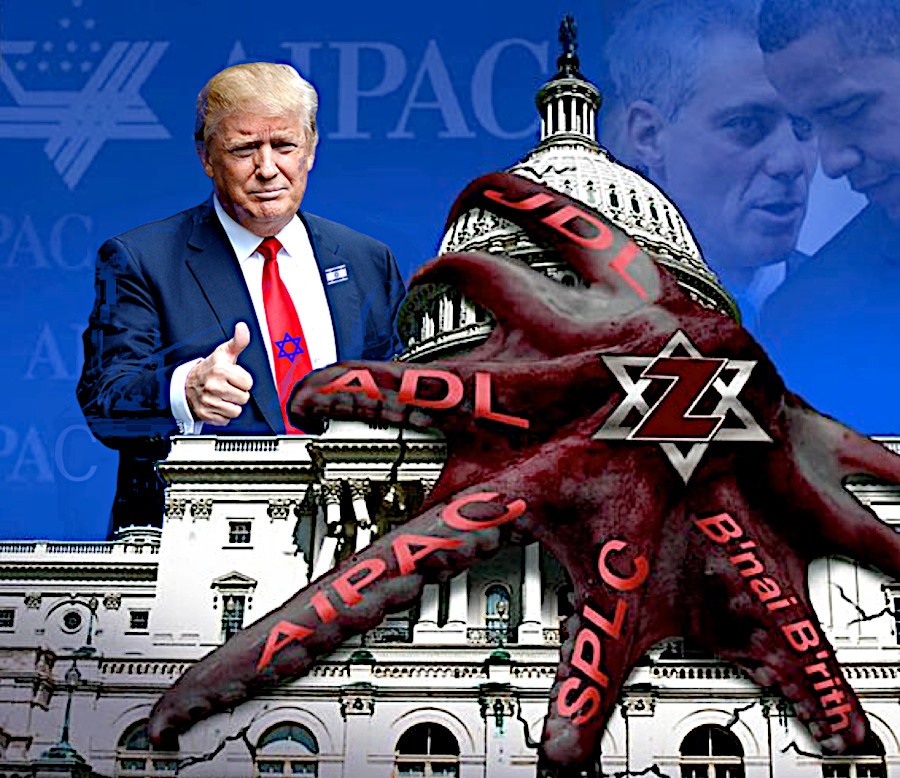
I've never seen a President--I don't care who he is--stand up to them. It just boggles your mind. They always get what they want. The Israelis know what is going on all the time. I got to the point where I wasn't writing anything down. If the American people understood what a grip those people have got on our government, they would rise up in arms. Our citizens don't have any idea what goes on. -- Thomas H. Moorer, US Navy Admiral (ret.) and Chairman of the Joint Chiefs of Staff, during an interview with Mordecai Gur, quoted in They Dare To Speak Out, by Paul Findley
Paul Findley (1921-2019) was a man of admirable integrity and guts. An author and U.S. Congressman from Illinois, his published works include The Transparent Cabal: The Neoconservative Agenda, War in the Middle East, and the National Interest of Israel (2008), Deliberate Deceptions: Facing the Facts About the U.S.-Israeli Relationship (1993) and They Dare to Speak Out: People and Institutions Confront Israel's Lobby (1985).
They Dare To Speak Out is a book about the Israeli-Jewish-Zionist influence in the United States, particularly through their powerful Jewish lobbies including the American Israel Public Affairs Committee (AIPAC). A few years ago Al Jazeera produced a 4 part documentary titled "The Lobby" which never aired due to pressure from Jewish interest groups. This important documentary was eventually leaked and is now available on various video hosting platforms. Watch: The Lobby
Following are some selected excerpts from They Dare To Speak Out. As you read through them, keep in mind that Jews have been persecuted throughout history in many countries. One would do well to wonder why that is.
- My quest for a publisher began in March 1983 and was predictably long and frustrating. Declining to represent me, New York literary agent Alexander Wylie forecast with prophetic vision that no major U.S. publisher would accept my book. He wrote, "It's a sad state of affairs." Bruce Lee of William Morrow and Company called my manuscript "outstanding," but his company concluded that publishing it "would cause trouble in the house and outside" and decided against "taking the heat." Robert Loomis of Random House called it an "important book" but reported that the firm's leadership decided the theme was "too sensitive." Twenty other publishers also said no.
- Assad received me in the spacious second-floor reception room of his offices. A tall, thickset man with a prominent forehead and a warm, quiet manner, Assad made his points forcefully but without a hint of hostility. While sipping small cups of rich Syrian coffee, he voiced his pain over United States support of Israel's actions: "We are bitter about the guns and ammunition you provide to Israel, and why not? But bitterness is not hostility. In fact, we have very warm feelings about the American people. Despite the war, the Syrian people like Americans and have for years."
- This time re-election was not to be. I lost by 1,407 votes, less than one percent of the total cast. In a vote that close, almost any negative development could account for the difference. The attack by pro-Israel activists was only one of several factors. Nevertheless, the American Israel Public Affairs Committee (AIPAC), Washington's principal pro-Israel lobby, claimed credit for my defeat. In a report to a Jewish gathering in Austin, Texas, a few days after election day, Thomas A. Dine, the organization's executive director, said his forces brought 150 students from the University of Illinois to "pound the pavements and knock on doors" and concluded, "This is a case where the Jewish lobby made a difference. We beat the odds and defeated Findley." He later estimated that $685,000 of the $750,000 raised by Durbin came from Jews.
- More often than not I stood completely alone when I criticized Israel, whether I spoke in committee or on the floor of the House of Representatives. Surely they realized that I posed no serious threat. Could Israel's supporters not tolerate even one lonely voice of dissent? Or was the lobby's purpose to make an example of me in the Elizabethan manner? (According to legend, Queen Elizabeth occasionally hanged an admiral,just as an example to the others). Was I chosen for a trip to the political gallows to discourage other Congressmen from speaking out? I could not reconcile the harsh tactics I had experienced with traditional Jewish advocacy of civil liberties, a record I had admired all my life. In Congress, I had worked closely in support of human rights causes with Jewish Congressmen like Allard Lowenstein, Stephen Solarz and Ben Gilman. In my wonderment, I pressed Doug Bloomfield, a friend on the AIPAC staff, for an explanation. He shrugged, "You were the most visible critic of Israeli policy. That's the best answer I can give."
- Washington is a city of acronyms, and today one of the best-known in Congress is AIPAC. The mere mention of it brings a sober, if not furtive look, to the face of anyone on Capitol Hill who deals with Middle East policy. AIPAC--the American Israel Public Affairs Committee--is now the preeminent power in Washington lobbying.
In 1967, as a fourth-term Congressman just named to the House Foreign Affairs Committee, I had never heard of it. One day, in private conversation in the committee room, I voiced a brief criticism of Israel's military attack on Syria. A senior Republican, William S. Broomfield of Michigan, responded with a smile, "Wait till 'Si' Kenen over at AIPAC hears what you've said." He was referring to I. L. Kenen, the executive director of AIPAC, whose name was just as unfamiliar to me as the organization he headed. I learned later that Broomfield was not joking. AIPAC sometimes finds out what Congressmen say about Middle East policy even in private conversations, and those who criticize Israel do so at their political peril. - The Anti-Defamation League is technically subordinate to B'nai B'rith with its worldwide membership of 500,000, but it raises its own funds and has attained substantial independence. Although prominent in their younger years, Washington representatives Hyman Bookbinder of the American Jewish Committee and Dave Brody of the Anti-Defamation League are now substantially eclipsed by AIPAC.
The Washington presence is only the most visible tip of the lobby. Its effectiveness rests heavily on the foundation built nationally by U.S. Jews, who function through more than 200 national groups. - This close coordination sometimes inspires intragovernment humor. "At the State Department we used to predict that if Israel's prime minister should announce that the world is flat, within 24 hours Congress would pass a resolution congratulating him on the discovery," recalls Don Bergus, former ambassador to Sudan and a retired career diplomat.
To Jewish organizations, however, lobbying Washington is serious business, and they look increasingly to AIPAC for leadership. Stephen S. Rosenfeld, deputy editor of The Washington Post editorial page, rates AIPAC as "clearly the leading Jewish political force in America today." AIPAC's charter defines its mission as legislative action, but it now also represents the interests of Israel whenever there is a perceived challenge to that country's interests in the news media, the religious community, on U.S. college campuses--anywhere. Because AIPAC's staff members are paid from contributions by American citizens, they need not register under the Foreign Agents Registration Act. In effect, however, they serve the same function as foreign agents.
Over the years the pro-Israel lobby has thoroughly penetrated this nation's governmental system, and the organization that has made the deepest impact is AIPAC, to whom even the president of the United States turns when he has a vexing political problem related to the Arab-Israeli dispute.
The Ascendancy of Thomas A. Dine
Faced with rising public opposition to the presence of U.S. Marines in Lebanon, President Ronald Reagan in October 1983 sought help from the American Israel Public Affairs Committee. The terrorist bombing which killed more than 200 Marines asleep in their barracks at the Beirut airport was yet to come. Still, four Marines had already died, three by sniper fire, and Congressional concern was rising.
Democratic Congressman Sam Stratton of New York, a veteran known for his "hawkish" views, called the Marines "sitting ducks" and predicted heavy casualties. He wanted them out. - Without AIPAC, foreign aid legislation would not be approved at the $7 billion-plus level of 1983 and might have difficulty surviving at all. A candid tribute to the lobby came from John K. Wilhelm, the executive director of the presidential commission that made recommendations in late 1983 on the future direction of foreign aid. Briefing a world hunger board at the State Department in January 1984, Wilhelm, a career veteran in the Agency for International Development, said the active support of the pro-Israeli lobby was "vital" to Congressional approval of foreign aid. In the early 1960s when aid to Israel was modest--less than $100 million a year--a foreign-aid bill squeaked through the House of Representatives by a scant five votes. AIPAC was then in its infancy.
AIPAC also crafted the strategy which produced a $510 million increase in 1983 aid for Israel--an increase which was astonishing because it came just after the indiscriminate bombing of Beirut and the failure of Israeli forces to halt the massacre of Palestinian refugees in the Sabra and Shatila refugee camps, events that aroused unprecedented public criticism of Israeli policy. - AIPAC had already confounded the administration on the House side, where the White House had argued against the increase for budgetary reasons, contending it would be at the expense of other needy countries. This argument was demolished when AIPAC lobbyists presented elaborate data showing how the extra aid to Israel could be accomplished without cutting support for other countries. An AIPAC lobbyist summed up: "The administration lobbyists really didn't do their homework. They didn't have their act together." By 1984 the aid level had risen to over $2 billion a year--all of it in grants with no repayment--and the approval margin was 112.
In February 1983, Secretary of State George Shultz named a "blue ribbon" panel of prominent citizens to recommend changes in the foreign aid program. Of the 42 on the commission, 27 were Senators or House members with primary responsibility for handling foreign aid legislation. The others had prominence in administering foreign aid in years past.
Only one full-time lobbyist was named to the panel: AIPAC's executive director, Thomas A. Dine. It was the first time to my knowledge that a lobbyist had been selected for such a prestigious government assignment, and Dine's selection was particularly surprising because it put him in a close working relationship with the handful of people who formulate and carry out policy on the very matter AIPAC was set up to influence--aid to Israel. - Dine's reputation has even stirred Arab capitals. In mid-March 1984 King Hussein of Jordan publicly blamed AIPAC, in part, for the decline in U.S. influence and leadership for peace in the Middle East. He also criticized the inordinate influence of the Israeli lobby on U.S. presidential candidates. He said the candidates had to "appeal for the favors of AIPAC, Zionism and Israel."
- Under Dine, AIPAC's membership has risen from 11,000 to over 50,000, and its annual budget from $750,000 to more than $3,000,000.
- Dine's influence is felt in power centers beyond the Oval Office. He receives calls from presidential candidates as well as presidents and reports that former Vice-President Walter Mondale "bounces ideas off us" before he issues statements on Middle East policy.
Most Congressional actions affecting Middle East policy are either approved or initiated by AIPAC. - Chotin told the conference that during the 1982 Congressional elections, 300 candidates "came to visit AIPAC" to explain their positions on "foreign aid, arms sales to Arab nations, and the general nature of U.S.-Arab relations." Ties with other interest groups are carefully cultivated. Christian outreach was announced as AIPAC's newest national program, and Merrie White, a "born-again Christian," was introduced as the director of relations with the Christian community. According to Chotin, the goal was nothing less than to "bring that community into AIPAC." He noted the presence of 50 Christians representing 35 states as evidence of progress already made toward this end. White helped organize the annual Religious Roundtable Prayer Breakfast for Israel the following February (see chapter nine). Chris Gersten, AIPAC's political director, came to the position after seven years as special assistant to the president of the International Union of Operating Engineers.
AIPAC's coast-to-coast outreach is enhanced by its speaking program. Its officers, staff members and representatives filled over 900 dates in 1982 alone. Receptions are held in scores of smaller cities. "Parlor briefings" in the homes of Jewish leaders nationally help raise money to supplement revenue from membership dues. Social events on Capitol Hill help spread the word to the thousands of high school and college students who work as interns in the offices of Senators and Congressmen or in committee offices.
Tours of Israel which other Jewish groups arrange help to establish a grassroots base for AIPAC's program. For example, in April 1982, the Young Leadership Mission, an activity of United Jewish Appeal, conducted 1,500 U.S. Jews on one week tours. "The visitors were given a view of the magnificence you will find in any country," observes an AIPAC staff member. He said the tour had profound impact: "It built spirit for the cause, and it raised money. The pitch for funds was the final event. It came right after the folks walked out of the memorial to the Holocaust." The effect was awesome: "The tour directors have it down to a science," he reports. "They know how to hit all the buttons." The United Jewish Appeal and Israel share the proceeds.
Larry Kraftowitz, a Washington journalist who attended a similar tour, calls the experience "profound." He adds, "I consider myself more sympathetic to the New Jewish Agenda goals [than current Israeli government policy], but I must say I was impressed." Tours are not just for Jews. Governors, members of state legislatures, and community leaders, including news media personnel, are also given the opportunity for expense-paid tours of Israel. Trips are also arranged for leaders nationally, especially those on Capitol Hill. - AIPAC is as successful at keeping lawmakers from visiting Arab countries as it is in presenting only Israel's views. When the National Association of Arab Americans, working through the World Affairs Council of Amman, invited all Congressmen and their spouses to an expense-paid tour of Jordan with a side trip to the West Bank in 1983, a notice in AIPAC's Near East Report quickly chilled prospects for participation. It questioned how Amman, without Israeli cooperation, could get the tourists across the Jordan river for events scheduled in the West Bank. It also quoted Don Sundquist, a Republican Congressman from Tennessee, as expressing "fear" that if any of his colleagues accepted the trip they would be "used" by anti-Israeli propagandists. Only three Congressmen made the trip. A 1984 tour was cancelled for lack of acceptances.
- Seemingly unaware of the AIPAC project, the Anti-Defamation League of B'nai B'rith almost simultaneously issued its own "enemies list": Pro-Arab Propaganda in America: Vehicles and Voices. It too is identified as a "first edition," and lists 31 organizations and 34 individuals. These books are nothing more than blacklists, reminiscent of the worst tactics of the McCarthy era.
A similar "enemies list" is employed in AIPAC's extensive program at colleges and universities (see chapter seven).
"They Get the Word Out Fast"
Through "Action Alert" mailings AIPAC keeps more than one thousand Jewish leaders throughout the United States informed on current issues. An "alert" usually demands action to meet a legislative challenge on Capitol Hill, requesting a telephone call, telegram or, if need be, a personal visit to a reluctant Congressman.
The network can have almost instantaneous effect. One day I whispered to a colleague in the Foreign Affairs Committee I might offer an amendment to a pending bill cutting aid to Israel. Within 30 minutes two other Congressmen came to me with worried looks, reporting they had just had calls from citizens in their home districts who were concerned about my amendment. - Lobbyists for AIPAC have almost instant access to House and Senate members and feel free to call them at their homes in the evening.
- An illustration of lobby power occurred October 3, 1984, when the House of Representatives approved a bill to remove all trade restrictions between the United States and Israel; 98.5 percent (416) voted affirmative, despite the strong opposition of the AFL-CIO and the American Farm Bureau Federation. The vote was 416 to 6 on legislation that normally would elicit heavy reaction because of its effect on markets for commodities produced in the United States.
As they voted, few were aware of a Commerce Department study which found that the duty-free imports proposed in the bill would cause "significant adverse effects" on U.S. producers of vegetables. Because the White House wanted the bill passed, notwithstanding its effects on jobs and markets, the study was classified "confidential" and kept under wraps. One Congressman finally pried a copy loose by complaining bitterly--and correctly--to the White House that AIPAC had secured a copy for its own use. - Sitting at a table in the House of Representatives restaurant during a late House session in 1982, Long explained,
Long ago I decided that I'd vote for anything AIPAC wants. I didn't want them on my back. My district is too difficult. I don't need the trouble [pro-Israeli lobbyists] can cause. I made up my mind I would get and keep their support. - AIPAC differs from most lobbies, in that it avoids endorsing candidates publicly and does not raise or spend money directly in partisan campaigns. Campaign involvement is left officially to pro-Israel political action committees (PACs). Over 3,000 PACs are registered under federal law, and almost all are directly affiliated with special-interest lobbies. There are 75 PACs which focus on support for Israel, though none lists an affiliation with AIPAC or any other Jewish organization.
Prior to 1979, pro-Israeli financial support to candidates and party organizations came entirely from individuals. Some of these individuals focused heavily on an Ohio Congressional race in 1976, the candidacy of Mary Rose Oakar, who was to become the first person of Syrian ancestry elected to Congress. A popular member of the Cleveland city council, she confronted a field of twelve male Democrats and an avalanche of Jewish money in the primary election race. Pro-Israeli interests selected State Senator Tony Celebreze, regarded as a "comer" in Ohio politics, as the candidate with the best chance to nudge her from the nomination. - The prominence of "Jewish-appearing" names in the Ohio race may have been a factor in encouraging Jews nationally to organize the first pro-Israel political action committees in 1979. By 1982 they had mushroomed to a total of thirty-one. Pro-Israel PACs contributed more than $1.8 million dollars to 268 different election campaigns during the 1981-82 Federal Election Commission reporting cycle, putting them in the highest political spending range. By mid-August 1984, the list had increased to 75 PACs, and they had accumulated $4.25 million for the 1984 federal elections.
None of them carried a name or other information which disclosed its pro-Israeli interest, nor did any list an affiliation with AIPAC or other pro-Israeli or Jewish organization. Each chose to obscure its pro-Israel character by using a bland title, like the "Committee for 18," "Arizona Politically Interested Citizens," "Joint Action Committee for Political Affairs," or the "Government Action Committee." Yet all are totally committed to one thing: Israel. - In 1982, NatPAC raised $1.04 million and spent $547,500 on 109 candidates for Congress. It gave the $5,000 legal limit to each of 31 Senate candidates. Twenty-eight of these were elected. On the House side, 57 of the 73 candidates it supported won. In the wake of those successes, NatPAC ran a full-page advertisement in The New York Times inviting further support and declaring that it was "helping to elect officials in all fifty states who realize that Israel's survival is vital to our own."
- A San Francisco-based PAC concentrates on contests outside California. Melvin Swig, who is chairman of the Bay Area Citizens Political Action Committee, says: "There are enough people locally who do enough for their constituency. We look for areas that have less Jewish visibility than others, places where there are fewer Jews." Golder explains the aims of such groups: We feel we are getting more Jewish people involved.... Look how much we can get from the United States government by being politically active. This is the key thing about PACs. We're trying to get those candidates [elected] who will vote 'Yes' on foreign aid.
- Too much or not, Jewish influence in fund raising is widely recognized. In August 1983 the Wall Street Journal reported, Several ranking Congressmen--most of whom wouldn't comment on the record for this story--say they believe the political effect of Jewish PAC money is greater than that of other major lobbies because it is skillfully focused on one foreign policy issue.
Focused it is. The pro-Israel PACs concentrate exclusively on federal elections and focus heavily on Senate races and on House members who occupy key foreign policy assignments. - Democratic candidates are especially dependent on contributions from Jewish sources. A non-Jewish strategist told Stephen D. Isaacs, author of Jews and American Politics: "You can't hope to go anywhere in national politics, if you're a Democrat, without Jewish money." In 1968, 15 of the 21 persons who loaned $100,000 or more to presidential candidate Hubert Humphrey were Jewish. According to Isaacs, the Democratic National Committee, whose principal charge is the advancement of Democratic Party prospects for the White House, for years received about 50 percent of its funds from Jewish sources.
12bytes says: The situation is not much different for Republicans today. There is virtually no chance of winning a Congressional or Senate seat, much less a presidency, without Jewish support. - After the 1982 elections, Thomas A. Dine summed up the significance of AIPAC's achievements: "Because of that, American Jews are thus able to form our own foreign policy agenda." Later, when he reviewed the 1984 election results, Dine credited Jewish money, not votes: "Early money, middle money, late money."
- Lobbyists for AIPAC are experts on the personalities and procedures of the House. If Israel is mentioned, even behind closed doors, they quickly get a full report of what transpired. These lobbyists know that aid to Israel, on a roll call vote, will receive overwhelming support. Administration lobbyists count on this support to carry the day for foreign aid worldwide.
- "As we anticipated," Solarz reported, "with the support of Congressman Hamilton, our proposal sailed through both his subcommittee and the full committee and was never challenged on the floor when the foreign aid bill came up for consideration." Democrat Frank Church of Idaho, the chairman of the Senate Foreign Relations Committee, and Jacob Javits, senior Republican--both strongly pro-Israei--guided proposals at the same level smoothly through their chamber.
Solarz summed up: "Israel, as a result, will soon be receiving a grand total of $660 million more in military and economic aid than it received from the U.S. government last year." He reflected upon the magnitude of the achievement: Through a combination of persistence and persuasion, we were able to provide Israel with an increase in military-economic aid in one year alone which is the equivalent of almost three years of contributions by the national UJA [United Jewish Appeal].
In his newsletter Solarz said that he sought membership on the Foreign Affairs Committee "because I wanted to be in a position to be helpful to Israel." He explained that, while "hundreds of members of Congress, Republicans as well as Democrats" support Israel, "it is the members of the Foreign Affairs Committee in the House, and the Foreign Relations Committee in the Senate, who are really in a position to make a difference where it counts--in the area of foreign aid, upon which Israel is now so dependent." Solarz's zeal was unabated in September 1984 when, as a member of the House-Senate conference on Export Administration Act amendments, he demanded in a public meeting to know the legislation's implications for Israel. He asked Congressman Howard Wolpe, "Is there anything that the Israelis want from us, or could conceivably want from us that they weren't able to get?" Even when Wolpe responded with a clear "no," Solarz pressed, "Have you spoken to the [Israeli] embassy?" Wolpe responded, "I personally have not," but he admitted, "my office has." Then Solarz tried again, "You are giving me an absolute assurance that they [the Israelis] have no reservation at all about this?" Finally convinced that Israel was content with the legislation, Solarz relaxed, "If they have no problem with it, then there is no reason for us to." A veteran Ohio Congressman observes: When Solarz and others press for more money for Israel, nobody wants to say "No." You don't need many examples of intimidation for politicians to realize what the potential is. The Jewish lobby is terrific. Anything it wants, it gets. - This Congressman divides his colleagues into four groups: For the first group, it's rah, rah, give Israel anything it wants. The second group includes those with some misgivings, but they don't dare step out of line; they don't say anything. In the third group are Congressmen who have deep misgivings but who won't do more than try quietly to slow down the aid to Israel.
- "Bleeding a Little Inside" Democratic Congressman Mervyn M. Dymally, former lieutenant governor of California, came to Washington in 1980 with perfect credentials as a supporter of Israel. He says, "When you look at black America, I rank myself second only to Bayard Rustin in supporting Israel over the past twenty years." Short, handsome and articulate, Dymally was the first black American to go to Israel after both the 1967 and 1973 wars.
In his successful campaign for lieutenant-governor, he spoke up for Israel in all the statewide Democratic canvasses. He co-founded the Black Americans in Support of Israel Committee, organized pro-Israeli advertising in California newspapers and helped to rally other black officials to the cause. In Congress, he became a dependable vote for Israeli interests as a member of the Foreign Affairs Committee.
Nevertheless, in 1982 the pro-Israeli community withdrew its financial support, and the following year the AIPAC organization in California marked him for defeat and began seeking a credible opponent to run against him in 1984. Explaining this sudden turn of events, Dymally cites two "black marks" against his pro-Israeli record in Congress. First, he "occasionally asked challenging questions about aid to Israel in committee"; although his questions were mild and not frequent, he stood out because no one else was even that daring. Second--far more damning in the eyes of AIPAC--he met twice with PLO leader Vasser Arafat. - Dymally's occasional independence in speaking and voting on Middle East questions predictably brought complaints from Israel's activists in his home district, and, although they did not succeed in finding a credible candidate to oppose him in 1984, he sees no likelihood that the breach will be closed. He says membership on the Foreign Affairs Committee is a "no win" situation.
"I must confess to you that I do not feel as free to criticize Israel as I do to criticize Trinidad, the island on which I was born," Dymally declares. Noting that Trinidad was one of the islands supporting the U.S. invasion of Grenada in 1983, he says his own strong opposition to the invasion did not cause the islanders to tum against him. "Sure, some of Trinidad's leaders were unhappy with me. But they are not boycotting my campaign for re-election. In fact, people from that area are putting on a fundraiser in New York for me. They don't see me as anti-black, anti-Grenada, anti-West Indies. They just disagree with me on the invasion, but they don't fallout." He contrasts this reaction with that of his Jewish critics in California. "What is tragic is that so many Jewish people misconstrue criticism of Israel as anti-Jewish or anti-Semitic." He speaks admiringly of the open criticism of Israeli policy that often occurs within Israel itself: "It is easier to criticize Israel in the Knesset [the Israeli parliament] than it is in the U.S. Congress, here in this land of free speech." - Under the watchful eye of Israel's lobby, Congressmen will go to extreme measures to help move legislation providing aid to Israel. Just before Congress adjourned in December 1983, a group of freshmen Democrats helped the cause by taking the extraordinary step of changing their votes in the printed record of proceedings, a step Congressmen usually shun because it makes them look indecisive. This day, however, under heavy pressure from pro-Israel constituents, the first-term members buckled and agreed to switch in order to pass catch-all legislation known as a Continuing Resolution. The resolution provided funds for programs Congress had failed to authorize in the normal fashion, among them aid to Israel. Passage would prevent any interruption in this aid.
For once, both the House Democratic leadership and AIPAC were caught napping. Usually in complete control of all legislative activities which relate to Israel, AIPAC failed to detect the brewing rebellion. Concern over the budget deficit and controversial provisions in the bill for Central America led these freshman Democrats to oppose their own leadership. Unable to offer amendments, they quietly agreed among themselves to oppose the whole package.
When the roll was called the big electric board over the Speaker's desk showed defeat--the resolution was rejected, 206 to 203. Twenty-four first-term Democrats had deserted the leadership and voted no. Voting no did not mean they opposed Israeli aid. Some of them, concerned over the federal deficit, viewed it as a demand to the leadership to schedule a bill raising taxes. For others, it was simply a protest. But for Israel it was serious.
"The Jewish community went crazy," a Capitol Hill veteran recalls. AIPAC's professionals went to work. Placing calls from their offices just four blocks away, they activated key people in the districts of a selected list of the errant freshmen. They arranged for "quality calls" to individuals who had played a major role in the recent Congressional election. Each was to place an urgent call to his or her Congressman, insist on getting through personally and use this message:
Approval of the continuing resolution is very important. Without it, Israel will suffer. I am not criticizing your vote against it the first time. I am sure you had reasons. However, I have learned that the same question will come up for vote again, probably tomorrow. I speak for many of your friends and supporters in asking that you change your vote when the question comes up again. Each person was instructed to report to AIPAC after making the calls.
The calls were accordingly made and reported. - The final vote on the Continuing Resolution authorized a remarkable new form of aid to Israel. It included an amendment crafted by AIPAC and sponsored by ardently pro-Israeli Congressmen Clarence Long of Maryland and Jack Kemp of New York that permitted $250 million of the military grant aid to be spent in Israel on the development of a new Israeli fighter aircraft, the Lavi. The new fighter would compete for international sales with the Northrop F-20 and the General Dynamics F-16--both specifically designed for export. The amendment authorized privileged treatment Uncle Sam had never before extended to a foreign competitor. It was extraordinary for another reason: it set aside a U.S. law that requires that all foreign aid procurement funds be spent in the United States.
During debate of the bill, Democrat Nick J. Rahall of West Virginia was the only Congressman who objected. He saw the provision as threatening U.S. jobs at a time of high unemployment: Approximately 6,000 jobs would be lost as a direct result of taking the $250 million out of the U.S. economy and allowing Israel to spend it on defense articles and services which can just as easily be purchased here in the United States.
Americans are being stripped of their tax dollars to build up foreign industry. - The following May, during the consideration of the bill appropriating funds for foreign aid, Rahall offered an amendment to eliminate the $250 million, but it was defeated 379 to 40. Despite the amendment's obvious appeal to constituents connected with the U.S. aircraft industry, fewer than 10 percent of House members voted for it.
After the vote, AIPAC organized protests against the 40 legislators who had supported the amendment. Rahall recalls that AIPAC carried out a campaign "berating those brave 40 Congressmen." - Arriving at the Denver airport, Abourezk told reporters, "As a United States Senator, I have sworn to uphold the government of the United States, but I never dreamed that I would be required to swear allegiance to any other government." In his remarks to the dinner audience of 700, he warned of the "extraordinary influence of the Zionist lobby." He said the United States "is likely to become, if it has not already, a captive of its client state."
- Ford, dissatisfied with Israeli behavior, had just issued a statement calling for a "reappraisal" of U.S. policies in the Middle East. His statement did not mention Israel by name as the offending party, but his message was clear: Ford wanted better cooperation in reaching a compromise with Arab interests, and "reappraisal" meant suspension of U.S. aid until Israel improved its behavior. It was a historic proposal, the first time since Eisenhower that a United States president even hinted publicly that he might suspend aid to Israel.
Israel's response came, not from its own capital, but from the United States Senate. Instead of relying on a direct protest to the White House, Jerusalem activated its lobby in the United States, which, in turn, signed up as supporters of Israel's position more than three-fourths of the members of the United States Senate.
A more devastating--and intimidating--response could scarcely be conceived. - In the wake of the highly publicized television series, "Holocaust," Capitol Hill was flooded with complimentary copies of the novel on which the TV series was based. The books were accompanied by a letter from AIPAC saying, "This chilling account of the extermination of six million Jews underscores Israel's concerns during the current negotiations for security without reliance on outside guarantees."
12bytes says: The alleged extermination of six million Jews in Hitler's Germany is a major factor which allows the parasitic Jewish-Zionist criminal cartel to wield the tremendous influence they do in all of the major U.S. institutions from government to Hollywood and beyond. We are constantly reminded of "the holocaust" as if it were the only one worth remembering, despite the historical fact that Jewish communists have slaughtered many more than six million people, such as they did during the Bolshevik Revolution in Russia.
The obvious problem with the claim is that it is provably false. In the hundreds of tons of documents captured by the allied forces, not a single document has ever been produced regarding a program to exterminate Germany's Jews. If such a document did exist, it would be featured prominently in every Jewish holocaust museum and school book.
The six million figure is a Jewish-religious figure that is easily traced back to the late 1800s. The figure is no longer used by any remotely creditable historian today. As for the alleged homicidal gas chambers, there is absolutely no creditable evidence they ever existed. The entire charade relies on alleged witness testimony, most of which has been proven to be fabricated. For a great deal more regarding this vital subject, read Rescuing Israel: The Holocaust."Also, I saw no gas chambers, nor even heard of them until after my release." -- Esther Grassman, Jewish prisoner of Auschwitz and Buchenwald, quoted from the 26-Oct-1979 edition of Hutchinson News (Kansas) (source)
"I was in the big concentration camps in Germany. I must truthfully state that in no camp have I ever seen anything that might have resembled gas chambers." -- Dr. Benedikt Kautsky, Austrian Social Democrat and Jewish prisoner of various concentration camps from 1938-1945, including three years in Auschwitz, quoted in Auschwitz -- A Personal Account, p.4 (source)
"Let me explain that even though I had been in Auschwitz I did not know about the gas chambers. Can you imagine that?" -- Marika Frank Abrams in Voices from the Holocaust, referenced during Mark Weber's testimony before the Human Rights Commission, Toronto, Canada, Dec. 9, 1998 (source)"The only thing we know about Hitler is that he killed six million Jews which never existed in gas chambers which nobody ever saw." -- Dr. Roger Dommergue, Jewish professor, philosopher, essayist and revisionist, during an interview conducted by Ernst Zündel (source)
- [...] Kennedy had gone to dinner with a small group of wealthy and prominent Jews in New York. An episode of the evening troubled him deeply. Describing it to Bartlett as an "amazing experience," he said one of those at the dinner party--he did not identify him by name--told him he knew his campaign was in financial difficulty and, speaking for the group, offered "to help and help significantly" if Kennedy as president "would allow them to set the course of Middle East policy over the next four years."
- It was not the first time Middle East politics intruded forcibly into presidential campaigns. Bartlett says that when he related the episode to Roger L. Stevens, head of the John F. Kennedy Center for the Performing Arts in Washington, D.C., Stevens responded, "That's very interesting, because exactly the same thing happened to Adlai [former U.N. Ambassador Adlai E. Stevenson] in Los Angeles in 1956." Stevenson was then the Democratic candidate for president, opposing the re-election of Dwight D. Eisenhower.
- Lobby pressure on the White House is applied at several different levels. The most direct--person-to-person--varies greatly, depending on the inclinations of the person who is president at the time.
Some of those applying pressure are close personal friends whose influence is limited to just one presidency, an example being Harry S. Truman's close friendship with Ed Jacobson, his former haberdashery partner and an ardent Zionist. Mr. and Mrs. Arthur Krim, Jewish leaders from New York, maintained a close relationship with Lyndon B. Johnson. A White House official of the period recalls: "Arthur Krim stayed at the LBJ Ranch during crucial moments before the 1967 war and his wife, Mathilde, was a guest in the White House during the war." White House logs show that Mrs. Krim talked frequently by telephone with Johnson.
Other Jewish leaders maintain a relationship from one administration to another. Abraham Feinberg of New York, who hosted the dinner for Kennedy in October 1960, kept close White House ties over a period of years. He was a frequent visitor at the White House during the Johnson years, and as late as 1984, during the pre-convention presidential campaigning, brought the leading Democratic contenders, WaIter Mondale and Gary Hart, together for a private discussion at his New York apartment. Philip Klutznick of Chicago, former president of B'nai B'rith, kept close relations throughout the Truman, Eisenhower, Kennedy, Johnson and Carter administrations.
Sometimes Israeli diplomats have a personal relationship which gives them direct access to the president. Ephraim Evron, then deputy chief in the Israeli embassy and a friend since Senate days, sometimes talked privately with Johnson in the Oval Office.
The second level of pressure comes through officials close to the president--his adviser on relations with the Jewish community or others among his top aides. President Kennedy told a friend, with a chuckle, that he learned that when he was away from Washington, Myer Feldman, his adviser on Jewish matters, would occasionally invite Jewish leaders to the White House for a discussion in the Cabinet Room.
The third level for pressing the presidency is within the top levels of the departments--the State Department, Defense Department and National Security Council--where Israeli officials and groups of U.S. citizens who are pro-Israeli activists frequently call to present their agendas to cabinet officers or their chief deputies (see chapter five). - Zionists began pressing their case early in the administration of Harry S. Truman and intensified their efforts in 1947 when Truman initially expressed opposition to the establishment of a Jewish state in Palestine. Jewish leaders bought newspaper advertising designed to transform public shame and outrage over the Holocaust into popular support for the idea of a Jewish national homeland. Both Houses of Congress passed resolutions urging presidential support.
When Truman continued to resist and publicly urged citizens to avoid inflaming "the passions of the inhabitants of Palestine," a group of New Jersey Jews wired: "Your policy on Palestine ... has cost you our support in 1948." With election day approaching, it was a reminder of the grim political facts of life. Two-thirds of American Jews lived in Pennsylvania and Illinois, and these states would cast 110 electoral votes in the presidential voting. Considered the underdog in the upcoming election despite his incumbency, Truman knew he must have those votes to win. - Secretary of State George C. Marshall opposed the decision so strongly that he bluntly told Truman soon after his recognition announcement that if the election were held the next day he would not vote for him. Sentiments were of course much different in Israel. During a 1949 White House visit, the chief rabbi of Israel told the president, "God put you in your mother's womb so you would be the instrument to bring about the rebirth of Israel after 2000 years." In partisan political terms, Truman's decision paid off. On election day he received 75 percent of the Jewish vote nationally, which helped him win a razor-thin upset victory--and a permanent place of honor on the face of Israeli postage stamps, as well as in the hearts of Zionists.
- In a September 1966 letter to Feinberg, Klutznick called for an improved relationship between Johnson and the American Jewish community. He did not want Jewish differences with Johnson over the Vietnam war and aid to private schools, for example, to complicate American support for Israel. He called on Feinberg to help establish a "sense of participation." The elements of a deal were present. At the time, Johnson desperately wanted public support for the war in Southeast Asia, and the Jewish leaders wanted assurance that the U.S. would stand by Israel in a crisis.
Aid levels were increased, clearances issued for almost any military item, and extensive credit extended.
Lobby pressure may not have been needed to persuade Johnson to support Israel, but the pressure came nevertheless. Harold Saunders, a member of the National Security Council staff and later Carter's assistant secretary of state for the Near East and South Asia, recalls the avalanche of telegrams and letters that urged President Johnson to stand behind Israel when Egypt's President Nasser closed the Strait of Tiran in May 1967: "I had 150,000 telegrams and letters from the Jewish community in boxes in my office. I do not exaggerate. There were 150,000 pieces of paper sitting there. They all said the same thing. And Johnson decreed that every one of them should be answered." - Saunders recalls that after the Arab-Israeli war, pro-Israeli interests blanketed the White House with the basic demand that Israel not be forced to withdraw from territory it occupied until the Arab states agreed to a 'just and lasting peace" with Israel. Under this demand. Israel could use occupied Arab territory as a bargaining "chip" in seeking Arab recognition, an option that President Eisenhower refused to permit Israel to use after the Suez crisis in 1957.
Saunders adds, "This Israeli demand was accepted by President Johnson without discussion in the National Security Councilor other policy institutions. It has had a profound impact on the course of events in the Middle East since that time." - During the Reagan administration, [George] Ball became one of the few Democrats trying to take his party back to the Middle East morality of Eisenhower. Of Reagan, he said, He did not demand, as he should have done under the law, that we would exact the penalties provided unless the Israelis stopped murdering civilians with the weapons we had provided them solely for self-defense.
- Despite the intimidating factors that led candidates Carter, Anderson and Glenn to avoid his help, Ball feels the lobby is overrated in the power it can deliver. While it controls many votes in strategically important states and provides generous financial support to candidates, he contends these are not the principal factors of influence.
Ball believes the lobby's instrument of greatest power is its willingness to make broad use of the charge of anti-Semitism: "They've got one great thing going for them. Most people are terribly concerned not to be accused of being anti-Semitic, and the lobby so often equates criticism of Israel with anti-Semitism. They keep pounding away at that theme, and people are deterred from speaking out." In Ball's view, many Americans feel a "sense of guilt" over the extermination of Jews by Nazi Germany. The result of this guilt is that the fear of being called anti-Semitic is "much more effective in silencing candidates and public officials than threats about campaign money or votes." - Carter was dismayed when Jews in the United States remained disgruntled with his administration despite his major role in achieving a long-sought Israeli goal, the peace treaty between Egypt and Israel. A senior diplomat whose career stretches back over twenty years, remembers the pressures Jewish groups brought to bear following the joint U.S.-Soviet communique of October 1977. Carter was trying to revive the Geneva conference on the Middle East in order to get a comprehensive settlement of the Arab-Israeli dispute. The American Jewish community strongly objected. The diplomat recalls, "I remember I really had my hands full meeting with protesting Jewish groups. I figured up one day, totaling just the people the groups said they represented, that I must have met with representatives of half the entire U.S. Jewish community."
The groups came well briefed. All, he says, used the same theme:
What a terrible unpatriotic act it was to invite the Russians back into the Middle East; it was anti-Israel, almost anti-Semitic. I would spend part of my time meeting Jewish groups on Capitol Hill in the offices of Senators and Congressmen.
Other times I would meet with groups of 20 to 40 in my conference room at State Department. Meanwhile Secretary of State Vance would be meeting with other groups, and the President with still others.
The pressure was too much. Carter yielded to lobby pressures and quickly dropped the proposal. Carter also learned, like Ford before him, that yielding to the lobby on relations with Israel did not pay dividends on election day. Many Jews deserted him when he sought reelection in 1980. - [John] Connally became the first prominent presidential candidate to declare his support for Palestinian self-determination. He said the Palestinians should have the option of establishing an independent state on the West Bank and Gaza or an autonomous area within Jordan. Palestinian leaders willing to work for a compromise peace settlement with Israel should be welcomed to discussions, he added, but "those extremists who refuse to cooperate and continue to indulge in terrorism should be treated as international outlaws by the international community."
Connally also suggested that future American aid be conditioned on Israeli willingness to adopt a more reasonable policy on the West Bank. Noting the strain imposed upon the Israeli economy by the need for constant military preparedness, he said, "Without billions of dollars in American economic and military aid, Israel simply could not survive. Yet it is only candid to say that support for this level of aid, in the absence of greater willingness by Israeli leadership to compromise with their neighbors, is eroding." He criticized the Begin government's "policy of creeping annexation of the West Bank," quoting a group of American Jewish leaders who earlier in the year had denounced Israeli policy on the West Bank as "morally unacceptable and perilous for the democratic character of the Jewish state."
Connally knew his speech would stir controversy, and indeed the criticism came quick and hard. - Few news commentators praised his speech. Christian Science Monitor columnist Joseph C. Harsch found Connally's peace plan remarkable for its candor. Harsch wrote that Connally "broke with and, indeed, defined the pro-Israel lobby." He "said things about Israel which no prominent American politician has dared to say for a long time, with the exception of Senator J. William Fulbright."
- Within a few days of the speech, however, less friendly voices were heard. A Jewish Republican running for mayor of Philadelphia snubbed Connally by refusing to be photographed with him. Two Jewish members of Connally's national campaign committee resigned in protest. One of them, Rita Hauser, chairman of the Foreign Affairs Council of the American Jewish Committee, called the speech "inexcusable" and said it represented "the straight Saudi line." The second, attorney Arthur Mason, said he was fearful that Connally's speech might stir anti-Semitism.
The bad news kept coming. The New York Republican Committee withdrew its invitation for Connally to speak at its annual Lincoln Day dinner, and traditional big givers boycotted a fundraiser in New York that was to feature Connally. The Washington Post quoted an unnamed source who said the speech had robbed Connally of support which his pro-business positions had won among some Jews: "Now they wouldn't give him a dime."
12bytes says: By this point it should be blatantly obvious that Israel has no intention of peaceful relations with the Palestinians, not then, not now, not ever. - In late 1983, certain to be a candidate for re-election, Reagan was in a position to deliver, not just promise. He had encountered Israeli pressures in opposition to his September 1982 peace plan and his delay in delivering fighter aircraft in the wake of Israel's bombing of the Iraq nuclear plant. But he had avoided a major showdown with Israel, and, beginning in 1983, Reagan went all-out for the Jewish vote, pandering to the Israeli lobby while trying to keep the Middle East crisis on hold until after the election.
- In December Reagan launched a broad bid for Jewish support. The first action was upgrading the position of White House liaison with the Jewish community, but his changes on the policy front were even more significant. After meeting with Israeli Prime Minister Yitzhak Shamir in December 1983, Reagan announced a dramatic increase in the level of aid. Instead of the old formula, under which Israel was required to pay back some of the funds advanced, the administration requested that in the future all aid be in the form of a grant. In addition, in a gesture to Israel's sagging industry, he agreed that $250 million in U.S. aid funds could be spent in Israel to help finance the manufacture of a new Israeli warplane. United States aircraft firms were dismayed, because they receive no similar government aid. (See chapter two.) Reagan proposed a new higher level of "strategic cooperation" in the military field and a free trade relationship which would make Israel the only nation with tariff-free access to both the European community and the United States.
All of this won applause from the Israeli lobby. - Near East Report, the AIPAC newsletter, declared editorially: "[Reagan] has earned the gratitude of all supporters of a strong U.S.-Israel relationship." In March, Reagan made further concessions to the lobby. He refused to intercede with Israel at the request of King Hussein of Jordan, whom he had been pressing to join the peace process. Aiming both to strengthen Yasser Arafat against more radical elements within the Palestine Liberation Organization, and to improve his own influence over the Palestinian cause, Hussein asked the president for help. He wanted Reagan to press Israel to permit Palestinians living on the West Bank and Gaza to attend the upcoming session of the Palestine National Council. In another message, Hussein asked the United States to support a U.N. resolution declaring illegal the settlements Israel has built in Arab territory it occupies, a position maintained for years by previous presidents. Reagan rejected both requests. Hussein told a reporter for the New York Times that "the United States is succumbing to Israeli dictates," and he saw no hope for future improvement.
The leading contenders for the Democratic nomination, like Reagan, never missed an opportunity to pledge allegiance to Israel. - The 1984 presidential contest often focused on the competition between former Vice-President Walter Mondale and Senator Gary Hart on the question of who was more loyal to Israel.
- The Pentagon, that enormous, sprawling building on the banks of the Potomac, houses most of the Department of Defense's central headquarters. It is the top command for the forces and measures which provide Americans with security in a troubled world. Across the Potomac is the Department of State, a massive eight-story building on Washington's Foggy Bottom, the nerve center of our nation's worldwide diplomatic network. These buildings are channels through which flow each day thousands of messages dealing with the nation's top secrets. No one can enter either building without special identification or advance clearance. Armed guards seem to be everywhere, and in late 1983 concrete emplacements were added and heavy trucks strategically parked to provide extra buffers if a fanatic should launch an attack. These buildings are fortresses where the nation's most precious secrets are carefully guarded by the most advanced technology.
But how secure are the secrets?
"The leaks to Israel are fantastic. If I have something I want the secretary of state to know but don't want Israel to know, I must wait till I have a chance to see him personally." This declaration comes from an ambassador still on active duty in a top assignment, reviewing his long career in numerous posts in the Middle East. Although hardly a household name in the United States, his is one of America's best-known abroad. Interviewed in the State Department, he speaks deliberately, choosing his words carefully.
"It is a fact of life that everyone in authority is reluctant to put anything on paper that concerns Israel if it is to be withheld from Israel's knowledge," says the veteran. "Nor do such people even feel free to speak in a crowded room of such things."
The diplomat offers an example from his own experience. "I received a call from a friend of mine in the Jewish community who wanted to warn me, as a friend, that all details of a lengthy document on Middle East policy that I had just dispatched overseas were 'out.'" The document was classified "top secret," the diplomat recalls. "I didn't believe what he said, so my friend read me every word of it over the phone."
His comments will upset pro-Israel activists, many of whom contend that both the State Department and Defense Departments are dominated by anti-Israeli "Arabists." Such domination, if it ever existed, occurs no longer. In the view of my diplomat source, leaks to pro-Israeli activists are not only pervasive throughout the two departments but "are intimidating and very harmful to our national interest." He says that because of "the ever-present Xerox machine" diplomats proceed on the assumption that even messages they send by the most secure means will be copied and passed on to eager hands. "We just don't dare put sensitive items on paper." A factor making the pervasive insecurity even greater is the knowledge that leaks of secrets to Israel, even when noticed--which is rare--are never investigated.
Whatever intelligence the Israelis want, whether political or technical, they obtain promptly and without cost at the source. Officials who normally would work vigilantly to protect our national interest by identifying leaks and bringing charges against the offenders are demoralized. In fact, they are disinclined even to question Israel's tactics for fear this activity will cause the Israeli lobby to mark them as trouble-makers and take measures to nullify their efforts, or even harm their careers.
The lobby's intelligence network, having numerous volunteer "friendlies" to tap, reaches all parts of the executive branch where matters concerning Israel are handled. Awareness of this seepage keeps officials--whatever rung of the ladder they occupy--from making or even proposing decisions that are in the U.S. interest.
If, for example, an official should state opposition to an Israeli request during a private interdepartmental meeting--or worse still, put it in an intraoffice memorandum--he or she must assume that this information will soon reach the Israeli embassy, either directly or through AIPAC. Soon after, the official should expect to be mentioned by name critically when the Israeli ambassador visits the secretary of state or other prominent U.S. official.
The penetration is all the more remarkable because much of it is carried out by U.S. citizens in behalf of a foreign government. - In its 1973 Yom Kippur war against Egypt and Syria, Israel sustained heavy losses in weapons of all kinds, especially tanks. It looked to the United States for the quickest possible resupply. Henry Kissinger was their avenue. Richard Nixon was entangled in the Watergate controversy and soon to leave the presidency, but under his authority the government agreed to deliver substantial quantities of tanks to Israel.
Tanks were to be taken from the inventory of U.S. military units on active duty, reserve units, even straight off production lines. Nothing was held back in the effort to bring Israeli forces back to desired strength as quickly as possible.
Israel wanted only the latest-model tanks equipped with 105 millimeter guns. But a sufficient number could not be found even by stripping U.S. forces. The Pentagon met the problem by filling part of the order with an earlier model fitted with 90-millimeter guns. When these arrived, the Israelis grumbled about having to take "second-hand junk." - Not only are the Israelis adept at getting the information they want--they are masters at the weapons procurement game. Les Janka, a former deputy assistant secretary of defense who is a specialist in Middle East policy, recalls Israeli persistence: They would never take no for an answer. They never gave up. These emissaries of a foreign government always had a shopping list of wanted military items, some of them high technology that no other nation possessed, some of it secret devices that gave the United States an edge over any adversary. Such items were not for sale, not even to the nations with whom we have our closest, most formal military alliance--like those linked to us through the North Atlantic Treaty Organization.
Yet Janka learned that military sales to Israel were not bound by the guidelines and limitations which govern U.S. arms supply policy elsewhere. He says, "Sales to Israel were different. Very different." Janka has vivid memories of a military liaison officer from the Israeli embassy who called at the Defense Department and requested approval to purchase a military item which was on the prohibited list because of its highly secret advanced technology: "He came to me, and I gave him the official Pentagon reply. I said, 'I'm sorry, sir, but the answer is no. We will not release that technology.'" The Israeli officer took pains to observe the bureaucratic courtesies and not antagonize lower officials who might devise ways to block the sale. He said, "Thank you very much, if that's your official position. We understand that you are not in a position to do what we want done. Please don't feel bad, but we're going over your head." And that of course meant he was going to Janka's superiors in the office of the secretary of defense, or perhaps even to the White House. - Others who have occupied high positions in the executive branch were willing to speak candidly, but, unlike Janka, they did so with the understanding that their names would not be published. As one explains, "My career is not over. At least, I don't want it to be. Quoting me by name would bring it to an end." With the promise of anonymity, he and others gave details on the astounding process through which the Israeli lobby is able to penetrate the defenses at the Defense Department--and elsewhere.
Sometimes the act is simple theft. One official says, "Israelis were caught in the Pentagon with unauthorized documents, sometimes scooping up the contents of 'in boxes' on desk tops." He recalls that because of such activity a number of Israeli officials were told to leave the country. No formal charges of espionage have ever been filed, and Israel covered each such exit with an excuse such as family illness or some other personal reason: "Our government never made a public issue of it." He adds, "There is a much higher level of espionage by Israel against our government than has ever been publicly admitted."
The official recalls one day receiving a list of military equipment Israel wanted to purchase. Noting that "the Pentagon is Israel's 'stop-and-shop,' " he took it for granted that the Israelis had obtained clearances. So he followed usual procedure by circulating it to various Pentagon offices for routine review and evaluation:
One office instantly returned the list to me with a note: 'One of these items is so highly classified you have no right to know that it even exists.' I was instructed to destroy all copies of the request and all references to the particular code numbers. I didn't know what it was. It was some kind of electronic jamming equipment, top secret. Somehow the Israelis knew about it and acquired its precise specifications, cost and top secret code number. This meant they had penetrated our research and development labs, our most sensitive facilities.
Despite that somber revelation, no official effort was launched to discover who had revealed the sensitive information. - If things are really hung up, it isn't long before letters or calls start coming from Capitol Hill. They'll ask, 'Why is the Pentagon not approving this item?' Usually, the letter is from the Congressman in whose district the item is manufactured. He will argue that the requested item is essential to Israel's security. He probably will also ask, 'Who is this bad guy in the Pentagon--or State--who is blocking this approval? I want his name. Congress would like to know.'
The American defense expert pauses to emphasize his point: "No bureaucrat, no military officer likes to be singled out by anybody from Congress and required to explain his professional duty."
He recalls an episode involving President Carter's secretary of defense, Harold Brown:
I remember once Israel requested an item on the prohibited list. Before I answered, I checked with Secretary Brown and he said, 'No, absolutely no. We're not going to give in to the bastards on this one.' So I said no.
Lo and behold, a few days later I got a call from Brown. He said, "The Israelis are raising hell. I got a call from [Senator Henry) 'Scoop' Jackson, asking why we aren't cooperating with Israel. It isn't worth it. Let it go." - A former administration official recalls a remarkable example of Israeli ingenuity:
Israel requested an item of technology, a machine for producing bullets. It was a big piece of machinery, weighed a lot, and it was exclusive. We didn't want other countries to have it, not even Israel. We knew if we said 'no,' the Israelis would go over our heads and somehow get approval. So, we kept saying we were studying the request. Then, to our astonishment, we discovered that the Israelis had already bought the machinery and had it in a warehouse in New York. - [Atlanta mayor Andrew] Young recalls, "I operated on the assumption that the Israelis would learn just about everything instantly. I just always assumed that everything was monitored, and that there was a pretty formal network." Young resigned as ambassador in August 1979 after it was revealed that he had met with Zuhdi Terzi, the PLO's UN observer, in violation of the U.S. pledge to Israel not to talk to the PLO. Press reports on Young's episode said Israeli intelligence learned of the meeting and that Israeli officials then leaked the information to the press, precipitating the diplomatic wrangle which led to Young's resignation.
Israel denied that its agents had learned of the Young-Terzi meeting. The press counselor at the Israeli embassy went so far as to tell the Washington Star, "We do not conduct any kind of intelligence activities in the United States." This denial must have been amusing to U.S. intelligence experts, one of whom talked with Newsweek magazine about Mossad's activities here: "They have penetrations all through the U.S. government. They do better than the KGB," said the expert, whom the magazine did not identify. - 'Mossad can go to any distinguished American Jew and ask for his help,' says a former CIA agent. The appeal is a simple one: 'When the call went out and no one heeded it, the Holocaust resulted.' The U.S. tolerates Mossad's operations on American soil partly because of reluctance to anger the American Jewish community.
- The theft of scientific data is a major objective of Mossad operations, which is often attempted by trying to recruit local agents: In addition to the large-scale acquisition of published scientific papers and technical journals from allover the world through overt channels, the Israelis devote a considerable portion of their covert operations to obtaining scientific and technical intelligence. This had included attempts to penetrate certain classified defense projects in the United States and other Western nations.
The Israeli security authorities (in Israel) also seek evidence of illicit love affairs which can be used as leverage to enlist cooperation. In one instance, Shin Beth (the domestic Israeli intelligence agency) tried to penetrate the U.S. Consulate General in Jerusalem through a clerical employee who was having an affair with a Jerusalem girl. They rigged a fake abortion case against the employee in an unsuccessful effort to recruit him. Before this attempt at blackmail, they had tried to get the Israeli girl to elicit information from her boyfriend.
Israel's espionage activities, according to the CIA, even included "crude efforts to recruit Marine guards [at the United States Embassy at Tel Aviv] for monetary reward." It reports that a hidden microphone "planted by the Israelis" was found in the office of the U.S. ambassador in 1954, and two years later telephone taps were found connected to two telephones in the residence of the United States military attache. - [Admiral Thomas] Moorer, speaking in his office in Washington as a senior counselor at the Georgetown University Center for Strategic and International Studies, says he strongly opposed the transfer but was overruled by "political expediency at the presidential level." He notes President Richard Nixon was then in the throes of Watergate. "But," he adds,
I've never seen a President--I don't care who he is--stand up to them [the Israelis]. It just boggles your mind. They always get what they want. The Israelis know what is going on all the time. I got to the point where I wasn't writing anything down.
If the American people understood what a grip those people have got on our government, they would rise up in arms. Our citizens don't have any idea what goes on. - In December 1976 the Middle East Arms Transfer Panel wrote a report to Secretary of Defense Donald Rumsfeld, concluding that no additional arms sales to Israel were necessary. However, Rumsfeld did not send the report to the State Department. It was the closing days of the Ford administration, and its transmission as an official document and subsequent leakage would have given the Democrats a partisan edge with the Israeli lobby.
- A former high-ranking official in security affairs cites the intimidating effect of this procession on career specialists:
When you have to explain your position day after day, week after week to American Jewish groups--first, say, from Kansas City, then Chicago, then East Overshoe--you see what you are up against. These are people from different parts of the country, but they come in with the very same information, the same set of questions, the same criticism.
They know what you have done even in private meetings. They will say, 'Mr. Smith, we understand that in interagency meetings, you frequently take a hard line against technology transfers to Israel. We'd like you to explain yourself.' - During a visit to Lebanon, the Reverend George Crossley, of Deltona, Florida, was shown cases of U.S.-made M-16 rifles which Israeli officials said were captured from Palestinian forces. Crossley noted they carried a Saudi insignia and wrote down the serial numbers. Saudi Arabia, of course, had no forces involved in the fighting in Lebanon, and the clergyman jumped to the conclusion that rifles the U.S. had sold to Saudi Arabia were turned over to PLO forces in Lebanon, then captured by the Israelis. If true, this would have been a violation of a U.S. law which prohibits transfer of U.S.-supplied weapons to another country without permission.
Crossley wrote to his Congressman, Bill Chappell, Jr., who asked the State Department to explain. A check of records showed the U.S. had never sold M-16 rifles to the Saudis, who prefer a German make. The rifles in question were provided directly to forces of the Lebanese government.
The episode got public attention at a time when the U.S. government, at great expense, was once again equipping Lebanese forces. A White House official, reading accounts of the Crossley affair, asked the desk officer at the Pentagon why the U.S. didn't demand that the Israelis give back these rifles and all other equipment they had taken from the Lebanese army. The Pentagon had an accurate list of what the U.S. had supplied. Surely, he argued, the Israeli government could be forced to cooperate, and this would ease U.S. costs substantially.
The desk officer exploded: "Are you kidding? Noway in hell! Who needs that? I answer maybe one hundred letters a month for the secretary of defense in reply to Congressmen who bitch and complain about our mistreatment of Israel. Do you think that I want to increase my work load answering more shitty letters? Do you think I am going to recommend action that will increase the flow of problem letters to my boss? Be serious." - The Assault on "Assault" Although Israel's lobby seems able at will to penetrate our nation's strongest defenses in order to gain the secret information it wishes, when the lobby's objective is keeping such information secret, our defenses suddenly become impenetrable.
After seventeen years, James M. Ennes Jr., a retired officer of the U.S. Navy, is still having difficulty prying loose documents which shed light on the worst peacetime disaster in the history of our Navy. In this quest, he has encountered resistance by the Department of Defense, the Anti-Defamation League of B'nai B'rith, the American Israel Public Affairs Committee, the book publishing industry, the news media, and the Israeli Foreign Ministry. The resistance, seemingly coordinated on an international scale, is especially perplexing because Ennes' goal is public awareness of an episode of heroism and tragedy at sea which is without precedent in American history.
As the result of a program of concealment supported by successive governments in both Israel and the United States, hardly anyone remembers the miraculous survival of the USS Liberty after a devastating assault by Israeli forces on June 8, 1967, left 34 sailors dead, 171 injured, and the damaged ship adrift with no power, rudder or means of communication.
The sustained courage of Captain William L. McGonagle and his crew in these desperate circumstances earned the Liberty a place of honor in the annals of the U.S. Navy. But, despite energetic endeavors, including those of Ennes, McGonagle's officer of the deck that day, the entries remain dim and obscure. Ennes's stirring book-length account of the attack, Assault on the Liberty, itself continues to be under heavy assault five years after publication.
The episode and its aftermath were so incredible that Admiral Thomas L. Moorer, who became chairman of the Joint Chiefs of Staff a month after the attack, observes, "If it was written as fiction, nobody would believe it." Certain facts are clear. The attack was no accident. The Liberty was assaulted in broad daylight by Israeli forces who knew the ship's identity. The Liberty, an intelligence-gathering ship, had no combat capability and carried only light machine guns for defense. A steady breeze made its U.S. flag easily visible. The assault occurred over a period of nearly two hours-first by air, then torpedo boat. The ferocity of the attacks left no doubt: the Israeli forces wanted the ship and its crew destroyed.
The public, however, was kept in the dark. Even before the American public learned of the attack, U.S. government officials began to promote an account satisfactory to Israel. The American Israel Public Affairs Committee worked through Congressmen to keep the story under control. The President of the United States, Lyndon B. Johnson, ordered and led a cover-up so thorough that sixteen years after he left office, the episode was still largely unknown to the public--and the men who suffered and died have gone largely unhonored.
The day of the attack began in routine fashion, with the ship first proceeding slowly in an easterly direction in the eastern Mediterranean, later following the contour of the coastline westerly about fifteen miles off the Sinai Peninsula. On the mainland, Israeli forces were winning smashing victories in the third Arab-Israeli war in nineteen years. Israeli Chief of Staff Yitzhak Rabin, announcing that the Israelis had taken the entire Sinai and broken the blockade on the Strait of Tiran, declared: "The Egyptians are defeated." On the eastern front the Israelis had overcome Jordanian forces and captured most of the West Bank.
At 6 A.M. an airplane, identified by the Liberty crew as an Israeli Noratlas, circled the ship slowly and departed. This procedure was repeated periodically over an eight-hour period. At 9 A.M. a jet appeared at a distance, then left. At 10 A.M., two rocket-armed jets circled the ship three times. They were close enough for their pilots to be observed through binoculars. The planes were unmarked. An hour later the Israeli Noraltas returned, flying not more than 200 feet directly above the Liberty and clearly marked with the Star of David. The ship's crew members and the pilot waved at each other. This plane returned every few minutes until 1 P.M. By then, the ship had changed course and was proceeding almost due west.
At 2:00 P.M. all hell broke loose. Three Mirage fighter planes headed straight for the Liberty, their rockets taking out the forward machine guns and wrecking the ship's antennae. The Mirages were joined by Mystere fighters, which dropped napalm on the bridge and deck and repeatedly strafed the ship. The attack continued for over 20 minutes. In all, the ship sustained 821 holes in her sides and decks. Of these, more than 100 were rocket size.
As the aircraft departed, three torpedo boats took over the attack, firing five torpedoes, one of which tore a 40-foot hole in the hull, killing 25 sailors. The ship was in flames, dead in the water, listing precariously, and taking water. The crew was ordered to prepare to abandon ship. As life-rafts were lowered into the water, the torpedo boats moved closer and shot them to pieces. One boat concentrated machine-gun fire on rafts still on deck as crew members there tried to extinguish the napalm fires. Petty Officer Charles Rowley declares, "They didn't want anyone to live."
At 3: 15 P.M. the last shot was fired, leaving the vessel a combination morgue and hospital. The ship had no engines, no power, no rudder. Fearing further attack, Captain McGonagle, despite severe leg injuries, stayed at the bridge. An Israeli helicopter, its open bay door showing troops in battle gear and a machine gun mounted in an open doorway, passed close to the deck, then left. Other aircraft came and went during the next hour.
Although U.S. air support never arrived, within fifteen minutes of the first attack and more than an hour before the assault ended, fighter planes from the USS Saratoga were in the air ready for a rescue mission under orders "to destroy or drive off any attackers." The carrier was only 30 minutes away, and, with a squadron of fighter planes on deck ready for a routine operation, it was prepared to respond almost instantly.
But the rescue never occurred. Without approval by Washington, the planes could not take aggressive action, even to rescue a U.S. ship confirmed to be under attack. Admiral Donald Engen, then captain of the America, the second U.S. carrier in the vicinity, later explained: "President Johnson had very strict control. Even though we knew the Liberty was under attack, I couldn't just go and order a rescue." The planes were hardly in the air when the voice of Secretary of Defense Robert S. McNamara was heard over Sixth Fleet radios: "Tell the Sixth Fleet to get those aircraft back immediately." They were to have no part in destroying or driving off the attackers.
Shortly after 3 P.M., nearly an hour after the Liberty's plea was first heard, the White House gave momentary approval to a rescue mission and planes from both carriers were launched. At almost precisely the same instant, the Israeli government informed the U.S. naval attache in Tel Aviv that its forces had "erroneously attacked a U.S. ship" after mistaking it for an Egyptian vessel, and offered "abject apologies." With apology in hand, Johnson once again ordered U.S. aircraft back to their carriers.
When the second launch occurred, there were no Israeli forces to "destroy or drive away." Ahead for the Liberty and its ravaged crew were 15 hours of lonely struggle to keep the wounded alive and the vessel afloat. Not until dawn of the next day would the Liberty see a U.S. plane or ship. The only friendly visit was from a small Soviet warship. Its offer of help was declined, but the Soviets said they would stand by in case need should arise.
The next morning two U.S. destroyers arrived with medical and repair assistance. Soon the wounded were transferred to the carrier hospital by helicopter. The battered ship then proceeded to Malta, where a Navy court of inquiry was to be held. The inquiry itself was destined to be a part of an elaborate program to keep the public from knowing what really had happened.
In fact, the cover-up began almost at the precise moment that the Israeli assault ended. The apology from Israeli officials reached the White House moments after the last gun fired at the Liberty. President Johnson accepted and publicized the condolences of Israeli Prime Minister Levi Eshkol, even though information readily available showed the Israeli account to be false. The CIA had learned a day before the attack that the Israelis planned to sink the ship. - The court was still taking testimony when a charge that the attack had been deliberate appeared in the U.S. press. An Associated Press story filed from Malta reported that "senior crewmen" on the ship were convinced the Israelis knew the ship was American before they attacked. "We were flying the Stars and Stripes and it's absolutely impossible that they shouldn't know who we were," a crew member said.
The Navy disputed the story, saying the U.S. "thoroughly accepted the Israeli apology." Testimony completed, Admiral Kidd handcuffed himself to a huge box of records and flew to Washington to be examined by the Chief of Naval Operations, Admiral McDonald, as well as by Congressional leaders before the long-awaited summary statement was issued. When finally released, it was far from comprehensive. It made no attempt to fix blame, focusing almost entirely on the actions of the crew.
The censored summary did not reveal that the ship had been under close aerial surveillance by Israel for hours before the attack and that during the preceding 24 hours Israel had repeatedly warned U.S. authorities to move the Liberty. It contained nothing to dispute the notion of mistaken identity. The Navy reported erroneously that the attack lasted only 6 minutes instead of 70 minutes and asserted falsely that all firing stopped when the torpedo boats came close enough to identify the U.S. flag. The Navy made no mention of napalm or of life-rafts being shot up. It even suppressed records of the strong breeze which made the ship's U.S. flag plainly visible.
12bytes says: James Ennes's book, Assault on the Liberty, is available in digital form on the Internet Archive, which is not actually an archive give they will sometimes censor and remove documents, or simply fail to archive content. If the book is removed, another copy can be found here.
Al Jazeera produced a brief, but otherwise good documentary regarding the attack: The Day Israel Attacked America (alternate copy). USS Liberty survivor testimony: The Day Israel Attacked America: "Justice For Liberty" - The cover-up of the attack on the Liberty had other, more personal consequences. On recommendation of the Navy Department, William L. McGonagle, captain of the Liberty, was approved by President Johnson for the nation's highest award, the Congressional Medal of Honor. According to Ennes, the captain "defied bullets, shrapnel and napalm" during the attack and, despite injuries, stayed on the bridge throughout the night. Under his leadership, the 82 crewmen who had survived death and injury had kept the ship afloat despite a 40-foot hole in the side and managed to bring the crippled vessel to safe harbor.
McGonagle was an authentic hero, but he was not to get the award with the customary style, honor, ceremony and publicity. It would not be presented personally by the president, nor would the event be at the White House. The Navy Department got instructions to arrange the ceremony elsewhere. The president would not take part. It was up to the Navy to find a suitable place. Admiral Thomas L. Moorer, who had become chief of naval operations shortly before the order arrived, was upset. It was the only Congressional Medal in his experience not presented at the White House. He protested to the Secretary of Defense Robert S. McNamara, but the order stood. From the two houses of the legislature for which the medal is named came not a voice of protest.
The admiral would have been even more upset had he known at the time that the White House delayed approving the medal until it was cleared by Israel. - Moshe Dayan, identified in a CIA report as the officer who personally ordered the attack, made no mention of the Liberty in his lengthy autobiography. According to the CIA document, Dayan had issued the order over the protests of another Israeli general who said, "This is pure murder."
The cover-up also dogged Ennes in the marketing of his book. Despite high praise in reviews, book orders routinely got "lost," wholesale listings disappeared mysteriously, and the Israeli lobby launched a far-flung campaign to discredit the text. - As the result of radio talk shows and lecture platforms on which Ennes appeared, he heard from people "all over the country" who had been frustrated in efforts to buy his book. Several retail book stores, seeking to order the book from the publisher, Random House, were given false information--they were told the book did not exist, or that it had not been published, or that it was out of print, or that it was withdrawn to avoid a law suit.
Talk show host Ray Taliaferro caused a stir one Sunday night in 1980 when he announced over San Francisco radio station KGO that he would interview Ennes the following Sunday. Over 500 protest letters poured into the station, but the program went on as scheduled. Public response was overwhelming, as listener calls continued to stream in for a full hour after the two-hour show with Ennes had ended. Two phone calls arrived threatening Taliaferro's life--one on a supposedly private line. - The Israeli lobby pays special attention to the crucial role played by American colleges and universities in disseminating information and molding opinion on the Middle East. Lobby organizations are concerned not only with academic programs dealing with the Middle East but also with the editorial policies of student newspapers and with the appearance on campus of speakers critical of Israel. In all three of these areas of legitimate lobby interest and activity, as in its dealings on Capitol Hill, pro-Israeli organizations and activists frequently employ smear tactics, harassment and intimidation to inhibit the free exchange of ideas and views.
As government, academic and public awareness of the Middle East increased following the 1973 OPEC oil price hike, such organizations as the American Israel Public Affairs Committee and the American Jewish Committee developed specific programs and policies for countering criticism of Israel on college campuses.
In 1979 AIPAC established its Political Leadership Development Program, which trains student activists on how to increase pro-Israeli influence on campus. Coordinator Jonathan Kessler recently reported that in just four years "AIPAC's program has affiliated over 5,000 students on 350 campuses in all 50 states":
They are systematically monitoring and comprehensively responding to anti-Israeli groups on campus. They are involved in pro-Israel legislative efforts, in electoral campaign politics as well. - AIPAC then has pro-Israeli resolutions passed in these bodies and can run pro-Israel advertisements signed by the (liberal) Americans for Democratic Action and (conservative) Young Americans for Freedom, for example, rather than just by AIPAC. The workshop handout says: "Use coalitions effectively. 'fry finding non-Jewish individuals and groups to sign letters to the editor, for it is far more effective and credible."
In 1983 AIPAC distributed to students and faculty around the country a ten-page questionnaire on political activism on their campuses. Its instructions include: "Please name any individual faculty who assist anti-Israel groups. How is this assistance offered? What are the propaganda themes ... ?" The survey results form the body of the AIPAC College Guide: Exposing the Anti-Israel Campaign on Campus, published in April 1984.
While AIPAC claims to respect the right of all to free speech, number eight on its list of 10 suggested "modes of response" to pro-Palestinian events or speakers on campus reads: "Attempt to prevent." Number 10 on the same list reads "Creative packaging." Edward Said, a professor of comparative literature at Columbia University who frequently speaks on campuses in support of the Palestinian cause, described a case of "creative packaging" at the University of Washington where he spoke in early 1983:
They stood at the door of the auditorium and distributed a blue leaflet which seemed like a program but it was in fact a denunciation of me as a 'terrorist.' There were quotations from the PLO, and things that I had said were mixed in with things they claimed the PLO had said about murdering Jews. The idea was to intimidate me and to intimidate the audience from attending.
Said reports another experience at the University of Florida, where the group protesting Said's talk was led by a professor of philosophy: They tried to disrupt the meeting and [the professor] finally had to be taken out by the police. It was one of the ugliest things, not just heckling but interrupting and standing up and shouting. It's pure fascism, outright hooliganism.
Another episode involving Said occurred at Trinity College in Hartford, Connecticut. In the fall of 1982 Said spoke, at the invitation of the college's Department of Religion, on the subject of Palestine and its significance to Christians and Muslims as well as Jews. As the day of the talk approached, the department began to get letters of protest from prominent members of the Hartford Jewish community and from Jewish faculty members. Said, said the protesters, was pro-Palestinian and had made "anti-Israel" statements. One writer asked the organizers of the talk: "How could you do this, given the fact that there are two Holocaust survivors on the faculty?"
After Said spoke, more letters of protest arrived at the religion department, and a move was made to deny the department a new $1 million chair in Jewish Studies. The uproar died down after several months, but the protests had their effect. Asked whether the department would feel free, given the reaction of the Jewish community, to invite Edward Said again, a department spokesperson responded, "No, I don't think we would."
The AIPAC College Guide also includes profiles of 100 U.S. campuses and the anti-Israel campaign "unprecedented in scope and magnitude" which supposedly pervades them. Anti-Semitism is also cited as a major influence on some campuses. For example, Colorado State University's campus newspaper, the Collegian, is said to have printed anti-Semitic letters to the editor; but only a letter which "sought to draw attention to the 'Jewish lobby and the true extent of its influence over the U.S. media'" is cited as evidence.
Challenges to Academic Freedom
An example of how the lobby works on campus came in the spring of 1982 when the American Indian Law Students Association (AILSA) at Harvard Law School hosted a conference on the rights of indigenous peoples in domestic and international law. They invited Deena Abu Lughod, an American of Palestinian origin who worked as a researcher at the PLO mission to the United Nations, to participate in the conference. The Harvard Jewish Law Students Association (HJLSA), which according to one source has an active membership of only about twenty, first asked AILSA to remove Abu-Lughod from the program.
When this failed, the Jewish group protested vehemently to the dean of the law school and also asked the dean of students to consider withdrawing all funding for the conference. The latter refused, saying she was "not in the business of censoring student conferences." But the dean of the law school, who was slated to give the opening address at the conference, backed out. Several members of the Indian Law Students Association and the director of the Harvard Foundation (which co-sponsored the conference), received telephoned death threats. One came from callers who identified themselves as Jewish Harvard students. Told of these, a member of the HJLSA said, "We were contacted by the JDL [Jewish Defense League], but we didn't want to have anything to do with any disruption of the conference."
The conference took place as scheduled, but one organizer recalls:
The atmosphere was incredibly tense. We were really very concerned about Deena's physical safety and about our own physical safety. We had seven policemen there. We had many, many marshals and very elaborate security. We had searches at the door, and we confiscated weapons, knives--not pocket knives--but butcher knives. We also had dogs sniff the room for explosives. - AIPAC is not the only pro-Israel organization to keep files on speakers. The Anti-Defamation League of B'nai B'rith keeps its own files. Noam Chomsky, world renowned professor of linguistics at MIT and author of two books on the Middle East, was leaked a copy of his ADL file, containing about a hundred pages of material. Says Chomsky: "Virtually every talk I give is monitored and reports of their alleged contents (sometimes ludicrously, even comically distorted) are sent on to the [Anti-Defamation] League, to be incorporated in my file."
Says Chomsky:
When I give a talk at a university or elsewhere, it is common for a group to distribute literature, invariably unsigned, containing a collection of attacks on me spiced with "quotes" (generally fabricated) from what I am alleged to have said here and there. I have no doubt that the source is the ADL, and often the people distributing the unsigned literature acknowledge the fact. These practices are vicious and serve to intimidate many people. They are of course not illegal. If the ADL chooses to behave in this fashion, it has a right to do so; but this should also be exposed.
Student publications are also monitored. When the monthly Berkeley Graduate, a magazine of news and opinion intended for graduate students at the University of California at Berkeley, published in its April 1982 issue several articles critical of Israeli Prime Minister Menachem Begin and his government's policies, the office of the magazine began to receive anonymous phone calls, generally expressing in crude terms the callers' opinion of the magazine. One caller suggested that the editor, James Schamus, "take the next train to Auschwitz." According to Schamus, these calls continued for several weeks. - Many U.S. Christians, both conservative and mainline, support Israel due to shared cultural and political values and in response to the horror of the Holocaust. Many conservatives feel, as did the young official in Shelbyville, that the creation of Israel in 1948 came in fulfillment of biblical prophecy, and that the Jewish state will continue to play a central role in the divine plan.
- Virtually all Christians approach the Middle East with at least a subtle affinity to Israel and an inclination to oppose or mistrust any suggestion that questions Israeli policy. The lobby has drawn widely upon this support in pressing its national programs. More important, fresh perspectives which challenge shibboleths and established prejudices regarding the Middle East are often denounced by both the lobby and many of its Christian allies as politically extremist, anti-Semitic, or even anti-Christian.
The religious convictions of many Americans have made them susceptible to the appeals of the Israeli lobby, with the result that free speech concerning the Middle East and. U.S. policy in the region is frequently restricted before it begins. The combination of religious tradition and overt lobby activity tends to confine legitimate discussion within artificially narrow bounds.
Conservative Christians Rally to the Cause
Fundamentalist and evangelical groups have been active in this campaign to narrow the bounds of free speech. Jerry Falwell and Pat Robertson proselytize tirelessly for ever-increasing U.S. backing of Israel, citing scriptural passages as the basis for their arguments. As the membership of conservative Protestant churches and organizations has expanded over the last decade, this "Christian Zionist" approach to the Middle East has been espoused from an increasing variety of "pulpits": local churches, the broadcast media and even the halls of Congress. - In the summer of 1983, Mike Evans Ministries of Bedford, Texas, broadcast an hour-long television special called "Israel, America's Key to Survival." Evangelist Evans used the program to describe the "crucial" role played by Israel in the political-and spiritual-fate of the United States. Since the show was presented as "religious programming," it was given free broadcast time on local television stations in at least 25 states, in addition to the Christian Broadcasting Network cable system. Yet the message of the program was by no means entirely spiritual.
Interspersing scripture quotations with interviews of public and military figures and other evangelists, including Pat Robertson, Oral Roberts and Jimmy Swaggart, Evans made a number of political assertions about Israel. These included the wild contention that if Israel gave up control of the West Bank and other territories occupied after the 1967 war, the destruction of Israel and the United States would follow; and the implication that Israel is a special victim of Soviet pressure in the form of "international terrorism," which would otherwise be brought to bear directly against the United States and Latin America.
Evans concluded the broadcast with a climactic appeal for Christians to come to the support of "America's best friend in that part of the world" by signing a "Proclamation of Blessing for Israel." Stating that "God distinctly told me to produce this television special pertaining to the nation of Israel," Evans argued that the proclamation was particularly important since "war is coming, and we must let our President and Prime Minister Begin know how we, as Americans, feel about Israel." - Jerry Falwell periodically conducts tours of Israel for "born again" Christians. Although Falwell is careful to avoid the appearance of money flowing from Israel to Moral Majority, former Israeli Prime Minister Menachem Begin demonstrated his commitment by arranging for a jet plane to be sold to Falwell's organization at a substantial discount.
Besides Falwell, there are many other Christian groups offering Israel their support. - Every government of Israel gives high priority to maintaining unity among U.S. Jews. This unity is regarded as a main line of Israel's defense--second in importance only to the Israeli army--and essential to retaining the support Israel must have from the United States government.
American Jews are made to feel guilty about enjoying safety and the good life in the United States while their fellow Jews in Israel hold the ramparts, pay high taxes, and fight wars. As Rabbi Balfour Brickner states: "We hide behind the argument that it is not for us to speak our minds because the Israelis have to pay the price."
For most Jews, open criticism of Israeli policy is unthinkable. The theme is survival--survival of the Zionist dream, of Judaism, of Jews themselves. The fact that the Jewish community in the United States has produced little debate in recent years on Middle East questions even within its own ranks does not mean that all its members agree.
In private. many American Jews hold positions in sharp disagreement with official Israeli policies. The differences are startling. A 1983 survey by the American Jewish Committee revealed that about half of U.S. Jews favor a homeland for the Palestinians on the West Bank and Gaza and recommend that Israel stop the expansion of settlements in order to encourage peace negotiations. Three-fourths want Israel to talk to the Palestine Liberation Organization if it recognizes Israel and renounces terrorism. Only 21 percent want Israel to maintain permanent control over the West Bank. - Of the more than 200 principal Jewish organizations functioning on a national scale, only the New Jewish Agenda and its predecessor, Breira, have challenged any stated policy of the Israeli government.
In return for their occasional criticism of Israel's policies, the two organizations were ostracized and kept out of the organized Jewish community. Breira lasted only five years. - Threatening phone calls have become a part of life for Gail Pressberg of Philadelphia, a Jewish member of the professional staff of the American Friends Service Committee. In her work she is active in projects supporting the Palestinian cause. She reports that abuse calls are so frequent that "I don't pay any attention anymore." One evening, after receiving several calls on her unlisted telephone in which her life was threatened for "deserting Israel," in desperation she left the receiver off the hook. A few minutes later the same voice called on her roommate's phone, also unlisted, resuming the threats.
In my 22 years in Congress, I can recall no entry in Congressional Record disclosing a speech critical of Israeli policy by a Jewish member of the House or Senate. - When the fledgling nation [Israel] was struggling to build its economy, Goldmann negotiated with West German Chancellor Konrad Adenauer the agreement under which the Germans paid over $30 billion in compensation and restitution to Israel and individual Jews.
- Finding an American publishing house willing to publish a book which departs from the standard Israeli line is about as easy as selling a thoughtful exposition of atheism to the Osservatore Romano in Vatican City.
- Pro-Israeli PACs contributed nearly a million dollars to Senate races alone in 1982, and many members of Congress place a value on AIPAC support which is beyond accounting in dollars.
- "We Will Destroy You Economically" Bias and intimidation assume many forms and know no geographical boundaries. Mediterranean House restaurant became an instant success after it opened in Skokie, a predominantly Jewish suburb of Chicago, in 1973. With an Arab cuisine and a mainly Jewish clientele, owner Abdel-Hamid El-Barbarawi--a Palestinian-born naturalized American citizen--held his staff to a strict "no politics" policy. He fired two employees for becoming involved in political discussions with clients.
At the peak of its success, Mediterranean House was recommended in all major Chicago dining guides and was frequently praised in newspaper articles. A growing business led Barbarawi to expand, opening several other restaurants under the same name in other areas.
On a summer night in 1975 a 6-foot pipe bomb was thrown through the window of the one in Morton Grove. No one was injured because the attack came late at night, but the restaurant was destroyed. Fire experts said the bomb was meant to "level the building."
Trouble returned a year later when Barbarawi and members of his staff emerged from his restaurant in Skokie about 3 A.M., discovering that one side of the building had been covered with posters proclaiming that "Mediterranean House food in your stomach is like Jewish blood on your hands," and "Money Spent Here Supports PLO Terrorism." The graphic impact of the posters' message was enhanced by red paint and raw liver thrown on the walls. Though the vandals were nowhere in sight, Barbarawi found the editor of the Chicago Jewish Post and Opinion taking pictures of the display. The editor said he just happened to be passing. - A propaganda campaign was mounted against the restaurant. Leaflets urging local Jews to "Stop Paying for Arab Propaganda" were distributed door to door in Skokie. Large numbers of abusive calls and false orders forced Barbarawi to stop accepting orders by phone. One call threatened his life. In exasperation, Barbarawi interrupted a caller's invective with an anguished question: "Why don't you bomb the place like you did before?" The answer was chilling: "We wouldn't give you that satisfaction. We will destroy you economically. You will die while you are still living."
- In the end, the hate campaign of unseen enemies put him out of the restaurant business completely. After losing $3 million dollars, Barbarawi had $3 in his pocket when the local sheriff came to close down his restaurant.
- During the summer of 1982, Minneapolis columnist Richard Broderick devoted several installments of his "Mediawatch" column weekly feature on media coverage-to exposing such inequities in American media coverage of the Israeli invasion. Among his findings:
Tapes purportedly of [Vasser] Arafat's 'bunker' and 'PLO military headquarters' being bombed aired over and over again while tape of civilian casualties wound up on the edit room floor. ... As Israeli ground forces swept through Southern Lebanon, the American press continued to employ the euphemism 'incursion' to describe what was clearly an invasion.
In local newspaper coverage, Broderick found:
While Palestinian and Lebanese civilians were being killed by the thousands, the Minneapolis Star and Tribune ran a front-page photo of an Israeli mother mourning her dead son.
Later that same day, another photo showed a group of men bound and squatting in a barbed-wire enclosure guarded by Israeli soldiers. The caption described the scene as a group of 'suspected Palestinians' captured by Israeli forces. Simply being Palestinian, the caption implied, was sufficient cause to be rounded up. - Broderick quoted in his column a report by the nationwide American-Arab Anti-Discrimination Committee which described the league as "the unregistered foreign agent of the Phalange Party and the Lebanese Front. They work in close consultation with AIPAC, which creates for them their political openings." Senator Boschwitz, upset at seeing this information made public, castigated Hopp and Broderick in a lengthy telephone call. Three weeks later, Broderick was informed that his services would no longer be needed at the Twin Cities Reader.
"Frau Geyer" Under Fire
Concern over appearances and external pressure also led the Chicago Sun-Times to drop the regular column of veteran foreign correspondent and syndicated columnist Georgie Anne Geyer for several months during the 1982 war in Lebanon. The decision followed an outpouring of reader protest over Geyer's columns criticizing the war and Israeli policy. Letters assailed Geyer as "a well-known Jew hater," "an anti-Semite par excellence," and "an apologist for the PLO"--the sort of innuendos to which Geyer has grown accustomed during many years of covering both sides of the Arab-Israel dispute. She is frequently denounced in print and harassed at lectures with similar charges. Geyer, whose worldwide journalistic coups have made headlines for years, told me that receiving "this endless, vicious campaign of calumny and insults because you write what you know to be impeccably true" is the most distressing aspect of her life as a journalist.
Editor Howard Kleinberg of the Miami News also suffered criticism for carrying Geyer's columns. He wrote in a 1982 editorial that I cannot remember receiving more outside pressure on anything than I have about Georgie Anne Geyer's columns on Israel. - A New York businessman almost made an "enemies list," thanks to media coverage of his views. Jack Sunderland, businessman and chairman of Americans for Middle East Understanding, a national organization which issues scholarly reviews, made statements supporting Palestinian self-rule and an end to Israeli West Bank settlement construction during a trip to the Middle East several years ago. His remarks were widely reported in the U.S. and foreign media, and shortly after returning to his New York home, Sunderland learned that a man had visited several of his neighbors asking personal questions about his family, including his children's schedule and routes to and from school. Concerned for his family's safety, Sunderland engaged a private detective.
Working with FBI cooperation, the detective soon located a graduate student who admitted to the obtrusive questioning and also to illegally gaining access to computer information about Sunderland's finances and credit record. The student said he was an employee of B'nai B'rith and that Sunderland was being investigated as a prospect for inclusion on the organization's "enemies list." - Even when the media make an effort to ignore the dangers and resist pressure and bias, the price can still be high for those who speak out. James Batal, a man of Lebanese ancestry, was interviewed on Miami TV during the 1973 Arab-Israeli war. He was 72 years old at the time. Batal sought to explain the little-understood Arab view of the conflict. Following the broadcast of his interview, he received an abusive-and anonymous-phone call warning that his house would be burned down or bombed in retaliation for his remarks on television. Batal appealed to local police and the FBI, but was told that they were unable to provide protection. In desperation, he and his ailing wife closed their home and moved into a small apartment with her sister.
Grace Halsell, a noted writer on the Middle East, tells of a similar incident which took place in late 1983. While in Jerusalem, she visited Amal, a young Palestinian woman with whom she had become friends while living in Jerusalem some years before. An American TV journalist had asked to interview Amal while she was employed as assistant to the U.S. vice-consul in East Jerusalem, and her American boss had agreed to her being interviewed. But when the interview was shown, she was fired. She explains, "I was thought to be too pro-Palestinian. I had merely said, in answer to a question, that my family lived in a house where Israelis now live."
The consequences of publishing reports which do not convey such a congenial message can be even more drastic than loss of employment or public pressure from lobby groups. John Law, a veteran journalist who founded and edited the Washington Report on Middle East Affairs, a nonpartisan newsletter published by the American Educational 'ftust, once described the aim of the publication in these words: It would like to see Middle East issues approached in a way that will benefit the interests of the people of the United States, while being consistent with their standards of justice and fair play.
On May 6, 1982, Law received a telephone call which threatened his physical safety and warned that he should "watch out." The following day John Duke Anthony, then an official of the American Educational Trust, was assaulted by two men near his home. One subdued Anthony by striking him on the head with a brick. The "muggers" took neither his money nor his credit cards--only his personal address book. - Major national media have not escaped these pressures. Organized letter campaigns are a favored tactic of pro-Israel groups. Lawrence Mosher, a staff correspondent for the National Journal, observes that such groups have a seemingly indefatigable army of workers who will generate hundreds or thousands of letters to Congressmen, to newspaper editors, etc., whenever the occasion seems to warrant it.
- In its April 1974 issue, National Geographic Magazine published a major article entitled "Damascus, Syria's Uneasy Eden." The article discussed ancient and modern life in the Syrian capital, but a brief segment on the life of the city's small Jewish community caused a storm of protest.
Author Robert Azzi, a journalist with years of experience in the Middle East, found that "the city still tolerantly embraces significant numbers of Jews" and Sephardic Jews enjoy "freedom of worship and freedom of opportunity" although they live under a number of obtrusive restrictions, including strict limitations on travel and emigration.
He had learned that about 500 Jews had left Syria in the years following the 1967 war, and that "reprisals against the families of those who leave are ... rare."
A number of U.S. Jewish groups and many subscribers were outraged by Azzi's portrait of Jewish life in Syria. A torrent of angry letters poured into the offices of the National Geographic Society protesting the "whitewash" of Syria's treatment of its Jewish citizens and the refusal of the editors to correct Azzi's "shocking distortions." Society President Gilbert M. Grosvenor later recalled that his offices received more than 600 protest letters. This correspondence was liberally seasoned with harsh charges, including "hideous lies," "disgraceful," "inhuman," "Communistic propaganda," and "as bad as Hitler's hatred for the Jews." One letter threatened Grosvenor's life. - Reflecting on her experiences, Collins concludes: "I don't think there's any Israeli or Jewish control of the media at all. It's influence; and people can be influenced only if they allow themselves to be influenced."
Criticism of Collins evaporated with the 1982 Israel invasion of Lebanon-during which Collins herself cited shortcomings in network coverage of the daily progress of the fighting. At the onset of the action, NBC was covering the attack on Lebanon not from Lebanon, but from Israel. Despite the courage of NBC crews in filming the progress and results of the Israeli advance to Beirut, film footage broadcast on the "NBC Nightly News" showed only Israel forces on their way to Lebanon. Moreover reports frequently described weapons used by Arabs as "Soviet-made," while the Israelis were never described as using "American-made" F-16s, or "U.S.-built" tanks. - Despite the instances of pro-Israeli bias on the part of NBC cited by Patsy Collins, Alexander Cockburn, Richard Broderick and others, eight affiliates of the network in New York came under pressure in 1983 from partisans who alleged bias against Israel in "NBC Nightly News" coverage of the war in Lebanon. Americans for a Safe Israel (AFSI), a New York-based lobbying organization, filed petitions with the Federal Communications Commission to prevent the eight affiliates in New York from renewing their broadcast licenses.
- Such attempts to stifle media coverage deemed uncomplimentary to Israel are augmented with a $2 million media campaign by Israel designed to "remind Americans that Israelis are 'nice, warm' people and not 'bloodthirsty militarists.'"
- Lobbyist in the News Room Fairness in reporting Middle East events has been a special concern of the Washington Post over the last several years. Complaints from pro-Israel groups about its coverage of Lebanon-especially the massacres at Sabra and Shatila--led to the unprecedented placement of a representative from a pro-Israel group as an observer in the Post newsroom.
The idea arose when Michael Berenbaum, executive director of the Jewish Community Council of Greater Washington, council president Nathan Lewin, and Hyman Hookbinder, area representative of the American Jewish Committee, met with Post editors to inform them that the paper had "a Jewish problem." The meeting followed substantial correspondence between the Washington Post and Jewish community leaders. As an accommodation, executive editor Benjamin C. Bradlee agreed to have Berenbaum observe Post news operations for one week, provided he not lobby or "interfere with the editorial process in any way."
Many members of the Post staff were unhappy at working under the surveillance of an outsider. News editor Karen DeYoung declared the idea "not the best in the world. ... There's no question that someone following you around all day is an inconvenience." Columnist Nick Thimmesch found the experience "very intimidating." - Typical of the messages was this one aired in Pennsylvania:
While there are more than 12 million Americans unemployed, with over half a million from Pennsylvania alone, Congress decided to give Israel two billion, 485 million of your tax dollars. Senator Arlen Specter [D-PA] is on the Senate Appropriations Committee that wanted to give Israel even more. Is funding for Israel more important than funding for Pennsylvania? Call your senators and ask them if they voted to give your tax dollars to Israel."
Thirteen Pennsylvania stations contracted to carry the NAAA message, but four of these cancelled the ads after only three days of an agreed-upon five-day run. Mike Kirtner, an ad salesman representing two stations in Allentown, informed the NAAA that its ads were being taken off the air because "they were getting a lot of calls, hate calls, and a lot of pressure was coming down on the station to stop the ads." Station management refused to comment on who was pressuring the station to take the ads off the air.
Mike George, salesman for an Erie station which canceled the ads, was more frank. He informed the NAAA that the station owner had been called by "a group of Jewish businessmen who told him that if he did not cancel the ads immediately, they were going to cause his radio and television stations to lose hundreds of thousands of dollars." - In gathering material for this book I sought answers to troubling questions: Was my congressional experience at the hands of the Israeli lobby "just politics" or part of a broader attempt to silence criticism of Israeli policy? Do other Congressmen and officials of government encounter similar pressures? What about people in other occupations on the campus, in business, the pulpit, the news rooms, in everyday life? The answers I found are not reassuring. They can be summed up in a single sentence: A dangerous erosion of free speech is occurring in the United States.
It is clear that many Americans do not feel they can speak freely on one of most complicated and challenging current issues: the Arab-Israeli dispute. The relatively few people who have ventured into this arena have found their cherished vision of the free and open society an illusion. Unlike other controversies, those on one side of the argument leave no room for honest disagreement. The only side that can be advocated with impunity is the Israeli side.
Those who criticize Israeli policy in any sustained way invite painful and relentless retaliation, and even loss of their livelihood, by pressure by one or more parts of Israel's lobby. Presidents fear it. Congress does its bidding. Prestigious universities shun academic programs and grants which it opposes. Giants of the media and military leaders buckle under its pressure. Instead of having their arguments and opinions judged on merit, critics of Israel suddenly find their motivations, their integrity, and basic moral values called into question. No matter how moderate their criticism, they may be characterized as pawns of the oil lobby, apologists for Arab terrorists, or even anti-Semitic.
The charge of anti-Semitism is a worrisome one, particularly because its use is becoming more widespread. Listen to Ben Meed, president of the American Gathering of Jewish Holocaust Survivors: "Years ago they used to call it anti-Semitism. Today they call it anti-Zionism, but actually it's the same thing." In other words, by his definition, if you are against Israel, you are against all Jews.
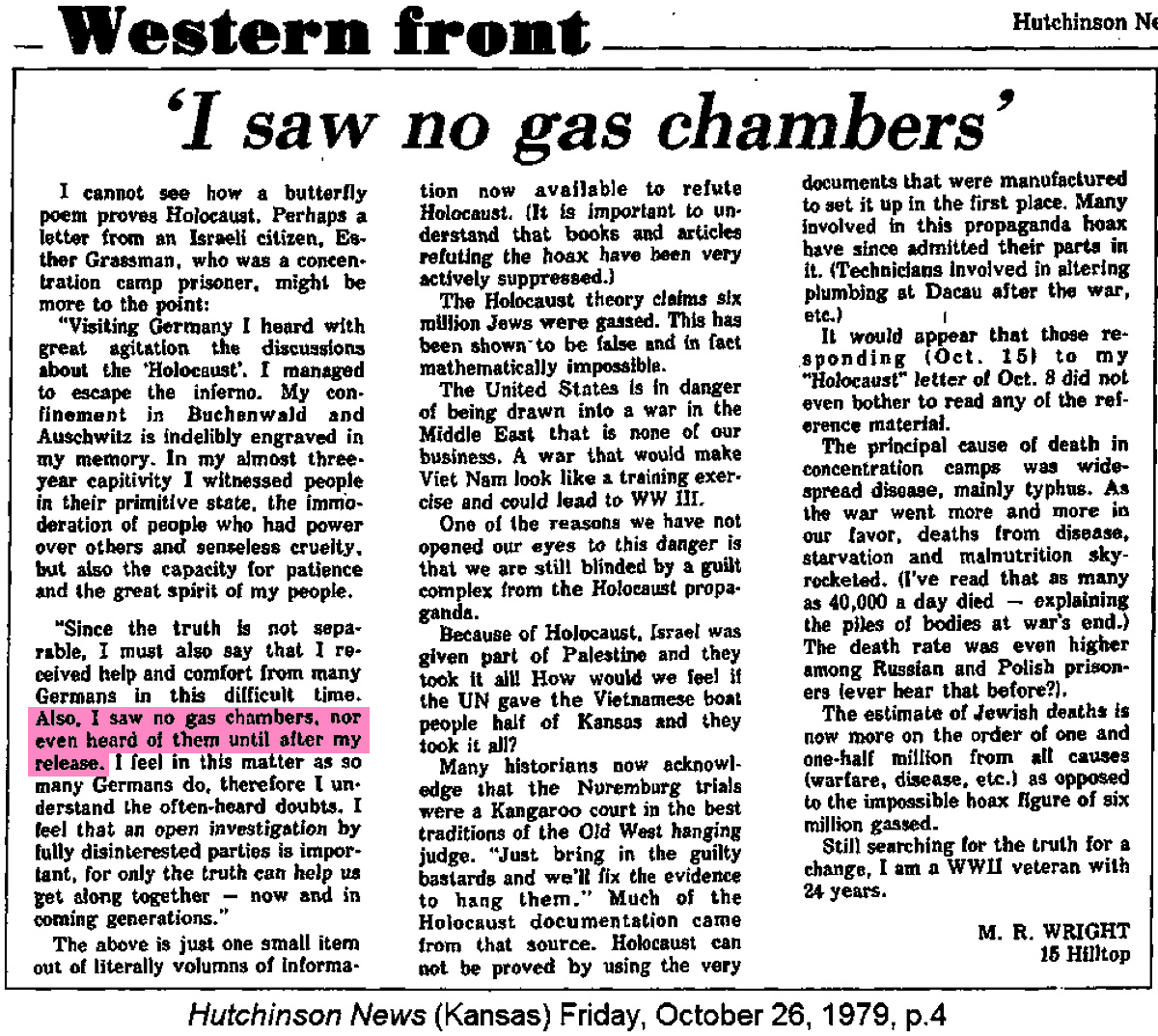
"To determine the true rulers of any society, all you must do is ask yourself this question: Who is it that I am not permitted to criticize?" -- Kevin Alfred Strom, All America Must Know the Terror That is Upon Us, Aug 14, 1993 (source)