Firefox add-ons with over 1 million (gullible) users and my comments on them
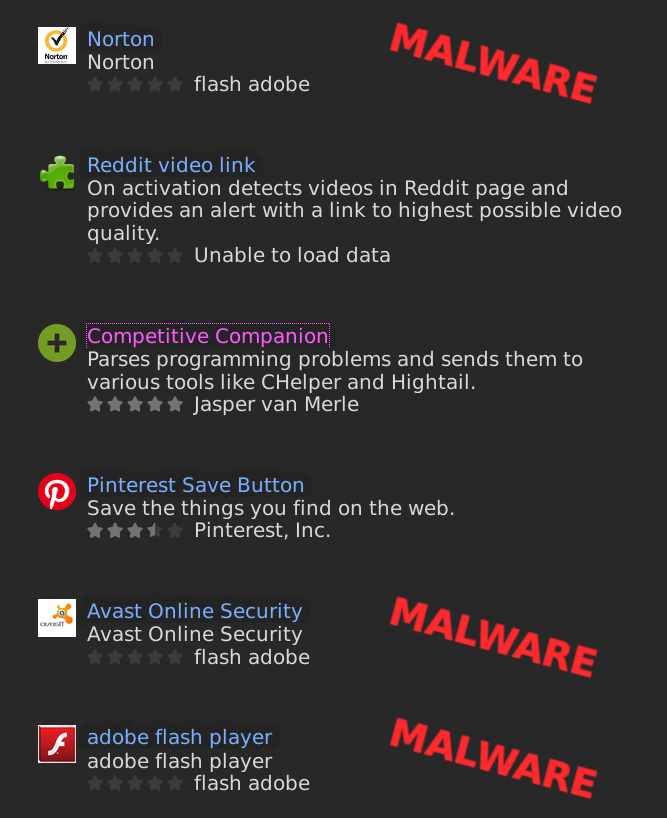
As much as i dislike Mozilla i'm still forced to recommend Firefox for those who care about their privacy, though a lot of tweaking is necessary to beat it into submission. I've also kind of boxed myself in since i depend on quite a few add-ons for Firefox. I often browse the Mozilla Add-ons website (AMO) to keep track of what's new, though the vast majority of add-ons are worthless or, worse, contain malware which i define as anything containing data harvesting functionality, ads, coupon related add-ons, or anything else that isn't required for the stated purpose of the add-on.
The M&M's (Morons at Mozilla, corporate) neutered the functionality of the AMO website by both removing the RSS feed functionality and limiting the sorting options, however one can still sort add-ons by the number of users and doing so reveals some interesting selections. Here's the list of add-ons with 1 millions users or greater and my comments on them:
- uBlock Origin, 5,968,728 users: uBlock Origin (uBO) is literally the only one on the list that's actually worth installing. uBO is an excellent content blocker and though it can be installed on Chromium and it's derivatives, it only offers full functionality on Firefox.
- Adblock Plus, 4,870,451 users: Now there's a great idea; let's get rich by making an "ad blocking" add-on which allows ads by default and then charge advertises to have their ads whitelisted!
- Easy Screenshot, 3,659,589 users: This ding-dong developer uses the official sounding name 'Mozilla Online' but is located in China. See how easy it is to fool nearly 4 million gullible people by sticking 'Mozilla' in your user name?
- Video DownloadHelper, 1,941,350 users: Let's nag users for money and not let them know about yt-dlp, a far better solution.
- AdBlocker Ultimate, 1,872,164 users: Well, at least this one claims to black all ads, but it isn't uBlock.
- DuckDuckGo Privacy Essentials,1,605,557 users: 'DuckDuckGo' (possibly the dumbest name for a search engine ever) and 'privacy' do not belong in the same sentence. DuckDuckGo, which is little more than a proxy for Bing, has been caught more than once violating user trust and they not only censor their own search results, but have convinced the idiots at Bing to do so also.
- Cisco Webex Extension, 1,463,112 users: This privacy hating piece of garbage is for video meetings. Read their "privacy" policy and then run away.
- Facebook Container, 1,227,098 users: What can i say. Facebook? Really? Disregarding the insidious assault on privacy that people using Facebook subject themselves to (as well as the rest of us non-Facebook users), containerized or not, Firefox already has the tools built-in. Open its preferences and set Enhanced Tracking Protection (ETP) to Strict and learn how to set exceptions.
- Ghostery - Privacy Ad Blocker, 1,119,088 users: Enable
privacy.(RFP) in about:config, set ETP to Strict as already mentioned, and forget about Ghostery. Better yet, use the 'arkenfox' user.js.resistFingerprinting - AdBlock for Firefox, 1,070,688 users: Again, pales in comparison to uBlock, however it is nice to see 4 ad/content blocking add-ons among the most popular. PS: remember that time when Mozilla forgot to renew its add-on signing certificate?
- Privacy Badger,1,046,527 users: Unnecessary with ETP, RFP, uBlock and the 'arkenfox' user.js.
Another huge problem is those using the plethora of VPN add-ons for Firefox. Though none have in excess of 1 million users as of this writing, several have 100's of thousands of users.
If you search the Firefox add-ons website for "VPN", 233 results are returned at the time of this writing and the number continues to grow. Not all of these are add-ons for so-called Virtual Private Networks (they are really proxies), but most are and some of the more popular ones are for companies which advertise their service as being "free".
Rule #1: Just as with email, NEVER trust a VPN whose service is "free"! It costs a lot of money, time and effort to run a proper VPN service, so if it's advertised as being "free", it's because you are the product. For example, the most used VPN add-on is Browsec VPN with 462,688 users at the moment. Let's have a look at two excerpts from their "privacy" policy:
1.1 Personal information
"Personal information" means any information that identifies you and includes information provided by you when using our services.
2. Use of Personal Information
2.1 Use
Browsec may use automatically-collected information in the aggregate for the purpose of monitoring, research or analysis. The information is collected only when Browsec service is currently active.2.2 Disclosure
Browsec may share anonymous data in aggregated form with third parties, including its affiliates, advertisers and other current or prospective business partners. Browsec may use anonymous data for web site administration, advertising and promotional purposes and may share such information with affiliated and unaffiliated entities for such purposes.
Browsec may provide access to anonymous data collected from Browsec users to outside companies for purposes of monitoring, analytics, advertising and marketing.
Does Browsec VPN sound like a Virtual Private Network provider to you?
Rule #2: A browser add-on is never necessary to use any quality VPN service.
Rule #3: Protecting only browser traffic leaves the rest of your system and network devices unprotected.
Rule #4: Many, if not most VPN's, are GARBAGE!
Rule #5: Many "reviews" of VPN companies are written by paid bloggers or employees.
Rule #6: Any caring VPN provider will not require any personal information to create an account. Payment may be made using cryptocurrency and not even an email address (or at least not a real one) will be required.
The fact is, no VPN can be trusted entirely unless you run it yourself with your own physically secured hardware and that is not a job for an amateur. That said, there are a few VPN providers that i've found that make this claim and seem to be trustworthy, one being AzireVPN and the other being Mullvad. Both claim to own, secure and deploy at least some of their own hardware (Mullvad leases the majority of their servers), both claim to run the OS in RAM only (no storage media), both support WireGuard, and both accept cryptocurrencies. More information on these companies is contained in my article, Tor versus a VPN - Which is right for you?. If you know of any other VPN's that tic these boxes, let me know.