Jessi Combs and the crash of the North American Eagle Project car
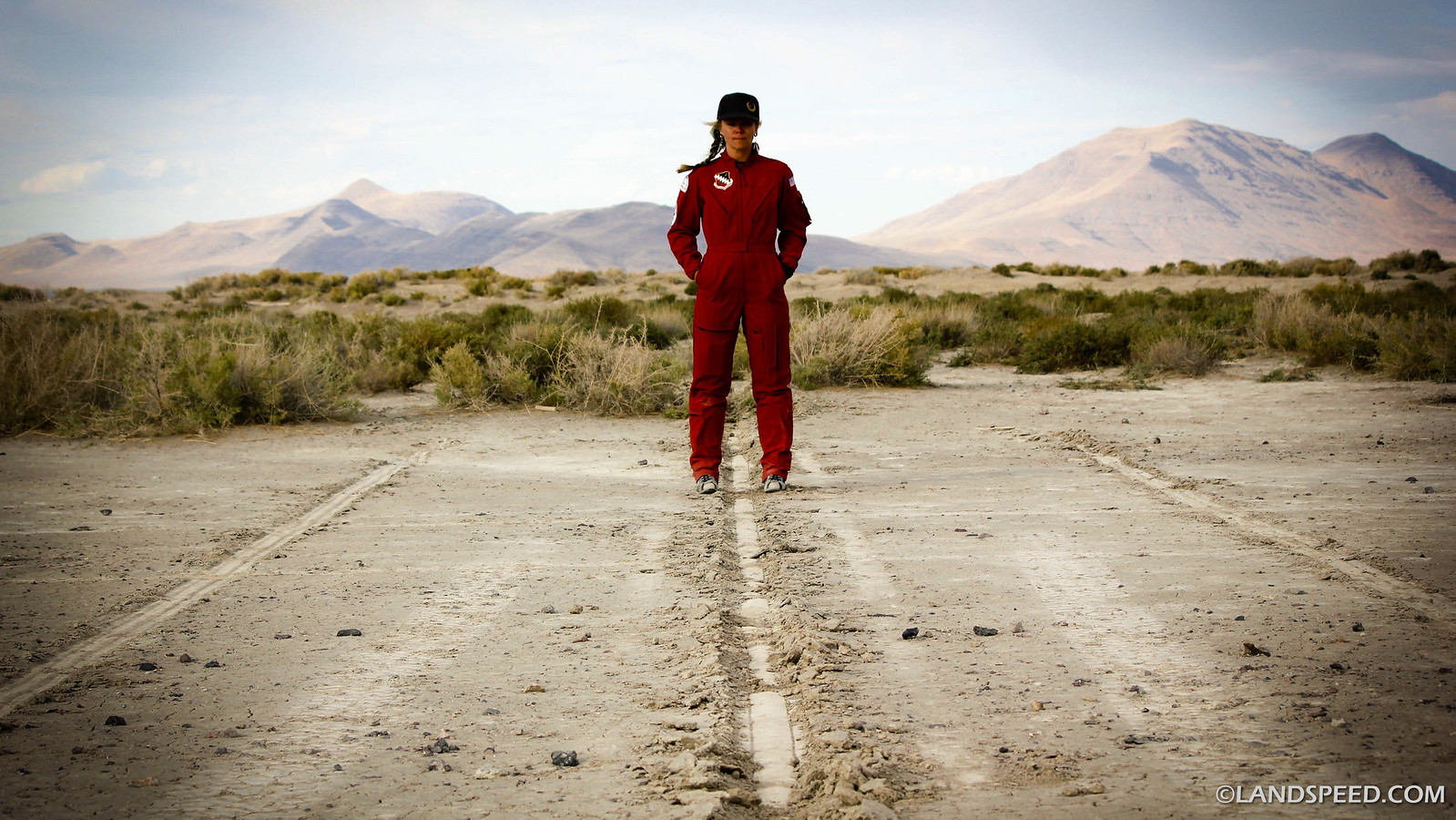
"It may seem a little crazy to walk directly into the line of fire... those who are willing, are those who achieve great things.
People say I'm crazy. I say thank you ;)"
-- Jessi Combs, Twitter, August 24, 2019, 3 days before her death
I recently watched The Fastest Woman On Earth, the 2022 documentary about the extraordinary life and heart-breaking death of 39 year old Jessi Combs while attempting to break her own land speed record. Her story touched me deeply.
I don't recall knowing of Jessi prior to the film, but she seems to have been quite popular and very well liked, as well as extraordinarily motivated and talented. She apparently excelled at multiple professions including fabrication, welding, mechanics and race car driving with a variety of vehicles.
Jessi lived in a world dominated by men and probably left quite a few damaged egos in her wake, but also many who respected her for her remarkable talent. She tells us she loved going fast and being an inspiration for women around the world, made possible in part by her presence in many television shows including Xtreme 4x4, Two Guys Garage, All Girls Garage, Heels On Wheels, Overhaulin', The List and MythBusters. There was, and is, something quite magnetic about her genuine personality.
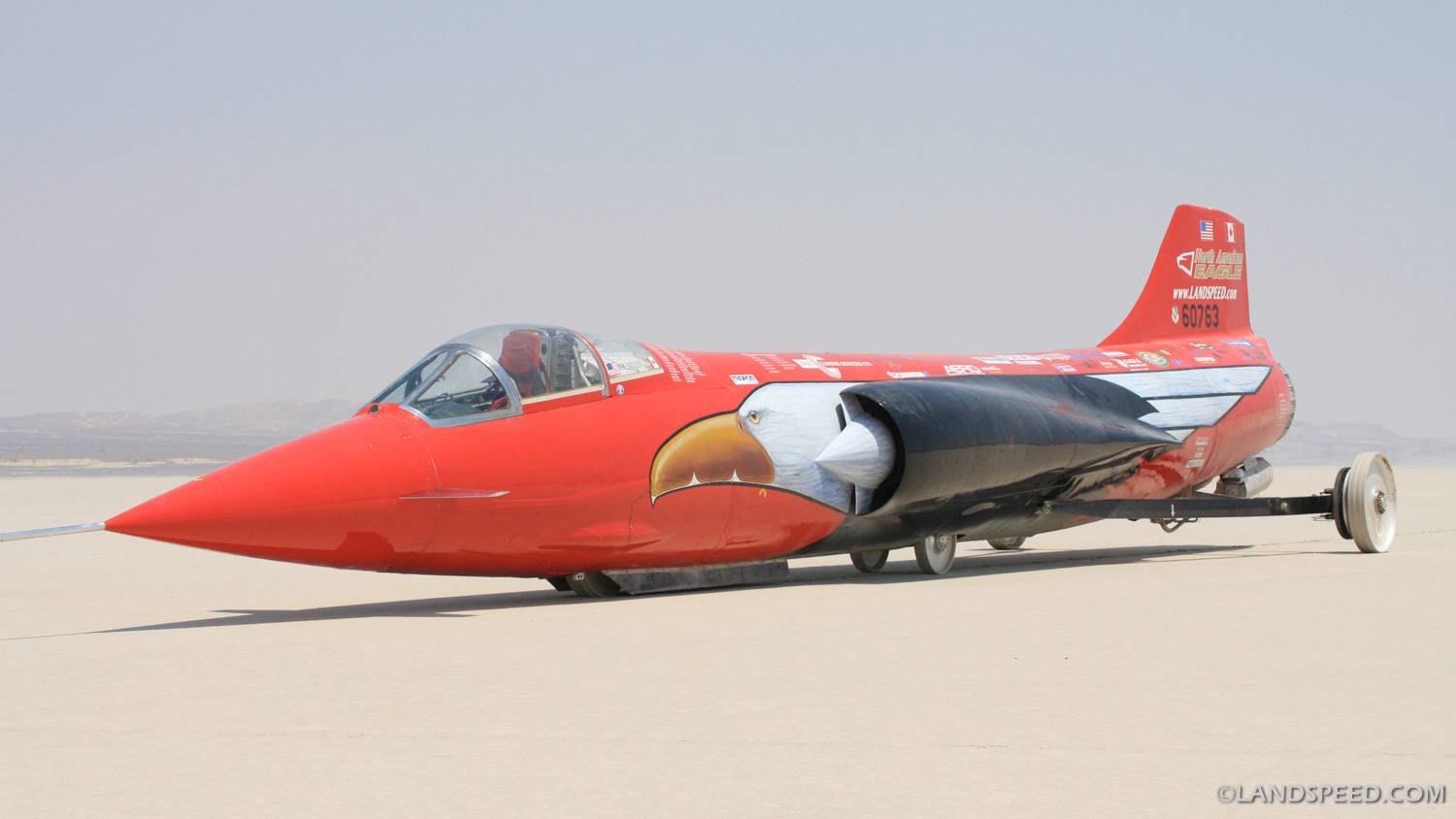
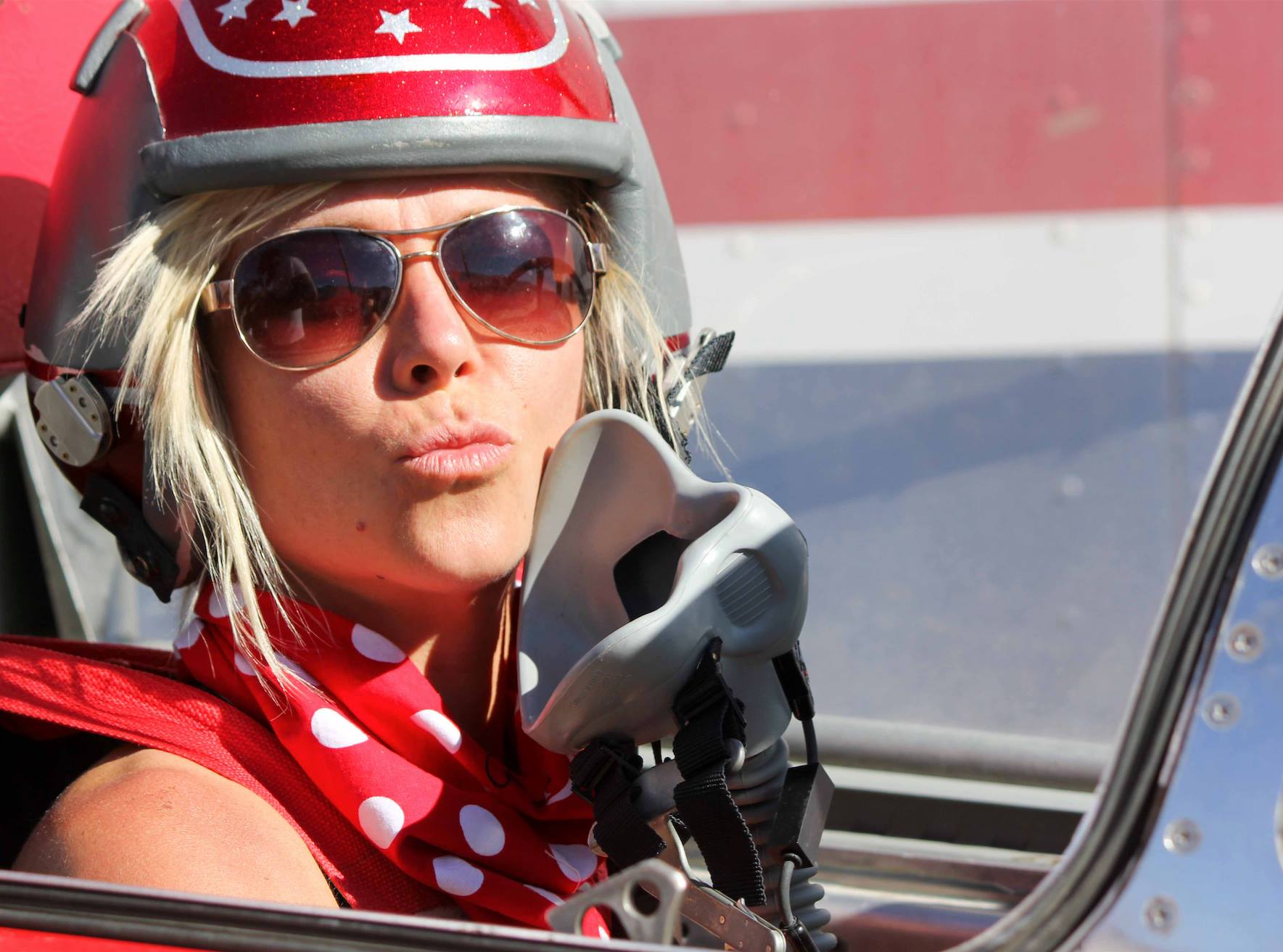
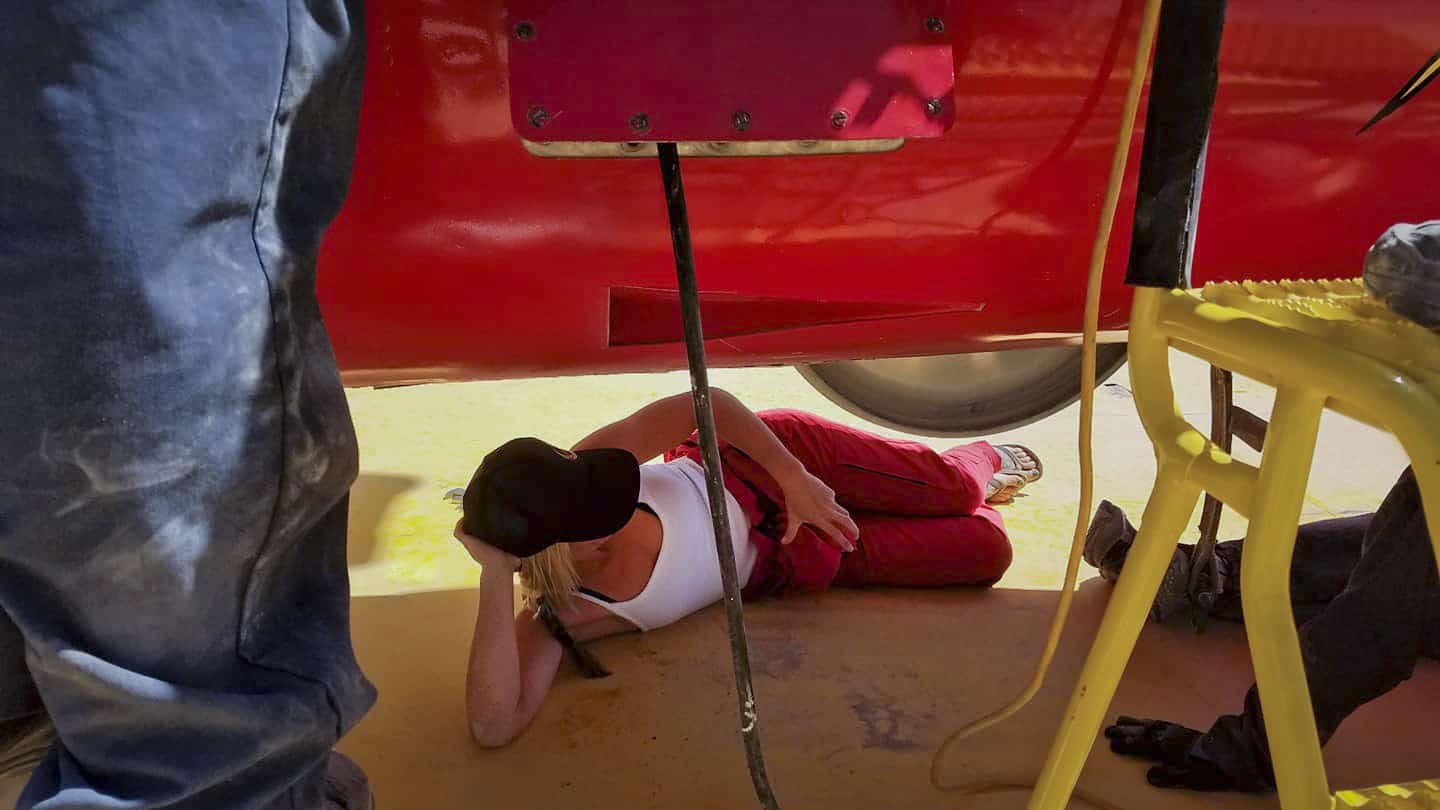
If you haven't yet seen The Fastest Woman On Earth or aren't aware of her story, the short version is that Jessi died while driving a jet engine powered "car" on the Alvord Desert in Oregon on August 27, 2019. The 18,780 lb. thrust North American Eagle (NAE) Project car, first owned by Ed Shadle (deceased), was built to break the all-time land speed record of 763 mph at the time. During the build-up to a record breaking run, Jessi and others made in excess of 40 runs in the vehicle over a period of nearly 2 decades. Jessi's involvement in the project as a driver culminated with an official 522.783 mph run and a top speed of 548.432 mph. That final run however ended in a horrific, fiery crash and an abrupt end of her life due to what appears to be a combination of a mechanical failure and serious design flaws which ultimately prevented the vehicle from slowing sufficiently before it reached the end of the track on the Alvord Desert and exploded into pieces.
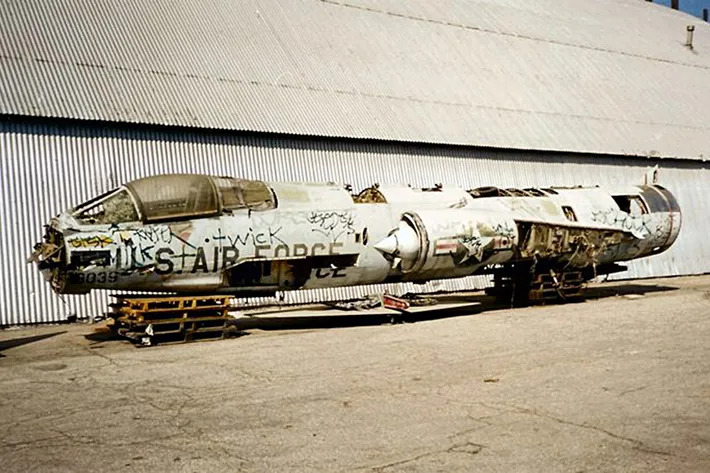
The following image shows the state of the vehicle when it was first purchased from an aircraft junkyard for approximately $25,000. During an interview Ed Shadle stated that the aircraft was "about 2 weeks away from becoming a beer can".
One of the better documentaries regarding how the North American Eagle land speed project took shape was produced by KBTC Public Television in 2016.
Video: The North American Eagle - KBTC Public Television (2016)
Approximate specifications of the vehicle:
| CHASSIS | Extensively modified F-104A-10 Lockheed Skunk Works Starfighter, tail no. 56-0763 |
| LENGTH | 56 ft. |
| WEIGHT | 13,000 lb. |
| ENGINE | Model: General Electric LM - 1500 Turbojet Dimensions: 17 ft. L x 3 ft. D Weight: 3,600 lb. Output: 18,780 lb. thrust (~52,000 hp) Fuel consumption: 40 gal./min. @ idle, 90 gal./min. @ full afterburner |
| WHEELS (5) | solid billet aluminum |
| BRAKING | magnetic wheel brakes, parachutes, air/speed brakes |
The documentary film, while absolutely well-worth watching in my opinion, left me a bit disappointed regarding the sequence of events that led to the crash, particularly why one or both parachutes were deployed while the engine was still throttled up, causing them to burn. Considering Jessi's overall experience with racing, mechanics, safety, and this vehicle specifically, and considering the sorted mechanical history of the experimental NEP vehicle, i suspect it is supremely unlikely that Jessi intentionally or accidentally deployed the parachutes while the engine was still throttled and therefore i think it's logical to surmise that a design or mechanical failure was the more likely cause of the crash. We are told by investigators that the ultimate cause of the crash was a failure of the nose wheel as a result of it striking an unidentified object and fragmenting, however i'm not convinced that explanation accounts for the early deployment of one or both of the two parachutes. We'll soon explore another potentially contributing factor that, based on the evidence i reviewed, may fill in some of the blanks.
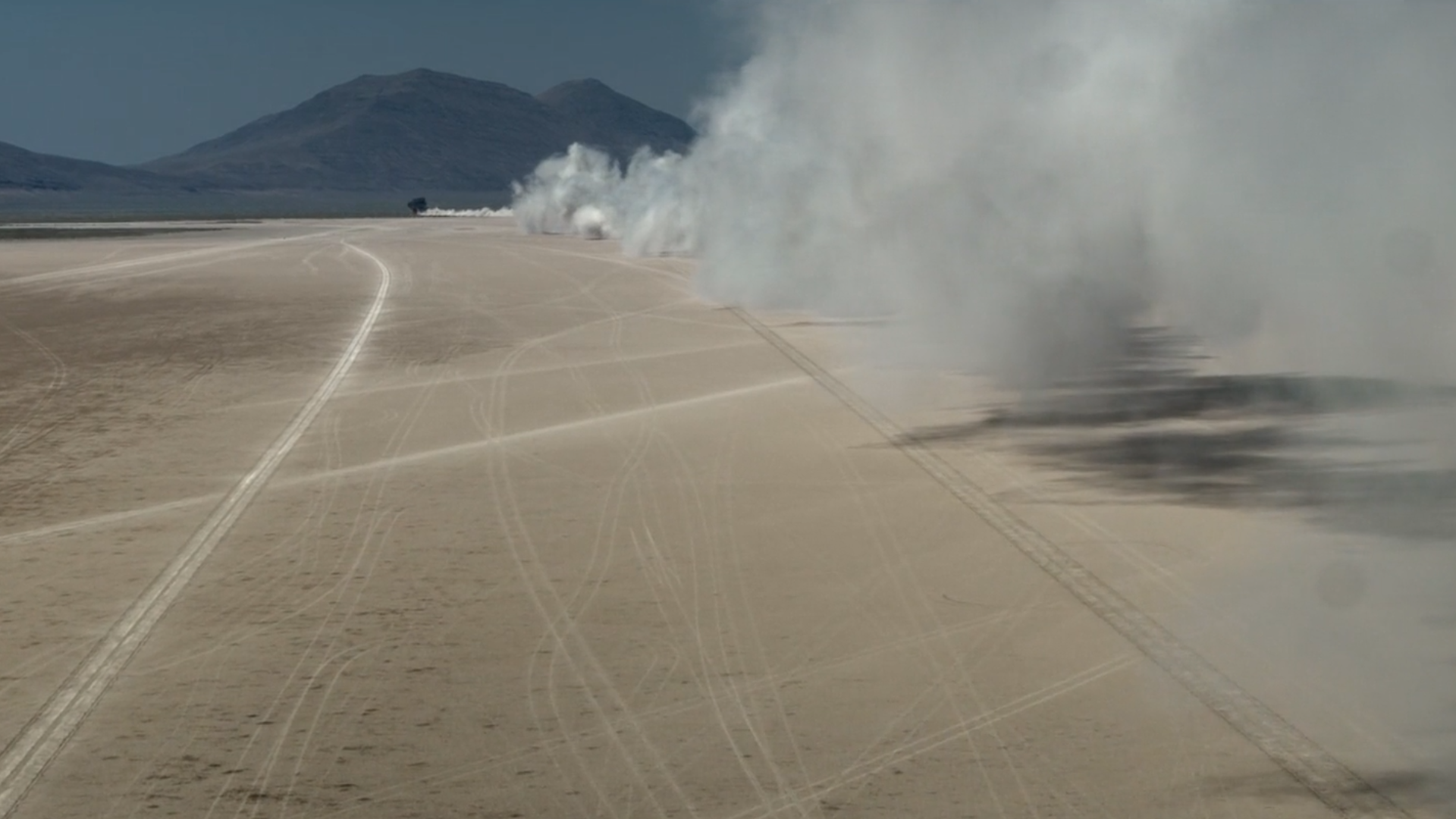
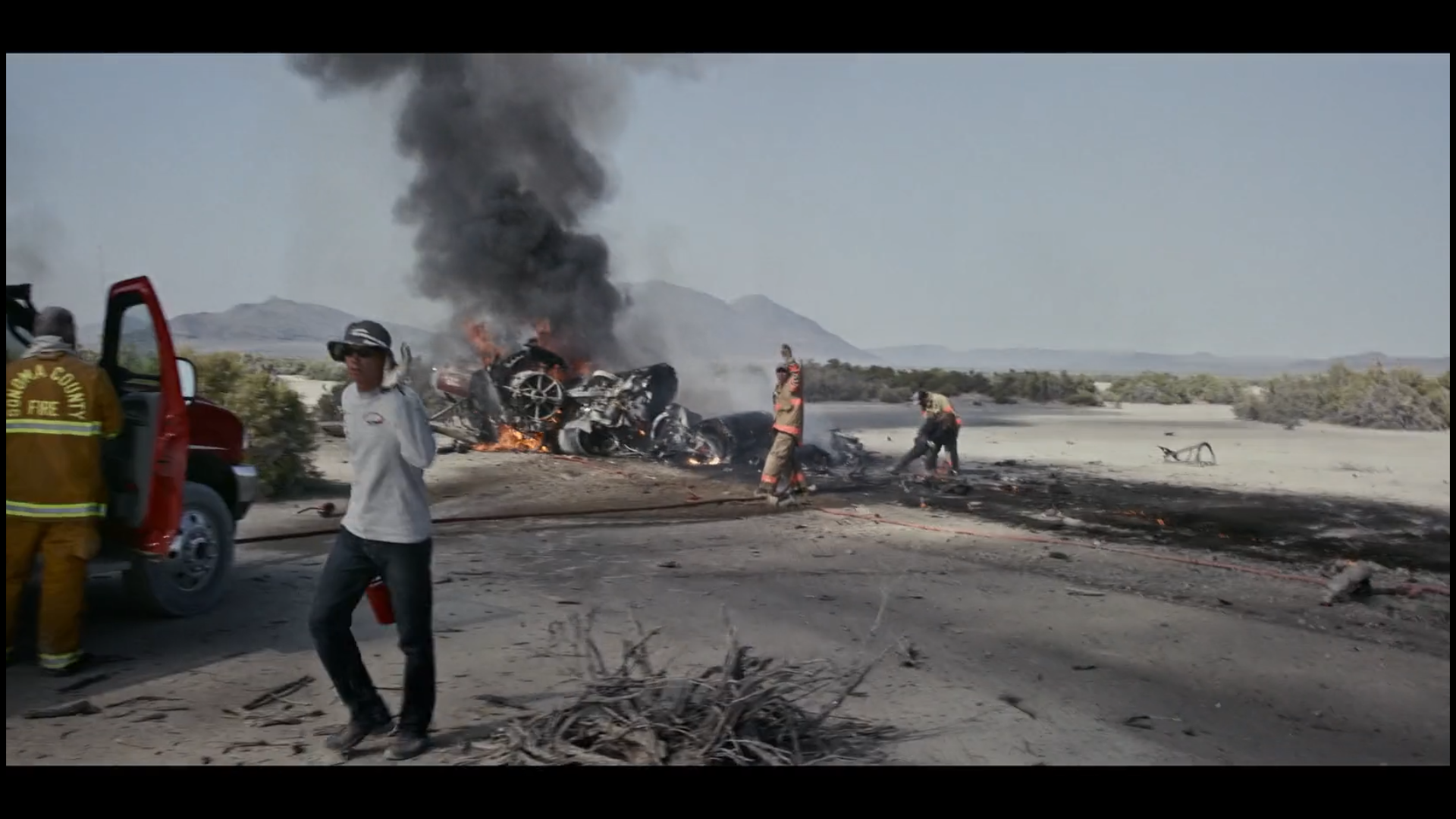
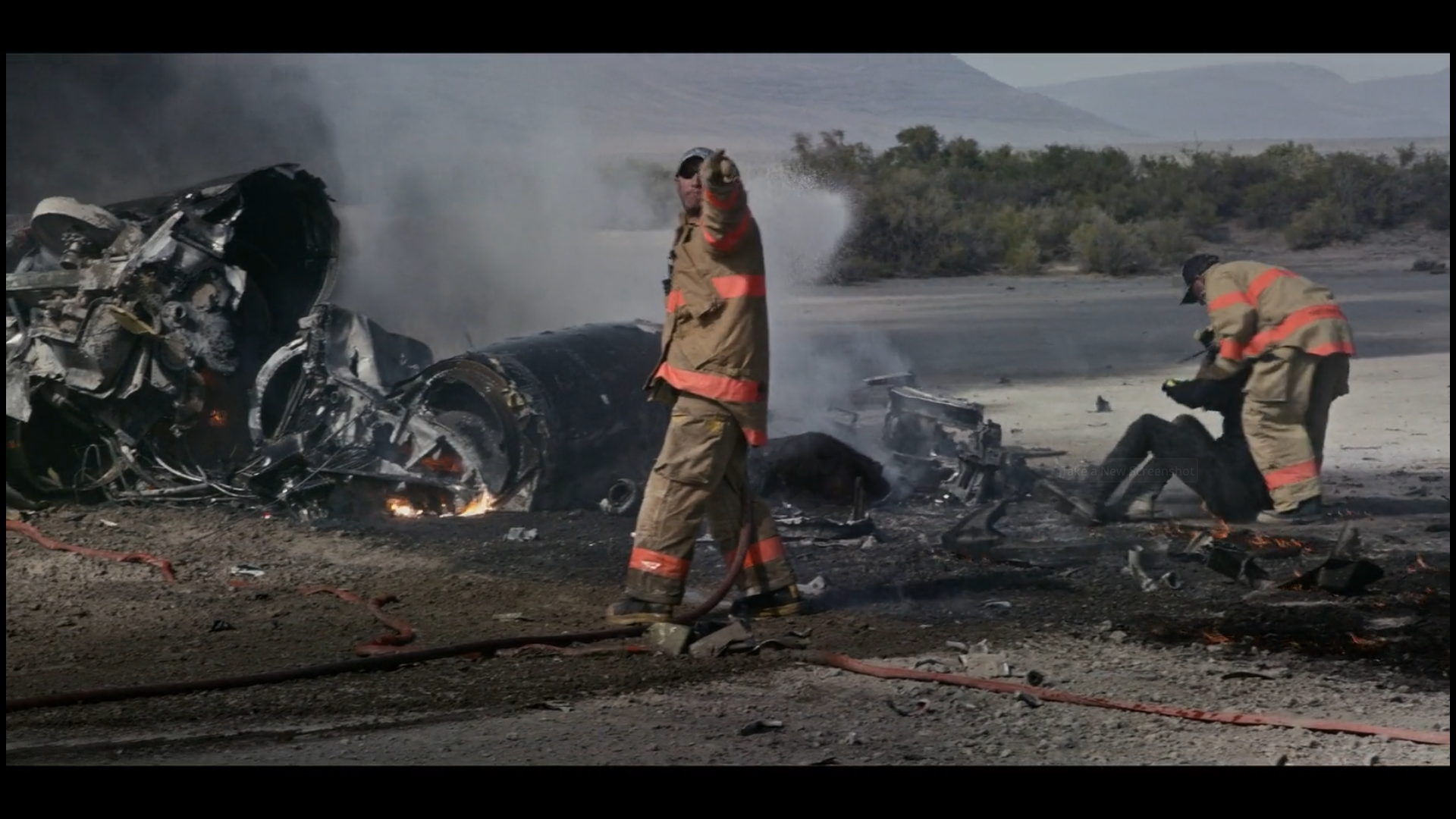
The extremely violent nature of the crash transformed the vehicle into a twisted pile of rubble and burning jet fuel. Thankfully, according to the coroner, Jessi appears to have died quickly of a blunt force head trauma prior to the fire. The following image was captured immediately after impact with the uneven terrain past the end of the track and in it we see a tiny black cloud of burning jet fuel beginning to rise in the distance.
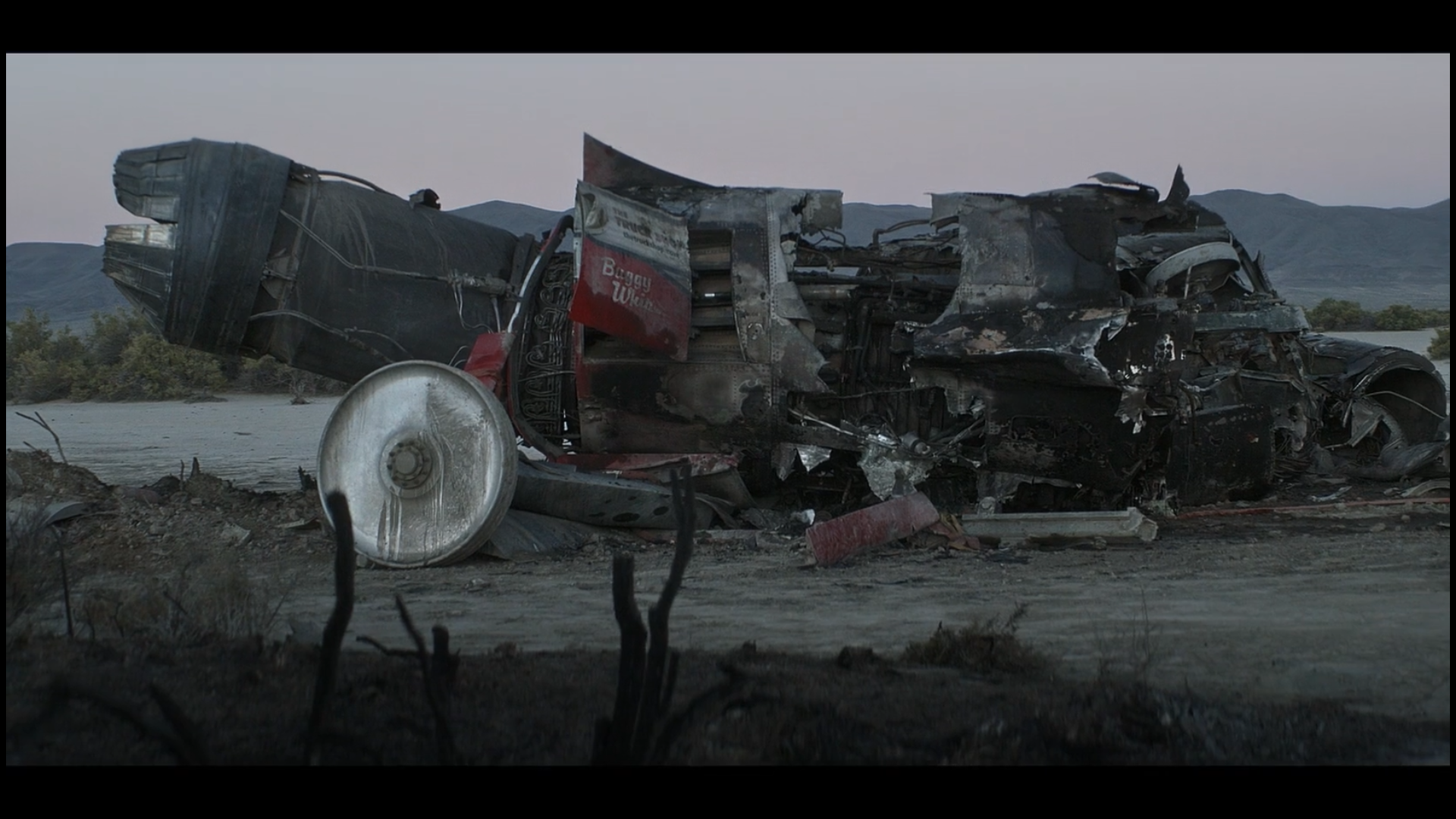
In the following image we see an upside-down wheel assembly near the front of the vehicle (right side). I can't be certain what wheel this is, but it seems it may be the nose wheel, as though the bottom part of the front of the vehicle had peeled back over the top of the chassis. Notably a fragment of the wheel is missing.
There are several points of interest that drew me to Jessi's life, one of them being the unflinching integrity she carried to her death despite being aware of what was about to occur. The documentary gives us a reasonably uninterrupted view from a camera mounted to the canopy behind Jessi's left shoulder and from this perspective we can observe her actions and behavior early in the run before all hell broke loose, as well as after when she was facing an abrupt and violent end to her life. What struck me about her behavior is that there was no visible change; she held her composure completely, right up to the moment of her death. In the following image Jessi is perhaps two seconds from her demise. We see she's at the end of the track where bushes begin to dot the dried desert mud. Her head is upright as she must be anticipating what is about to unfold.
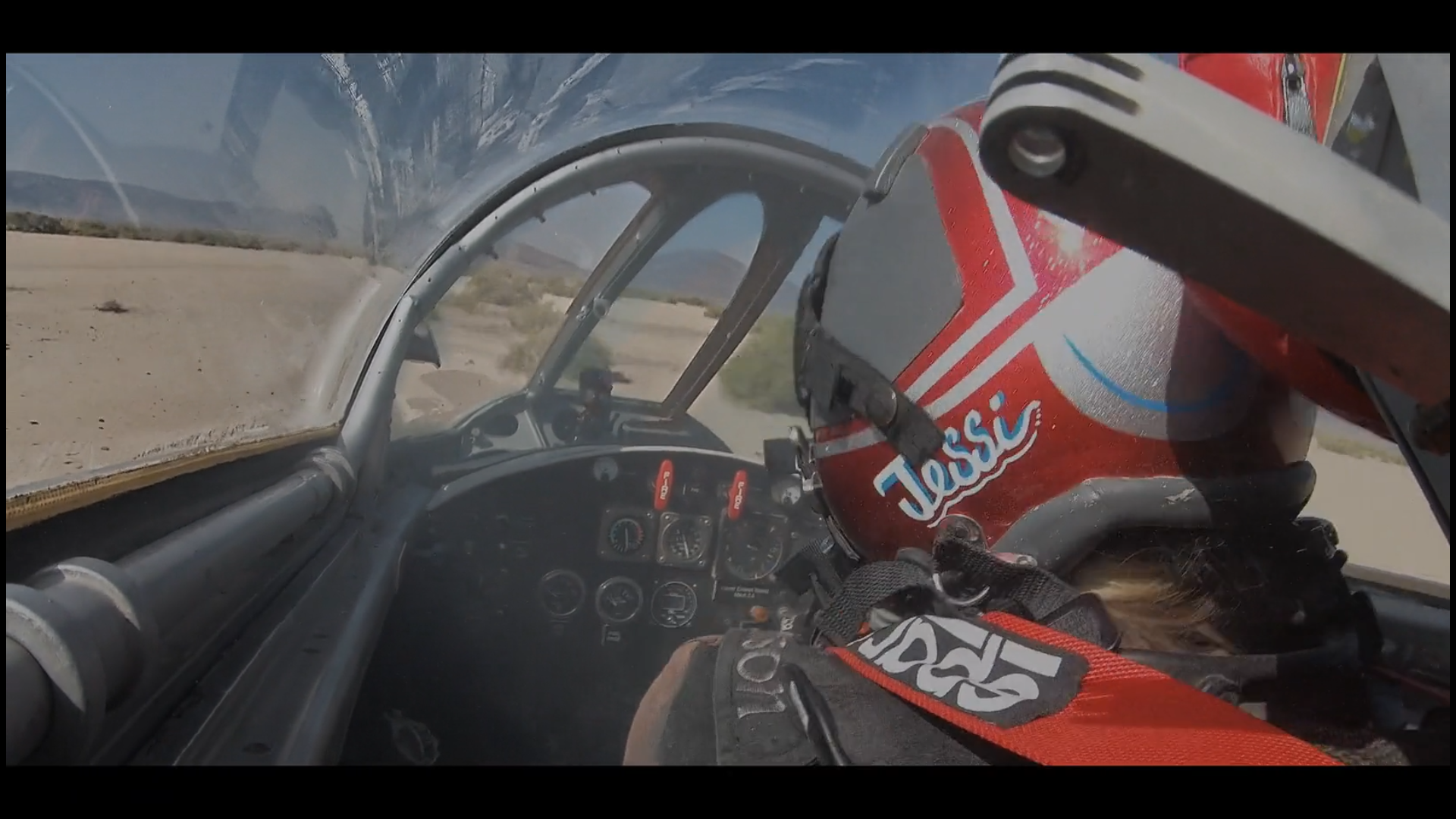
The following sequence of images, captured from the film, occur within the space of approximately 1 second. This next image shows the first visible sign of the fuselage being breached as the cabin begins to fill with dust and dirt. Jessi's head begins moving forward at this time.
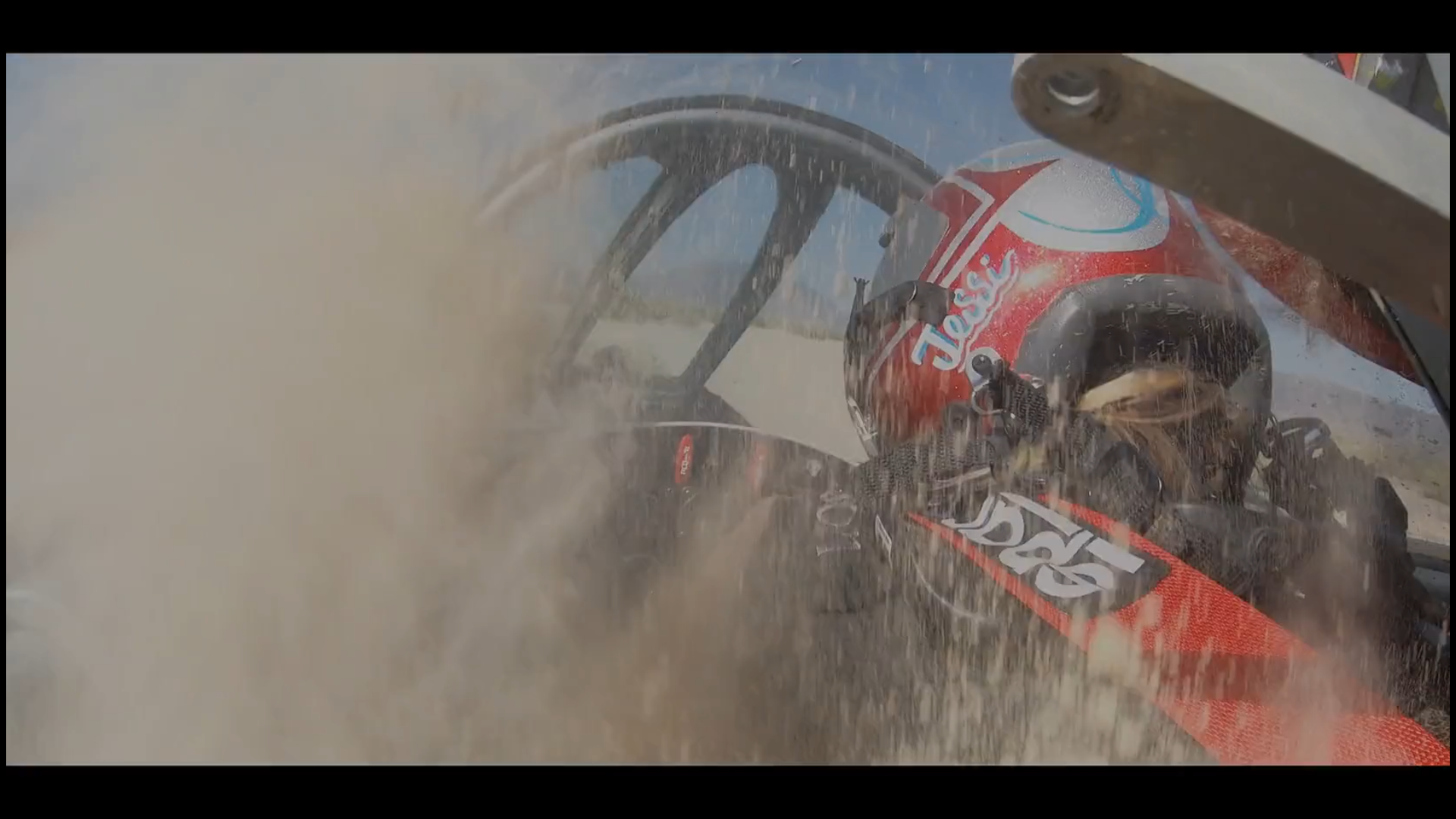
Just milliseconds later her head slams violently forward, presumably into the console which resulted in the fatal head injury.
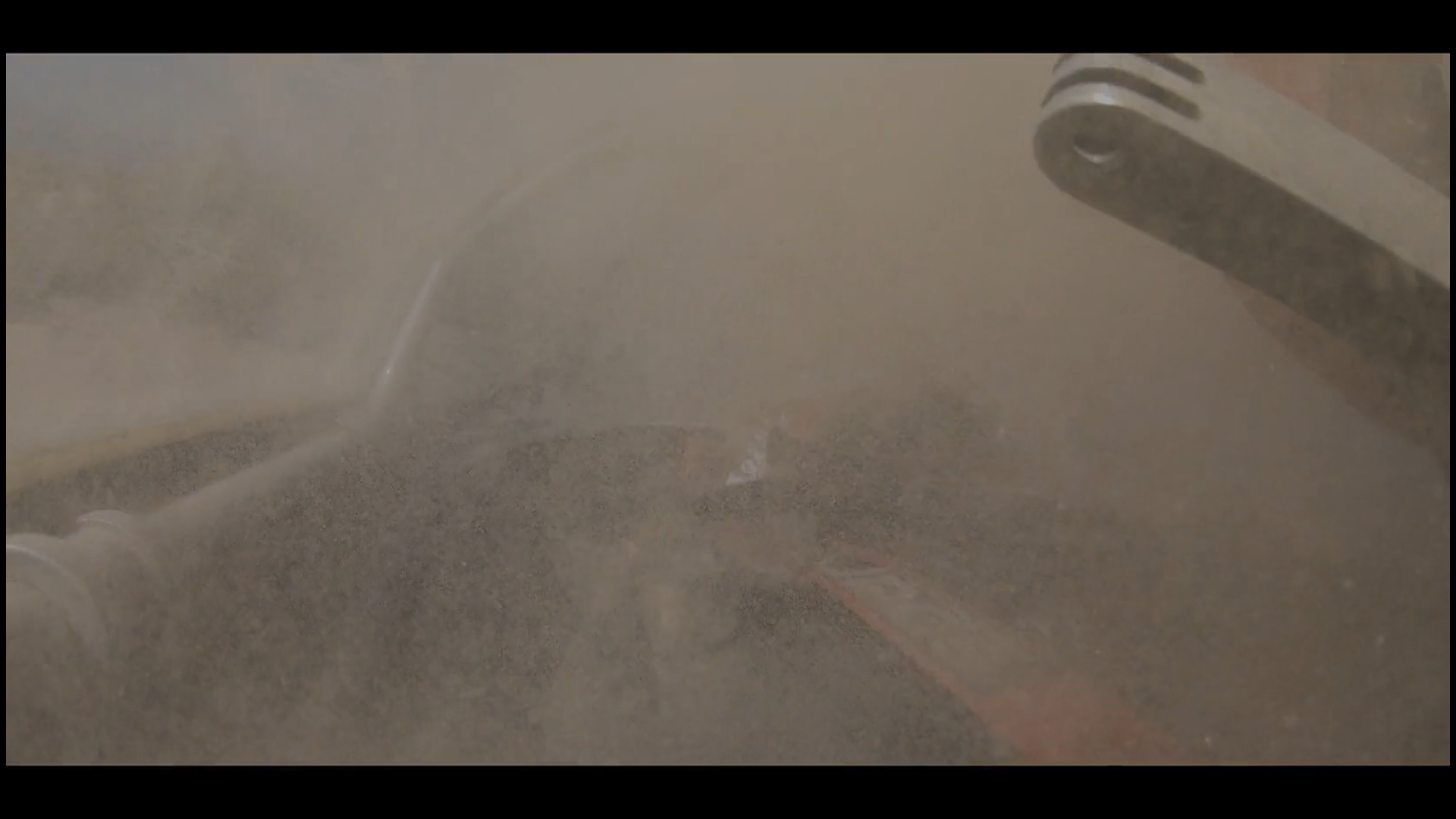
Nearly as fast as her head was slammed forward it returns again to an upright position, but we can see that her helmet visor is apparently no longer attached as evidenced by the flailing straps that held it in place. This rapid sequence of her head slamming forward and back would occur twice before the canopy, and with it the camera, detached from the fuselage whereupon we lose all sight of her.
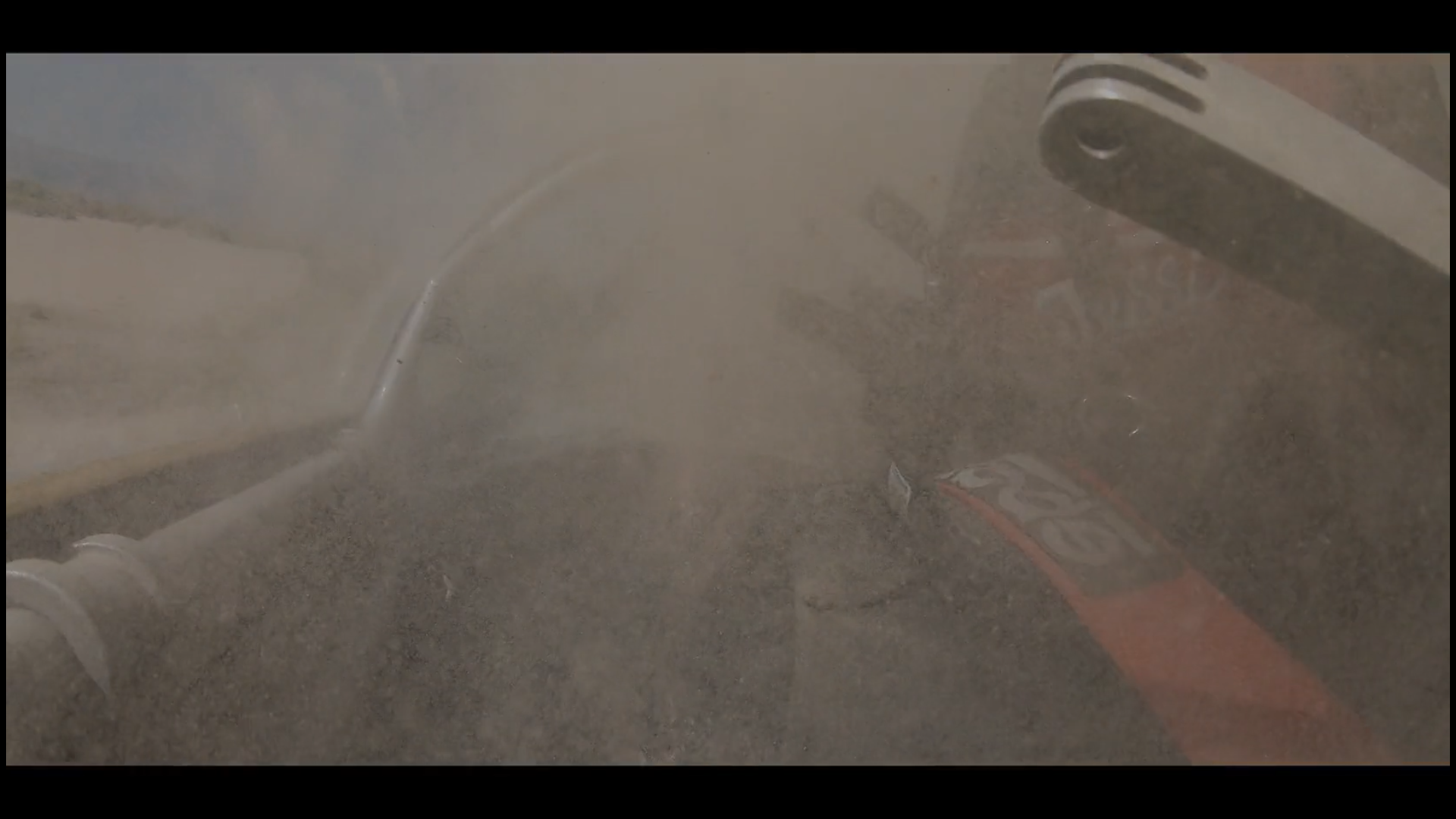
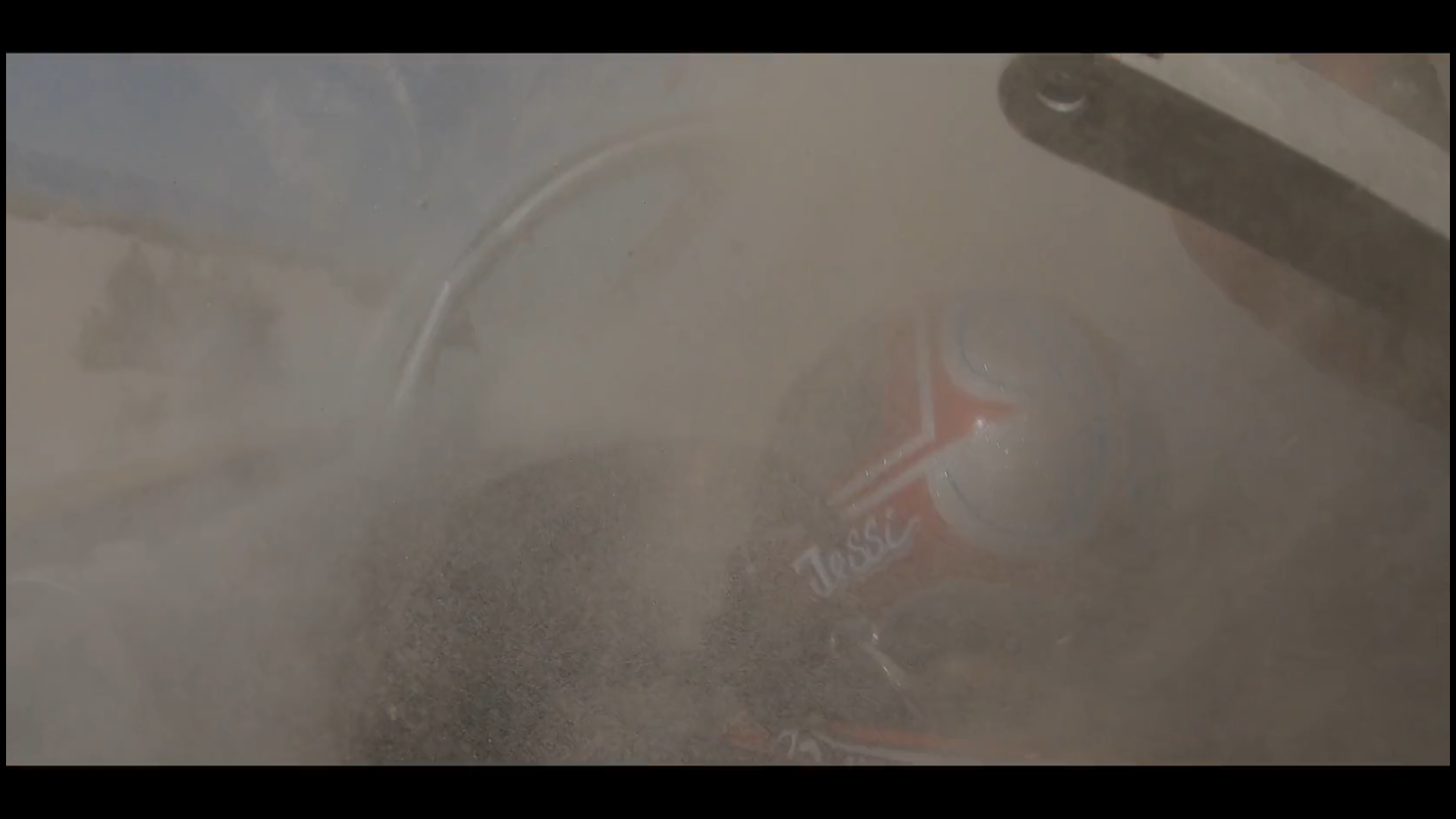
In the next image her body seems to be positioned substantially lower than normal in the vehicle. The camera perspective hasn't changed significantly and the canopy is still attached to the fuselage, thus i can only guess that it is at this moment when the fuselage is further compromised as a result of repeated impacts with the uneven terrain. From this point onward the camera view is completely obscured by dust and debris until the canopy finally detaches from the fuselage and begins tumbling through the air.
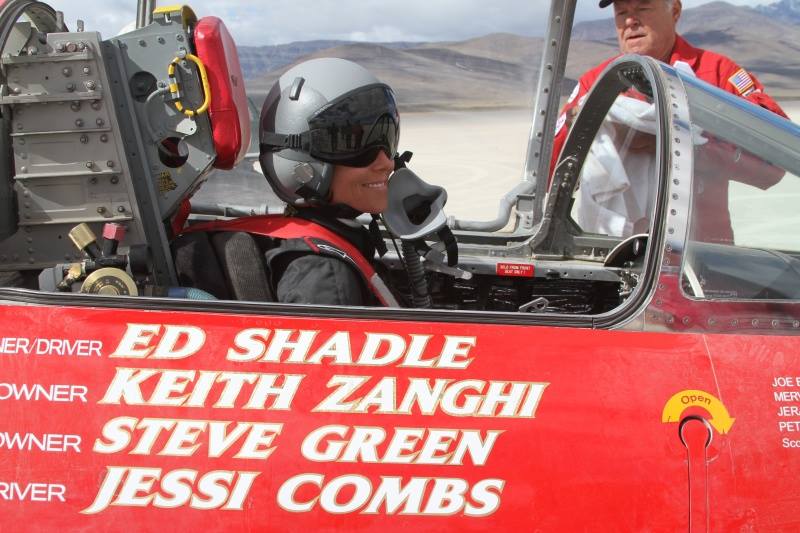
The vehicle retained the original F-104 ejection seat and some people have questioned why Jessi didn't eject. I believe part of the answer is that the F-104 apparently wasn't equipped with an ejection mechanism that could be activated at ground level whilst still ensuring the pilots survival. The other part of the answer could be that it was disabled, which would be the safe and logical choice if the first part of the answer is true. Nevertheless, it seems a bit odd to me that the seat would be retained unless it was an integral part of the vehicle or served multiple purposes. An ejection seat is certainly much heavier than a typical racing seat, however i believe it did contain the breathing apparatus which supplied the gas to the face mask worn by Jessi.
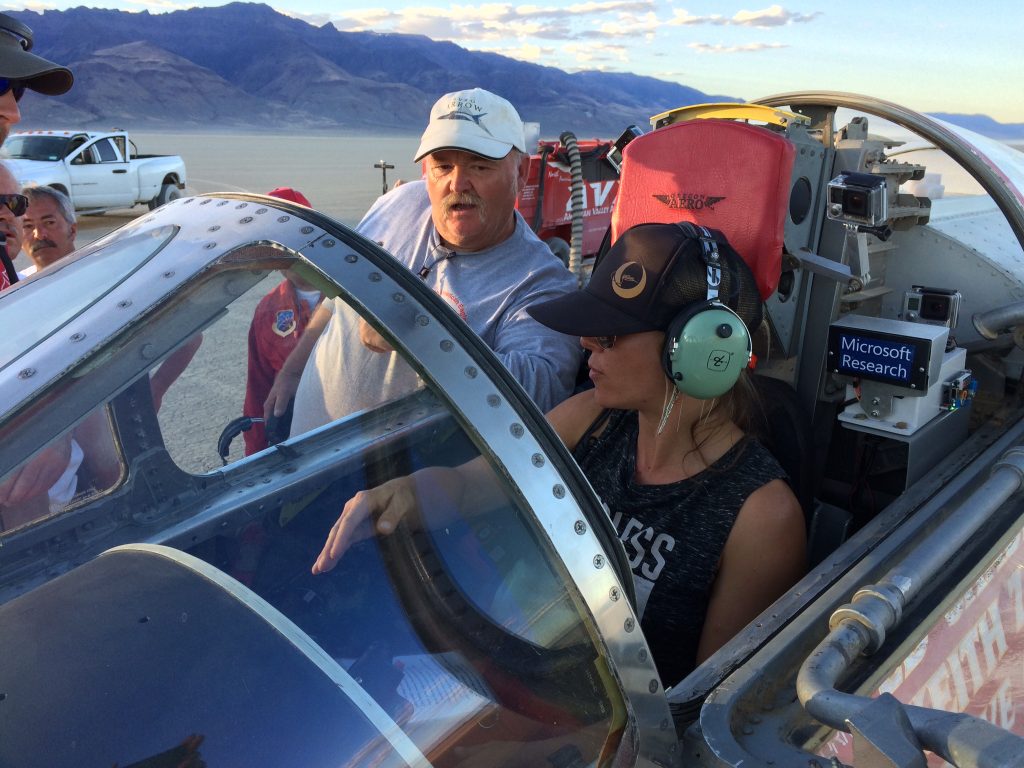
I threw this image in because the Microsoft branding caught my attention. According to the article, Microsoft Technology Helps Jessi Combs Strive To Become Fastest Woman On Earth:
Microsoft played a role in the effort as well. Built around Windows 10 IoT Core, the Pegasus Mission research scientists were able to develop a small cockpit sensor that sent telemetry data and received messages in real-time. The team created mobile apps with Xamarin, and a custom telemetry system that captured nearly 60,000 measurements per second and uploaded the data to Microsoft Azure for analysis using Cortana Intelligence.
It is very apparent that a very strong vibration appeared immediately after Jessi throttled down the engine sometime around the 6 mile mark. In the documentary we see the camera mounted in front of her swivel in its mount as a result and we are told that the source of the vibration was the nose wheel fracturing after coming into contact with an object, perhaps a sub-surface rock, after which multiple pieces of the wheel broke off which would have thrown it terribly out of balance. We are also told that the nose wheel "collapsed" at one point however this is not explained. From information available in the film it is not clear to me why wheel fragments were apparently found along the 5 mile section, yet the vibration didn't seem to occur until the 6 mile mark as Jessie throttled down the engine. The following comment was written by 'tallguy' on the Land Racing forum:
I met Jessi, and consider some of the NAE team members as friends. All great folks, in my opinion. But mistakes were made in the past. They didn't result in a crash then. More than a year ago, the wind, prior to a run, blew down a mile marker. Jessi, not seeing that marker, drove far off-course (onto un-cleared ground). I witnessed this, and shortly thereafter learned that the mile markers were not all safely and thoroughly secured to the ground. That's the kind of thing that can get someone killed. I was one of the people in earlier NAE test sessions that walked the course, picking up rocks. Most of those I found were fairly small(ish), but several were about 5 pounds, with only a tip showing above the dirt, like the tip of an iceberg.
Most disappointing from a forensic point of view is that the film provides no solid clue as to what caused the parachute(s) to deploy early, nor is any of the crucial telemetry data revealed even though the storage media on which the data resided was found unscathed, still plugged in to the computer main board of the Lenovo laptop. Did the parachute(s) deploy early as a result of the vibrating front wheel? Did debris or fragments from the front wheel catch the parachute tethers? Did Jessie make a mistake?
At the 6 mile mark, after reaching a maximum speed of 548.432 mph, Jessi is casually told to "shut her down" but there is apparently no acknowledgment from her. When the vehicle doesn't appear to be slowing the voice becomes distinctly agitated and Jessie is again ordered to initiate the shut-down process. A second or so later Jessi replies with "copy that" and that's the last we hear from her. Whether she received and ignored the first request is unknown. Whether the film editors decided to not include further communications from her due to content, or whether she made no further attempts to communicate is also unknown, however such communications, if made, could provide vital clues as to what went so terribly wrong.
In this next image we see what appears to be one of the burned parachutes found near the crash scene while the other was apparently found miles before the crash site.
Indeed there were crucial design flaws with the vehicle, not the least of which was the decision to modify an F-104 Lockheed Starfighter military aircraft for surface use and not include a proper roll cage to protect the driver. Braking failures, steering failures, parachute deployment failures and other problems plagued the project. Jessi came close to buying the farm in 2016 when both parachutes failed to deploy and the vehicle ran off the end of the track at close to 100 mph.. She also experienced problems steering the vehicle at that time which seems to have been due to the hydraulic fluid overheating and boiling. Jessi appeared to be shaken to the core as a result of the parachute failures and later described the incident during an interview as being her "sketchiest moment in a car". Earlier during that same session one of the parachutes failed to deploy for another driver. The following comment was written by 'sundancetao' on reddit:
I agree with you about it being a crappy team. There are signs everywhere in that documentary about Jessi that are red flags. I worked in the auto racing industry for many years when I ran the Bell Helmet Auto Racing Division as VP/GM, so it's not hard from my time around all kinds of race cars and teams to identify that this team had a lot to be desired. Truly, the safety of the driver was not paramount. The vehicle didn't even have a respectable safety pod to protect the driver. Utility compartment doors flying off during speed runs, chutes failing, etc., all signs of a sub standard operation, especially when attempting land speed records. I'm speculating here and I want to say that up front, but I read somewhere that the team claims the wheels were made from billet forged aluminum and rated for 900 miles per hour. Maybe so, but for how many runs are they safe. I wonder how often that team conducted thorough checks for repeated use stress of the metal in those wheels. They made lots of runs at high speeds on that lake bed surface and I am quite certain that the wheels had been subject to a lot of stress during those runs. They say the front wheel failed, "likely due to having hit something on the course or under the surface of the lakebed." That is conjecture from what I can tell. Is there any proof of that? "Likely" isn't good enough. Sure, land speed attempts are a risky business to begin with, but there are many things that can and should be done by any responsible team to offer as much protection the drivers of the vehicle as possible. Seems to me there are just so many areas of neglect. I'm not afraid of measured risk in pursuit of dreams. I've been jumping out of airplanes for 20 years. A full face helmet would have been a good idea, among many other things. I'm not sure if Jessi really understood the increased magnitude of risk she was exposed to by the team running the operation, the design of the car, the lack of safety features and protocols, etc. Maybe she did, but it's truly unfortunate that she lost her life pursuing the record with so many warning flags regarding unnecessary risks in the attempt. Such a tragedy in my view.
The following image is from Jessi's 2016 run that nearly ended her life. At the end of the track there are bushes and the ground becomes very uneven. Crossing this terrain at speed in the fragile vehicle is a death sentence. From the wheel tracks, as well as from the featured image of this page, we can see that the vehicle had 5 wheels; 1 nose wheel, 2 mid wheels and 2 rear wheels, all machined from solid billet aluminum we are told. We can see the faint imprints left by the mid wheels just aside from Jessi's feet despite that they are partially covered by debris scattered by the nose wheel. The imprints between the mid and outer-most rear wheel tracks are tire tracks from another vehicle.
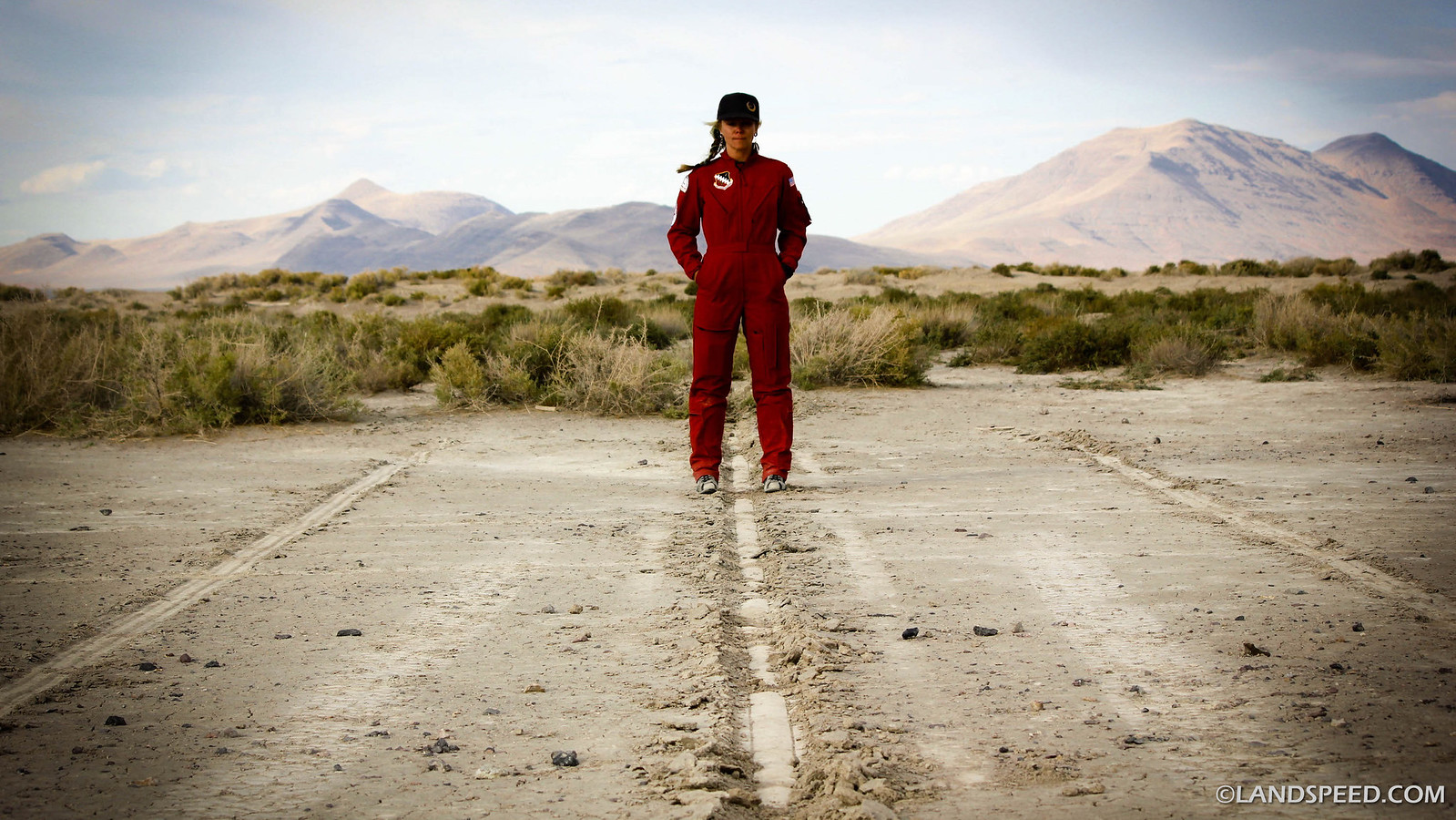
The two mid wheels were attached to swing arms that were actuated by 500 lb. force springs according to the builders. The fact that these wheels existed at all reveals another questionable decision to use an aircraft fuselage as a platform for a land speed record vehicle. The load of a fixed wing aircraft is supported by its wings and without the wings that load had to be shifted to the nose and the tail, much further away from the strongest part of the fuselage. It seems quite probable that the purpose of the mid wheels was to compensate for the missing wings, however given that the vehicle weighed around 13,000 lbs. and the mid wheels supported only about 1,000 lbs., the fuselage could have been subjected to substantial flexing and thus prone to fracturing. One possible reason for the seemingly negligible amount of weight supported by the mid wheels is that steering the vehicle might become more difficult had they supported more weight and so i suspect a compromise may have been made. The mid wheels, unlike the other wheels, appear to have been smooth along their circumference which i suspect was to help with steering by allowing them to slide sideways. The faint imprint they left on the ground is evidence that they supported far less weight than the other wheels.
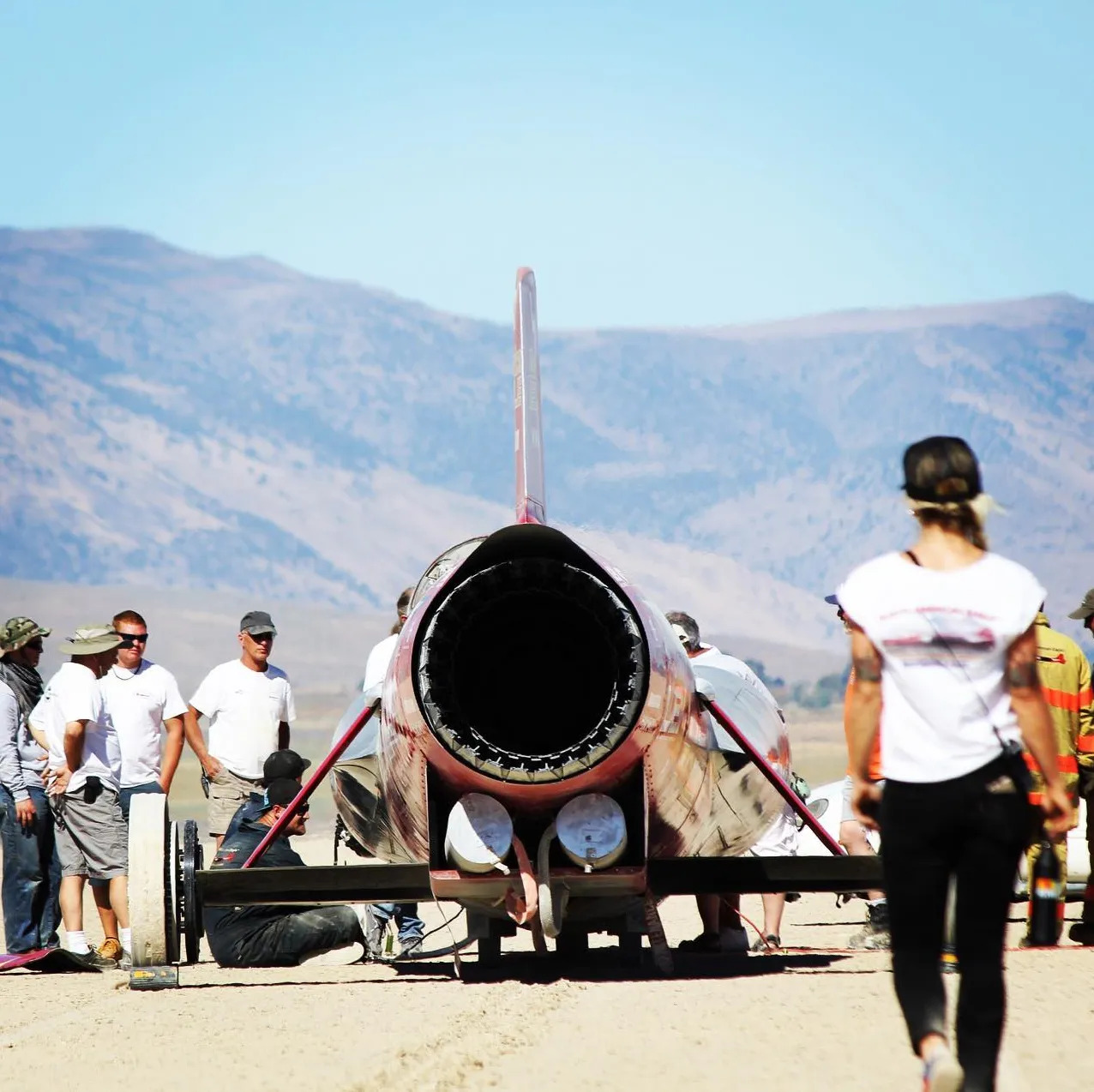
In the following image we see another crucial design flaw and possibly the one which provides us with a reason for the crash. The parachute tethers were left exposed to debris kicked up by the nose and the two mid wheels, all of which are located in front of the parachutes. We can clearly see in videos that the parachute tethers were being battered by debris kicked up by the wheels as they forged shallow trenches in the dried desert mud. Surely someone involved in the project must have recognized this potentially fatal problem and so why it was never corrected over the approximate 20 year span of the project is unknown and, frankly, disconcerting.
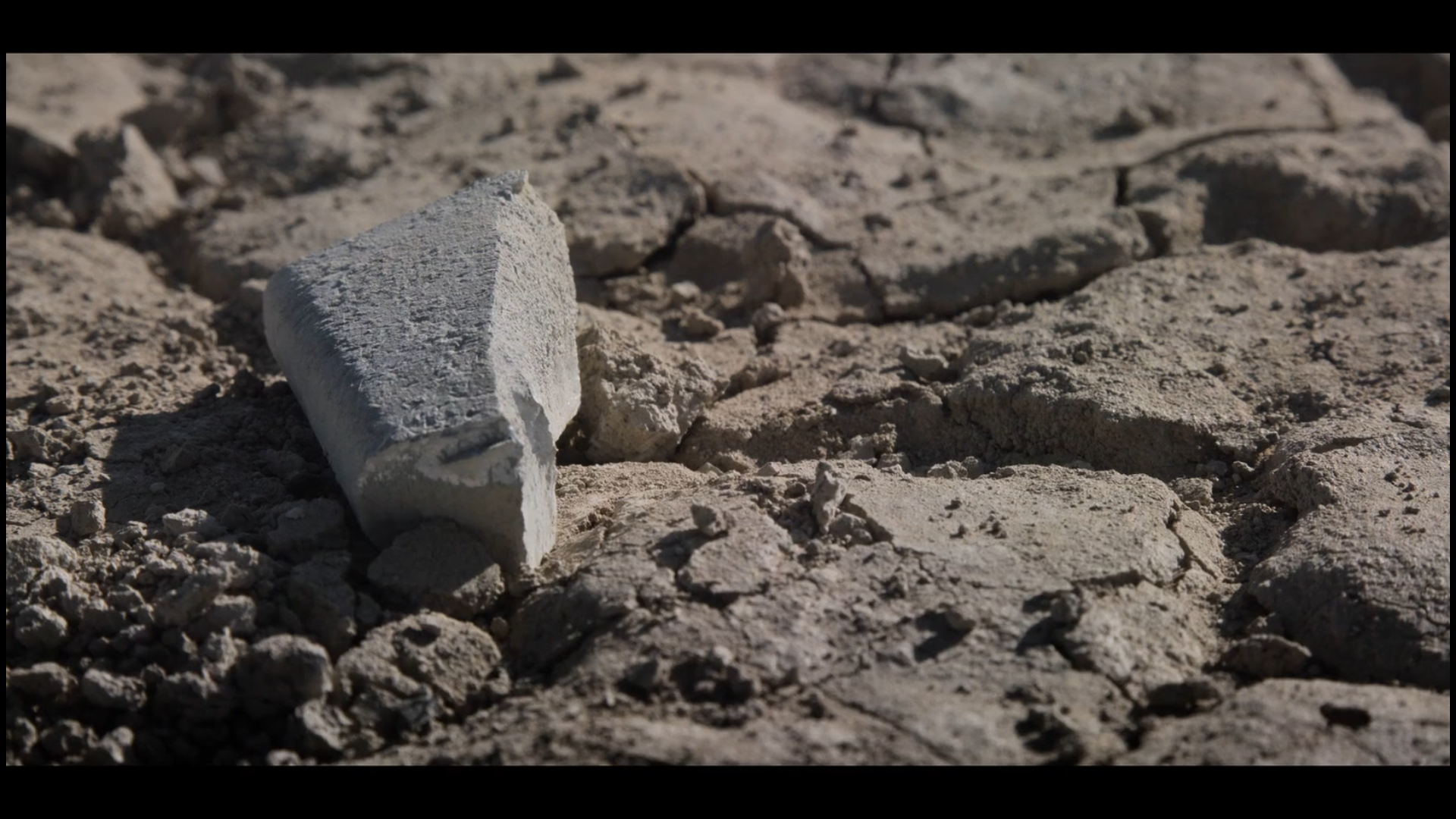
In the film we learn that the aluminum nose wheel of the car fractured, presumably after contacting something along the track such as an embedded rock which may not have been visible to those responsible for clearing the track. Multiple pieces of the nose wheel were found along the 5 mile section of the track we are told, however the vibration of the vehicle didn't seem to occur until the 6 mile mark and this doesn't make sense. That aside, had the front wheel struck a rock and fragmented as a result, it would seem that the exact point of failure would be readily apparent given that the imprint left by the wheel on the desert surface would have changed and thus the alleged rock could be easily located, so why then is it only assumed that a rock was the catalyst for the crash?
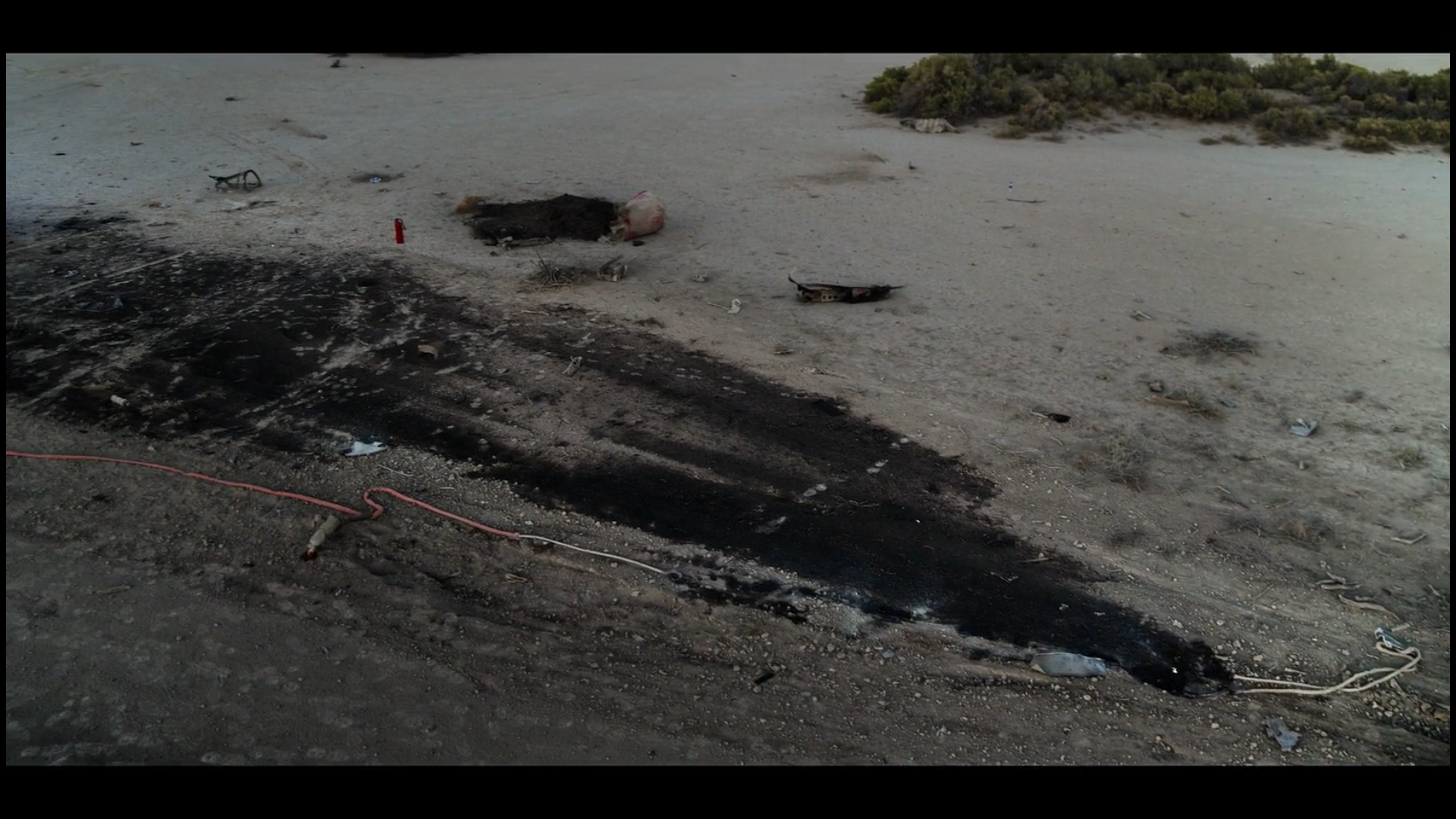
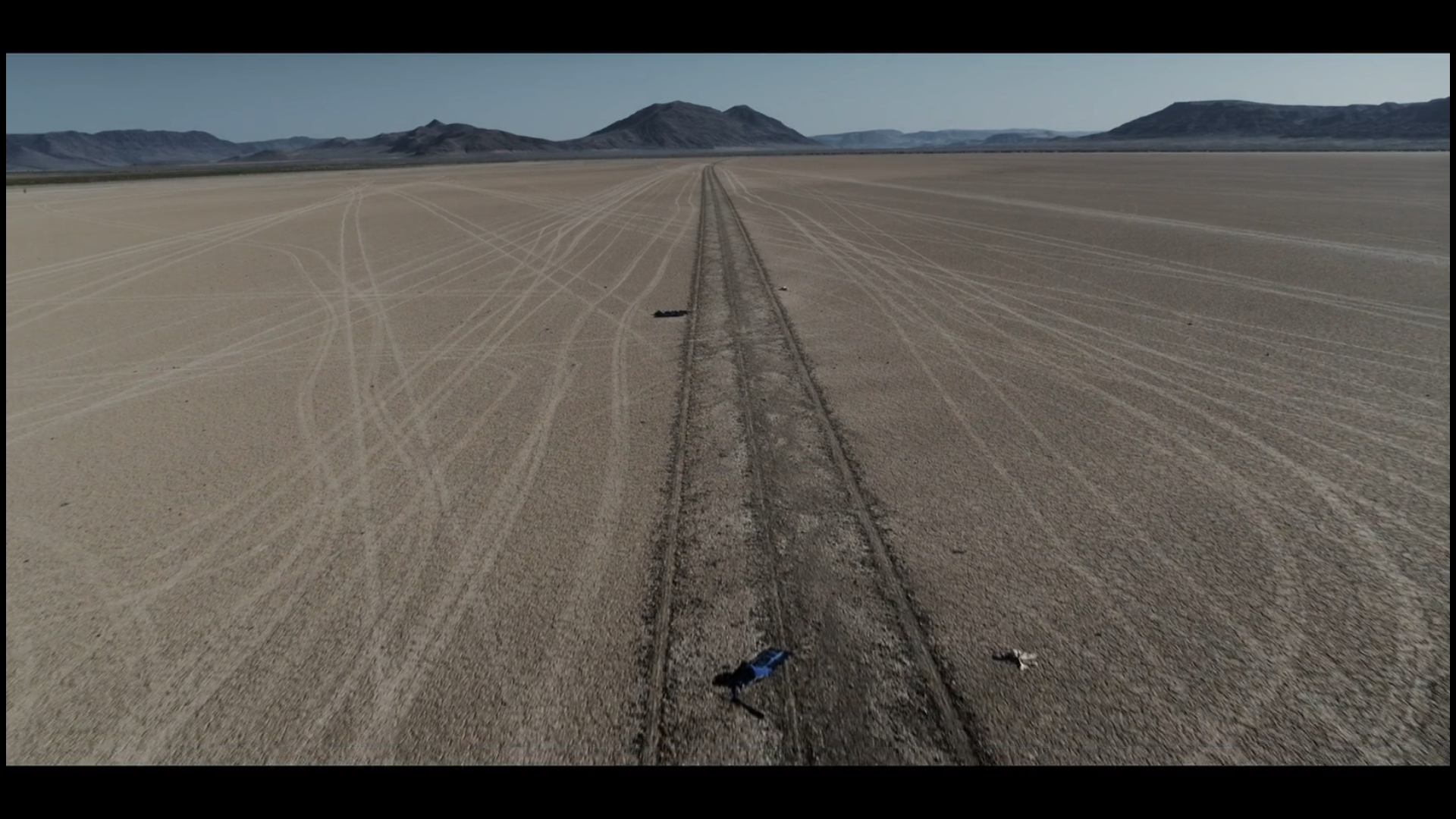
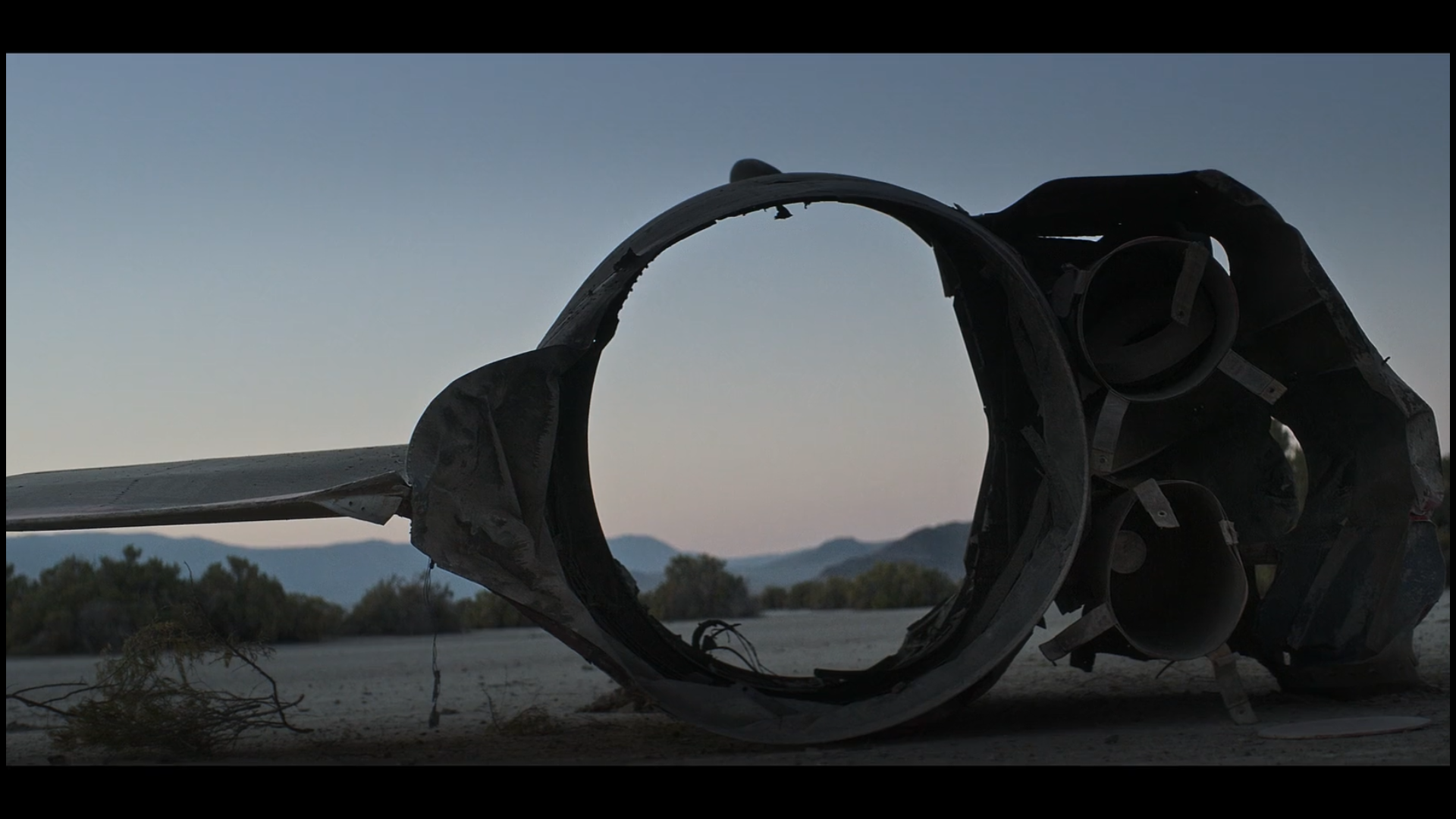
More debris was found scattered elsewhere along the track, miles before the crash site which is well off in the distance.
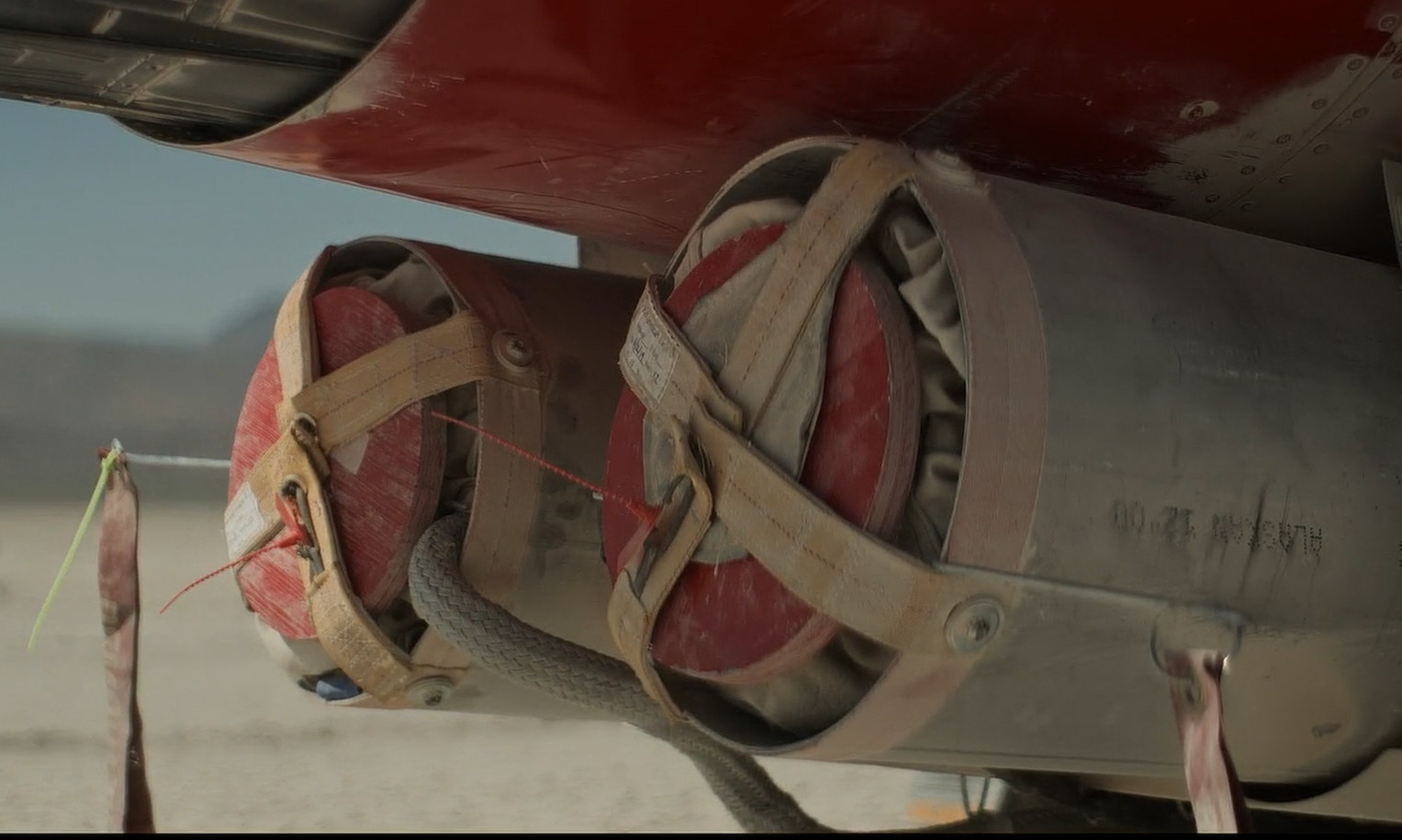
In this image we see that the parachutes were secured in their canisters by 4 straps which snapped together to form a cross over the canister end caps. The force from whatever mechanism was used to deploy the parachutes would cause the snaps to pop open as the chutes were ejected. This is not an uncommon affair for securing parachutes for various vehicles and it has proven to be a very reliable method for packaging and deploying parachutes, so why there were multiple failures in this case is baffling.
One of the parachutes seems to have been found well before the crash site. Unless the tether was compromised by debris striking it, or by some other condition or force, it is highly unlikely that it would have broken in its midst from excessive drag of the parachute being deployed, even at a high speed. The most likely point of failure in the system would likely be where the tether terminates on either end and given that the parachute was burned, it is safe to assume that it provided little or no drag force, further reinforcing that the tether was severed by other means. Also we do not hear Jessi make any mention of one or both parachutes being deployed early which indicates that she apparently wasn't aware they had been deployed.
As you may have surmised by now, the obvious question left unanswered and untouched by the documentary is whether one or both parachute tethers were impacted by fragments from the nose and/or mid wheels, the force of which presumably could have both dislodged one or both of the parachutes as well as cut their tethers. Was the reckless decision to leave the tethers exposed to the air stream the reason for Jessi's death? We simply don't know.
Another possibility is that the vibration of the vehicle, caused by the fractured front wheel, dislodged one or both parachutes from their canisters or caused some other component failure. In the documentary we learn from one of the NAE team members that the parachutes were deployed while the engine was throttled up, yet the vibration didn't occur until Jessi throttled down the engine which suggests that desert debris may have caused the parachutes to deploy before the engine was throttled down.
Another possibility, albeit an uncomfortable one, is that Jessi was to blame. At 1:34:02 during the cockpit video portion of the documentary we see Jessi's left hand pull the throttle back as she begins the shutdown process. Immediately the vibration starts after which it appears Jessi may have throttled the engine up again, though this is not confirmed by a gauge on the instrument panel which seems to measure some aspect of the engine, perhaps fuel pressure or fuel delivery. Others have speculated that the gauge may have failed due to the vibration, however i can see no evidence of that in the video (the gauge needle does not jump to its minimum or maximum position), or perhaps fragments from the front wheel penetrating the fuselage and damaged some related component. Jessi then flips one or both of the toggle switches to deploy the parachutes, though the obvious problem here is that, if indeed Jessi re-opened the throttle before deploying the parachutes, the hot engine exhaust would have burned them. In one sense this scenario seems difficult to accept due to Jessi's ability to operate under great pressure (she was a race car driver, after all) and her familiarity with the NAE vehicle. On the other hand, i suppose it could have been a gut reaction to reverse what she thought may have caused the vibration, so when she decreased the throttle and noticed the vibration, she may have intended to briefly increase it again to see whether the problem could be alleviated. If we assume this is what happened, is it then possible, in the midst of a terrifying situation, she forgot that she had opened the throttle when she deployed the parachutes?
Another possibility, or perhaps probability, comes from one of the people who was there that fateful day and who had access to the evidence. This person tell us that fragments of the front wheel penetrated the electronics bay and, if that is the case, this presumably could have caused the parachutes to deploy mid-run, but again, the problem here is one of timing; we don't seem to know exactly when the parachutes were deployed.
On her final record run- the front wheel assembly failed and as she decelerated just past the end of the run, it came apart and went up into the electronics/mechanical bay behind her seat and caused the accident. There was nothing that she could do and she did everything perfect. I don't know that this is anyone's business and it has been hard for me to talk about, but I have been asked about several false narratives lately that she had done something wrong and I can't live with anyone saying that anymore. I was in the safety vehicle beside her as she was slowing down when the accident happened, I watched the accident live as well as the onboard footage that was recovered. I can 100% tell you beyond any doubt that she did everything exactly as she was supposed to.
Whatever the case, in my mind the obvious problems with the parachutes and their insufficiently protected tethers was due to some very poor design decisions which i'm tempted to attribute to negligence and and that negligence may have contributed to the crash.
Valerie Thompson, another well known female racing driver, joined the NAE team as a driver prior to Jessi, but then left the team, apparently due to safety concerns which she alluded to during an interview. That a race driver like Valerie would pass up such an incredibly lucrative opportunity due to safety concerns suggests that those concerns were substantial.
According to others far more knowledgeable than i regarding land speed record vehicles, this "car" would have never passed a required safety inspection in order to run at a safer site like the Bonneville Salt Flats where room is more abundant, one reason being the exposed parachute tethers. Because of this the team was forced to utilize more dangerous tracks including the one in the Alvord Desert which i think was clearly too short for a delicate vehicle with a history of critical problems attempting to set a land speed record.
I don't for a minute think that discussions about safety are being dismissed in regards to the Alvord Desert Crash.
About seven or ten (?) years ago on this site Ed and others were discussing trying to get permission to run on the Alvord Desert.
As a native Oregonian who has never been to the site I pulled out a map and later posted that the nearest city of any size (think Hospital, Airport, etc.) was Lakeview, Oregon about a hundred miles west and requiring driving into Nevada to reach. The Alvord desert is used by Hang Glider and Wind Sailor's along with others and has limited if any patrol by the BLM, State or County Police. I tried to convince Ed and others who posted what I saw as a disaster waiting to happen.
In the end it isn't particularly difficult for me to place the bulk of the blame on the vehicle owners and engineers, and i don't think there's any doubt that they deserve the lions share of that blame, however given Jessi's extensive experience with racing and safety, and having been warned to not drive this vehicle, and given that she apparently had a several premonitions of what was to happen in dreams, it is ultimately only Jessi that is to blame for choosing to undertake such a risk. Accepting that risk was entirely her decision and as someone who has carelessly risked my own life in the pursuit of a thrill, i can certainly understand why she choose to do so. As Jessi implied, one has not lived a full life if it was a life lived free of risk. She did however have what seems to be serious concerns regarding the safety of the vehicle, to the point where she was apparently reconsidering her decision to backup her record run that fateful day. Jessi's partner, Terry Madden, wrote the following:
I really don't know how I feel about this at all as no record could ever be worth her not being here, but it was a goal that she really wanted - and as hard as it is for me to even look at the car without crying. I'm so proud of her. She woke up that morning to an alarm saying "lets make history" and we had an absolutely amazing day. On the morning run she broke her previous top speeds and we went back to the trailer and had a long heart to heart - she had a few things that were bothering us safety wise and I told her I would support her no matter what she decided to do. That afternoon we booked a house in Lake Tahoe for the next night, and she decided she was going to run that one last afternoon run to back up her record and then walk away from it for good and let her back up driver go for the overall world record instead of her. That was to be the last time she ever got in that car.
I don't want to criticize the people who worked on this project more than necessary. Those i have seen in various videos seem like really good people and they certainly did not treat Jessi as a sacrificial lamb. Ed Shadle, the original owner and primary driver of the vehicle before he died of cancer, had gone substantially faster in the NAE than Jessi would. There was indeed a massive amount of thought, engineering, hardship, sweat and money that was poured into the project, however in my opinion they started with a vary flawed concept. Aircraft are designed to be light, not to survive crashes, and given the many critical mechanical problems that were experienced over the years, you have to wonder if a catastrophic end wasn't set in stone at the outset. That said, if you remove all the risk, what's the point of going fast and breaking records?
I filed a public records information request with the Harney County Sheriff's Office asking for all available video of Jessi's final run, both from within the vehicle as well as that captured from the external cameras, as well as the telemetry data. I was offered nothing other than the police report which is useless since no serious investigation seems to have been preformed. The NAE team has been suspiciously quiet regarding the crash and i find that to be rather strange. There should be no reason to withhold evidence from the public unless perhaps they feel responsible for Jessi's death which is entirely possible given the shortcuts they took in developing this project. This "car" was indeed a death trap and they damn well knew it, yet they chose to roll the dice and so, too, did Jessi.
As previously mentioned, i don't believe i ever knew of Jessi until i watched The Fastest Woman On Earth and yet i'll miss the light she emanated, as will so many others. In my research for this article i ran across several people who knew and/or worked with her, or who were, or are currently involved in land speed racing and in nearly every case they wished that she rest in peace. Bullshit! I don't think Jessi will rest at all. I think she'll go even faster!