Product Review: MOTU M2 USB AMP/DAC Audio Interface
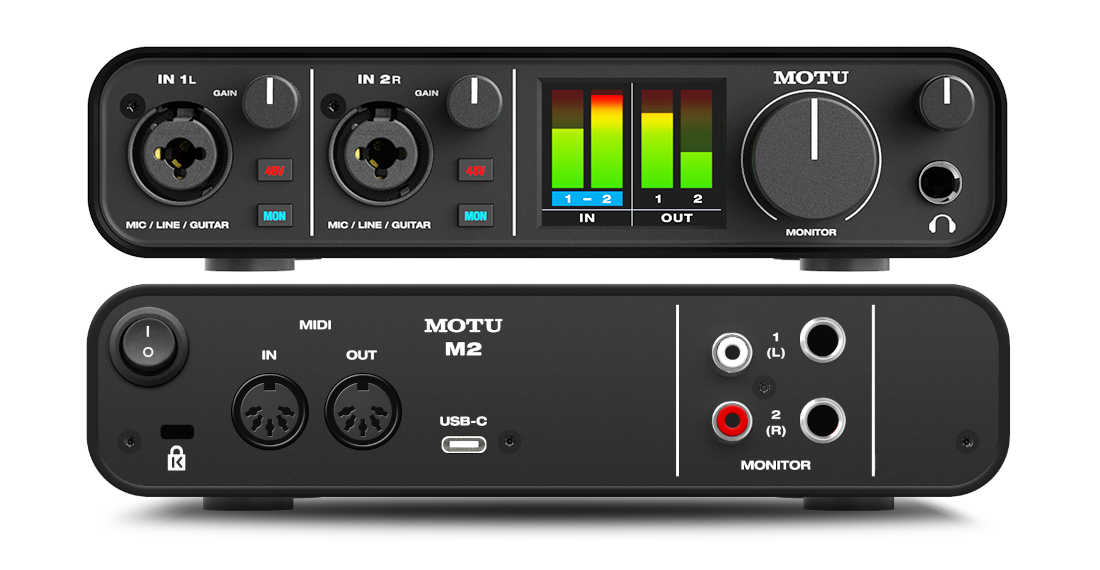
The MOTU M2 audio interface is a 2 channel, USB bus powered AMP/DAC with electronics and features typically not found in its price range. I paid U.S. $199 for it in early 2022 and it looks like the price remains unchanged.
Notable features of the M2 include a physical on/off switch, buttons to enable/disable phantom power for each microphone input, buttons to enable/disable monitoring for each microphone input, digital volume controls which eliminate all noise when changing volume levels, and stereo LCD input and output level meters, though they lack a decibel scale.
The MOTU M2, made by the U.S. based company MOTU, has garnered tons of positive reviews, however it's not perfect in my opinion. My comments will not be from the perspective of an audiophile since i don't consider myself to be a member of that elusive club. Instead i'll cover some of the basics along with my impressions and experience with using it on a GNU/Linux OS. If you want the impressions of an extremely knowledgeable, unbiased, hyper-geek audiophile, i'd suggest turning to Julian Krause who reviewed the M2 specifically in the first video and compared it with 11 other popular audio interfaces in its class in the second video (spoiler: the M2 is the winner).
Video: MOTU M2 USB-C Audio Interface - REVIEW and Measurements!
Video: Interface Headphone Amp Comparison (Focusrite, Behringer, Audient, Motu, SSL, NI, and Steinberg)
Audio hardware on a Linux desktop OS seems to be a bit of a hit or miss affair and the MOTU M2 is no exception. With PulseAudio, which made its appearance in 2004, i had some issues getting the MOTU working properly, however those problems were eventually solved with the PipeWire audio subsystem.
PipeWire is a project that aims to greatly improve handling of audio and video under Linux. It provides a low-latency, graph-based processing engine on top of audio and video devices that can be used to support the use cases currently handled by both PulseAudio and JACK. PipeWire was designed with a powerful security model that makes interacting with audio and video devices from containerized applications easy, with support for Flatpak applications being the primary goal. Alongside Wayland and Flatpak, we expect PipeWire to provide a core building block for the future of Linux application development.
In my case i use Manjaro Linux ('Arch for dummies' as i affectionately call it) on a scratch-built desktop PC along with PipeWire, the WirePlumber session manager and EasyEffects. My microphone is a Senal MC24-ES shotgun. For monitors i use the PreSonus Eris speakers and for headphones, it's the HIFIMAN Sundara planar magnetics. Given what i've learned about audio, i guess i would classify my setup as something around the 'advanced novice' or 'budding audiophile' level.
Regarding audio hardware, it seems to me that you can spend a little and get a little, or spend a moderate amount and get 'good', but exceeding 'good' requires an expenditure that is completely disproportionate to the perceived increase in sound quality. The instant 'audiophile' is injected into the mix, prices skyrocket at a rate far exceeding sound quality.
For music, it's strictly lossless for me and i prefer the FLAC format. Having worked long and hard on a Bash music processing script for Linux, and learning a lot about the different formats in the process, i am soooo done with the horrible MP3 format, though this is largely due to technical reasons rather than sound quality. My advice is to dump the MP3 format everywhere you can unless storage space is a deciding factor.
Back to the task at hand, i don't have a lot to add to Julian's review. I think the reputation of the MOTU M2 is very well deserved. The build quality is very good, the knobs are silky smooth and don't produce any static when adjusted (they're digital), the feature set is pretty darn good and the quality of the sound and electronics exceeds that of most and perhaps all audio interfaces in its class and price range, outperforming even some more expensive models from other manufacturers. As i mentioned earlier however, it's not perfect.
My gripes with the M2 are few and minor and by no means are they a reason to avoid it, but i do have a few:
- Switching between outputs, such as from speakers to headphones, requires lowering the volume on one output and increasing it on the other. It would have been nice to have a switch along with a 'ramp up' function to slowly increase the volume over a few seconds.
- No db scale on the LED meters, but the screen is colored so it's hardly a problem. More importantly, the M2 actually has meters which is unusual at this price point.
- Contrary to Julian's comment regarding the amp, i feel like it's a wee bit weak with the Sundara (32 ohm impedance) since the unit is powered only by the USB bus, the power output of which seems to vary among hardware and so this may or may not be problematic for some folks. On the plus side however, no separate power supply is needed.
- Rather than disabling my mic in the OS when i'm not using it, i use the phantom power button on the M2, however it's located just below, and very close to, the mic gain knob which means it's easy to unintentionally change the gain when whacking the button.
- While the LED level meter display is well lit, none of the controls are lit, the exception being when the monitor or phantom power buttons are engaged.
- MOTU doesn't offer firmware updates which can be installed using a Linux OS.
One reason why i bought the M2 is because i wanted to lower the noise floor of my microphone and i'm pretty happy in that regard. Another was to replace the two prior amps i had, the Schiit Hel 2 and the Mayflower ARC MK2, both of which have an 1/8" mic jack and are oriented toward gamers. If by chance you're in the market for a "gaming" headphone amp (an amp with a mic input jack), i'd highly suggest avoiding both the Mayflower ARC and the Schiit Hel since they both have issues and, more importantly, are at about the same price point as the superior MOTU M2. Both the Hel and ARC pale in comparison with regard to features, connectivity, build quality and sound quality. That said, if you're dead set on a so-called "gaming" headphone amp (which offers exactly nothing over the MOTU M2), the Hel may be the better option.
Now, more on the Linux part of all this...
Linux desktops represent a plethora of non-trivial problems. Between unethical hardware manufacturers failing to supply open-source drivers, the sound processing software problems and the often anemic drivers in the Linux kernel, the potential for headaches looms and so is the case with audio hardware on Linux from what i'm seeing. If you're lucky, and i think it is likely you would be, you'll plug in the M2 and it will just work since it does not require any special driver and isn't built for any specific OS. If luck eludes you however, troubleshooting will ensue. The good news is that there are solutions for many/most problems regarding hardware compatibility issues of any kind on Linux and the Arch wiki is a good place to start regardless of what flavor of Linux you're using.
In my case (Manjaro) the M2 just worked... and then one day, due to a package upgrade, it didn't. While the solution was a most simple one, and one which is no longer relevant, discovering it consumed about 2 days of my time. If you have trouble with audio hardware on Linux, here's some commands that may be helpful for diagnosing the problem yourself or preparing to ask for help on the web. Some of these are OS specific and some are PipeWire specific:
$ hwinfo --sound
$ pactl info
$ pactl list sinks
$ alsa-info.sh --help
$ aplay -l
$ pw-top
$ journalctl --user-unit pipewire-pulse.service
$ journalctl -xe | grep pipewire
$ journalctl -f
I suppose some sort of an obligatory conclusion is in order in the interest of providing a graceful exit to this somewhat unorthodox review, so with that in mind...
Buy it!
If you're in the market for a reasonably priced, high quality headphone and speaker amp with mic inputs and plenty of additional connectivity which performs exceedingly well given its price, the MOTU M2 is hard to beat. As mentioned, it is a no-brainer compared to the Schiit Hel 2, the Mayflower ARC MK2, or any other "gaming" headphone/speaker amp i researched and the price is very competitive. There's a reason why so many people like this unit and it's a well justified one in my considered opinion.