Although i continue to recommend the Firefox web browser for technical reasons, i hold nothing but contempt for the Mozilla corporation. To understand why this is we'll explore what Mozilla is and where it spends its money, along with some of the highly controversial decisions it has made and unethical projects the company has involved itself in.
Some of us may tend to associate the free, open-source software (FOSS) community with individuals or small organizations that selflessly give away their work while expecting little or nothing in return. While this perception is indeed accurate in many cases, it is wildly inaccurate with regard to Mozilla. A closely knit compilation of multiple companies, Mozilla is a billion dollar entity which rakes in hundreds of millions of dollars annually, the vast majority of which is generated as a result of their partnerships with various ethically challenged and proprietary search engine companies, primarily Google but many others as well.
Other offensive entities Mozilla has, or currently partners with, include Microsoft, Telefónica, LG Electronics, Sony, Verizon, Cisco and Cloudflare. While partnering with tech companies may not raise ones eyebrows, a clearer sense of Mozilla's core values and goals can be understood when one considers the political organizations to which they donate millions of dollars, much of which is provided by donations which the company solicits. These radical, left-leaning organizations include the Omidyar Network, the Ford Foundation, a funder of domestic terrorist groups, the Open Society Foundation, also a funder of domestic terrorist groups run by billionaire George Soros, the McKensie Mack Group, a global black and non-binary led "social justice" organization, the Action Research Collaborative, a politically connected "social justice" organization created by the New York State Legislature and run out of Cornell, and the New Venture Fund which funds only left of center organizations. Did you know that your donations to Mozilla are being used largely to fund their political agendas rather than funding the development of Firefox? As a matter of fact, Mozilla has substantially reduced the money that flows to Firefox development. For further details regarding some of these political partnerships and more, i highly suggest reading the research published by Bryan Lunduke in his article, Firefox Money: Investigating the bizarre finances of Mozilla (archived copy).
These kinds of political and Big Tech partnerships could not be more at odds with statements Mozilla has made in its manifesto, including "Committed to you, your privacy and an open Web" and the current "Mozilla puts people before profit". Mozilla claims to be a privacy and free speech advocate while simultaneously cultivating relationships with a laundry list of corporations, networks and foundations which have zero regard for privacy or freedom and, as a matter of fact, are feverishly working to erode both. If you do not wish to fund Mozilla's radical political agendas, i highly suggest disabling all of the search engine plugins that ship with Firefox and use sanitized versions instead or, better yet, use those that respect your privacy.
As a result of Snowden, many are now painfully aware that governments, "intelligence" communities and Big Tech are closely and constantly monitoring our web activities and selling, analyzing or storing the data they collect. Because of the partnerships it forms, Mozilla is very much complicit in these activities. Following is an excerpt from an article on unixsheikh.com titled So-called modern web developers are the culprits:
Google Chrome currently dominates the market share of web browsers. This is a problem because Google, being the advertisement company it is, are planing to implement the deceitful and threatening Manifest V3.
Some people naively look towards Mozilla Firefox as the "savior" and alternative to the Chrome hegemony. Maybe that's because of the way it previously saved the Internet from the "evil dominance" of Microsoft Explorer. The problem is that Mozilla is extremely mismanaged. In 2018 Mozilla got $435.7 million in revenue from search engines who pay to be the default search option in Firefox in different parts of the world, mainly Google, but also Yandex and Baidu. Still, in 2020 Mozilla cut about 25% (250 people) of its global workforce, blaming the corona virus impact on economies as something that "significantly impacted their revenue". Yet, Mozilla had received more [than] enough money. In 2018 Mozilla's top executive was paid $2.4 million and his payments has more than doubled the last five years!
Mozilla is NOT the "trusting" organization it used to be. If Mozilla is going to survive, the management needs to be fired ASAP with no compensation what so ever, products that nobody wants need to be stopped and Mozilla needs to be limited to its core competence, not only so that it can survive on less revenue (perhaps by donations only), but also so focus can be where it needs to be.
The Mozilla Foundation is a non-profit that owns the taxable subsidiary, Mozilla Corporation. The Foundation was launched in 2003 with financial and other assistance from AOL and the Mozilla Corporation was created two years later. It is the latter that controls the source code for Firefox.
I started using Firefox shortly before version 1.0 hit the streets in 2004. Back then Firefox seemed to cater to a small but devoted audience comprised of people who appreciated the ability to customize the browser beyond what most other browsers offered. Indeed it was a very hackable browser in that almost every element of its graphic interface, as well as its core functionality could be extensively modified without having to dig in to its source code. While Firefox still remains one of the most customizable web browsers, Mozilla began restricting what users and add-on developers could do with the adoption of the Web Extension API in 2015 and again with the release of Firefox Quantum in 2017.
The release of Quantum presented a very different user interface which was styled to look remarkably similar to Google Chrome and this caused quite a stir within the Firefox community. The uniqueness of Firefox was lost in the minds of many disillusioned users who had preferred it because it wasn't Google Chrome. The fallout continued as Mozilla caused several non-trivial headaches for add-on developers by changing the Application Programming Interface (API) several times, eventually settling on the Web Extension API which is far less capable than the older XUL/XPCOM API, albeit far less risky as well. As a result several frustrated add-on developers threw up their hands in disgust and thus the community suffered yet another hit with the loss of their work. Further controversy would soon follow.
It has become quite apparent to me (and others) that the goals of the Mozilla Foundation clash with the ethics of some of the developers writing code for Firefox. While at least a portion of the developer community has a strong regard for user privacy, decisions at the corporate level have made it abundantly clear that they are quite willing to sacrifice privacy in return for financial gain and market share. Some of these decisions have resulted in well deserved and severe backlashes from the community and it seems management is rather incapable of apologizing for their blunders. It seems obvious that the driving force behind many of the errant decisions by management is the perceived need to compete with Google Chrome which is by far the most popular web browser at this time. Note however that 'popular' is not necessarily synonymous with 'good'.
Another issue that has caused numerous concerns regarding the ethics at Mozilla is the fact that Firefox has long shipped with several controversial 'system add-ons' and "features" which are installed by default without notifying the user. Worse, these add-ons do not appear in the extensions management interface (about:addons) and therefore there is no obvious way for the average user to disable or remove them, or even be aware they're installed at all in some cases. As we shall see, these system add-ons have been used for highly controversial purposes, including the mass collection of user generated data.
Just ten days after taking the job, Brendan Eich has resigned as CEO of Mozilla after sparking outrage over his donation to an anti-same-sex marriage campaign.
In 2008, Eich donated $1,000 to California's Proposition 8 campaign. Prop 8 was a ballot initiative that sought to make same-sex marriage illegal in the state. News of Eich's donation was first made public in 2012, but attracted a new wave of attention last week when Eich was promoted to CEO from his previous job as chief technology officer.
There is actually a lot more to this story than meets the eye and frankly i find it a little odd that a donation to Prop 8 by Eich, who co-founded Mozilla, would be used against him six years later in what may have been a coup d'état. Nevertheless, this incident upset many "sensitive" users (typically anyone that begins a sentence with "i feel") but i would submit that their reasons were not entirely justified.
Mozilla, the maker of the popular web browser Firefox, recently announced that it still plans to follow through on its controversial plan to sell advertisements on "sponsored tabs."
Mozilla's original plan, introduced in February, called for new "Directory Tiles" to be added on a new tab for new users. In the past, these tiles were left blank until they were customized with recommendations based on a user's browsing history. Mozilla planned to sell these tiles to companies as sponsored ads, much to the chagrin of Firefox users.
[...]
In other words, Firefox plans to sell ad space on its tabs to monetize its user base of over 450 million users, who account for 17% of all web browsers used worldwide.
2015 - Mozilla removes ability to select a local file as the new tab page
Citing "security" concerns, Mozilla removed the ability to load a local HTML file as the new tab page in Firefox 41, effectively forcing users to install yet another potentially insecure add-on to replace removed functionality or jump through technical hoops to work around the stupidity. Mozilla surely bet on the fact that most users, especially on the less technical side, wouldn't employ such solutions. There is little doubt that the real reason this idiotic change was forced upon users, while still allowing to open local file:/// links from the address bar, was so that Mozilla could plaster links to monetized resources and add telemetry to the new tab page.
The complaints center around the fact Pocket is a proprietary third-party service, already exists as an add-on, and is not a required component for a browser. Integrating Pocket directly into Firefox means it cannot be removed, only disabled.
Mozilla notes that it is necessary to transfer address bar content to Cliqz servers to power the functionality. This means, essentially that anything that is entered into the address bar, either automatically or manually, is transferred to Cliqz.
In other words, users who are selected for participation are opted-in automatically in the data collecting.
What Mozilla did when they partnered with Cliqz was a flagrant violation of user privacy and trust, period. Not having learned anything from their monumentally stupid decision, the thick-headed jackasses at Mozilla corporate would follow up just a few months later with another gem of an idea.
Mozilla's latest Firefox release is better than Google Chrome, both in terms of speed and violating user's privacy.
[...]
As Drew pointed out, this extension is actually an alternate reality Game. This extension will invert text that matches a list of Mr. Robot-related keywords like "fsociety", "robot", "undo", and "fuck", and does a number of other things like adding an HTTP header to certain sites you visit.
While this might sound fun, doing it without end user's consent is a borderline privacy violation.
Ignoring the fact that these 'system add-ons', 'experiments' and 'Shield Studies' are often enabled by default, manipulating HTTP headers for certain websites as the Looking Glass add-on did, was not only possibly breaking web standards, it was compromising the privacy of its users. That they did this without warning them, some of which may have implemented precautions precisely to guard against such concerns, is unforgivable. The community backlash was immediate, widespread and harsh. As a result of the beating they took, Mozilla removed the add-on in the following version of Firefox and reworked their 'Shield Study' rules. As of this writing the Looking Glass add-on is still available on AMO where 17 people gave it a 5 star rating and 52 a 1 star rating (make that 53). Following are some of the comments left by disgruntled users...
Mozilla is not better than Google. It's maybe worse, because we expect it from Google but not from Mozilla. Mozilla has no ethics.
And...
Until today I thought that Mozilla's ethics would forbid this kind of action; indeed, it's the kind of thing I thought Mozilla would actively campaign against. I guess I'm disillusioned now.
I'm also concerned that Firefox is, on a technical level, able to install add-ons without explicit user/administrator approval. This seems like a MAJOR security vulnerability to me.
And...
This blunder is astonishing. It's not just that Mozilla installed it without permission or notification; it's also the implication that the company doesn't understand why this was a mistake. The apologies I've seen so far amount to "We're sorry we got caught. We didn't know better."
I don't like Chrome. And today I don't like Firefox. I have used Firefox from when it was Phoenix version 0.67. Last night I downloaded Vivaldi and Opera, and I will check them out.
Unsurprisingly, Mozilla has never offered a proper apology for its abuse of its users.
Today, we are announcing the Mozilla Information Trust Initiative (MITI)-a comprehensive effort to keep the Internet credible and healthy. Mozilla is developing products, research, and communities to battle information pollution and so-called 'fake news' online. And we're seeking partners and allies to help us do so.
So the company that is "committed to an open web" wants to limit its openness. Mozilla lists a few potential partners they'd like to work with in their authoritarian venture including one of the kings of mainstream news bias and propaganda, The Wall Street Journal, whom Mozilla sees as a "credible news-gathering organization". I have also seen an influx of 'fake news' detection add-ons in the AMO repository being developed by various companies, including The Self Agency, LLC and Trustie, many of which are flagging highly creditable websites, run by battle scarred, independent, investigative journalists, as "fake news".
As Mozilla correctly recognizes, there is indeed a massive amount of misinformation, disinformation and heavily biased information floating around on the Wild World Web, however they conveniently ignore, or are just too stupid to realize the fact that some of the most egregious offenders are the mainstream corporations which they repeatedly partner with, including those that promoted the Iraqi WMD bullshit and subsequent invasion of the country, the regime change wars in Syria and Libya, those frothing at the mouth over the nuclear weapons that Iran doesn't posses and how terrible the elected president of Venezuela was (Chavez) because he wasn't yet another U.S. puppet, and those who have promoted and caused massive economic, personal and social destruction as a result of two years of constant fear-mongering regarding a virus that doesn't exist. To all, it's a big thumbs-up as far as Mozilla is concerned.
The solution to the problem of "fake news" is not censorship and revenue generation under the laughably transparent guise of "community service", but rather to educate people on how to think critically and identify unreliable sources which obviously Mozilla is in no position to do given its desire to partner with those same sources.
Mozilla has positioned Firefox as the champion of privacy and independence on the internet but appears to be increasingly at risk of losing the trust of users.
The latest controversy regarding the company is its implementation of the screenshot feature, which uses clear dark patterns to trick users into uploading screenshots to their online screenshot gallery screenshots.firefox.com, which promoted but does not require the use of your Firefox Account.
The last week has not been great for Mozilla. Last Friday, reports started to come in from around the world that installed add-ons would not verify anymore and were disabled as a consequence. Users could not download and install add-ons from Mozilla AMO anymore either.
Latest figures show that about 60% of Firefox users install add-ons in the browser; any issue affecting 60% of the user base, especially when it comes to personal choices made by those users, is as critical as it gets.
"We put people over profit", and "a product to support user privacy", they say. However, with their decision to make Cloudflare the default DNS provider for DNS over HTTPS, they are definitely not supporting user privacy or putting people over profit.
DNS over HTTPS is by itself bad enough, and highly criticized with good reason, but by combining it with a US based company like Cloudflare makes it even worse.
[...]
Last, but not least, Cloudflare is an American company subject to American law, a law that pretty much undermines the foundation of any kind of privacy.
[...]
Mozilla should be ashamed! They are promoting Firefox as a product to support user privacy, yet at the same time they make Google the default search engine in the browser and Cloudflare the default DNS over HTTPS resolver.
Some users of the latest stable version of the Firefox web browser for Android have received a push notification by Mozilla itself. The notification links to this blog post on the Mozilla website in which the organization states that it has joined the StopHateForProfit coalition and asks its users to do the same. One of the goals of the campaign is to pressure Facebook into controlling certain content more tightly on the platform.
The user selection process is unclear, but it is possible that the notification is limited to users from the United States.
Public reactions to the use of non-browser-related push notifications by Mozilla have been negative mostly, see user reactions on Twitter or Reddit for example.
The Mozilla blog post that the 'arkenfox' article links to contains the following:
Facebook is still a place where it's too easy to find hate, bigotry, racism, antisemitism and calls to violence.
Today, we are standing alongside our partners in the #StopHateForProfit coalition and joining the global day of action to tell Facebook CEO Mark Zuckerberg: Enough is Enough.
Will you join hundreds of thousands of people who stand with this coalition to tell Zuckerberg to #StopHateForProfit?
No one should be using any of the data-slurping, perception engineering, mainstream social media platforms as far as i'm concerned, but that isn't the point here. This is yet another example of Mozilla attempting to censor content on the web. Perhaps these corporate clowns ought to stick to focusing on software development and keep their noses out of politics and forego interfering with free speech. That Mozilla used the built-in push notification capability of Firefox to spam users with a personal political message is yet another shocking blunder in an ever growing list.
RegretsReporter is yet another Mozilla Foundation initiative to tamper with the flow of information on the web, this one aimed at YouTube and packaged in the form of a browser extension. From the description:
The RegretsReporter extension gives you a way to report YouTube Regrets-videos that YouTube has recommended to you that you end up wishing you had never watched. This extension is part of a crowdsourced data campaign to learn more about what people regret watching, and how it was recommended to them. RegretsReporter is only for people who are 18 or older. By contributing your data to our research you can help us improve one of the most powerful recommendation engines on the planet.
James Corbett explains what Mozilla is doing with RegretsReporter.
In yet another stunning, radical, woke, communistic, left-sided display of utter contempt for free speech and mind-numbing hypocrisy, Mozilla published a blog post following the defeat of President Trump in the fraudulent 2020 U.S. presidential election:
There is no question that social media played a role in the attempted coup and take-over of the US Capitol on January 6.
As a point of fact, many protestors were allowed, and even encouraged by the capital police to enter the capital building. There was no insurrection, nor any attempt to overthrow the government, but facts are obviously irrelevant in the minds of those who have difficulty figuring out what their gender is.
Since then there has been significant focus on the deplatforming of President Donald Trump. By all means the question of when to deplatform a head of state is a critical one, among many that must be addressed. When should platforms make these decisions? Is that decision-making power theirs alone?
...says the corporation who states that "we work to ensure the internet remains a public resource that is open and accessible to all", except of course when someone says something these corporate scumbags don't agree with.
But as reprehensible as the actions of Donald Trump are, the rampant use of the internet to foment violence and hate, and reinforce white supremacy is about more than any one personality. Donald Trump is certainly not the first politician to exploit the architecture of the internet in this way, and he won't be the last. We need solutions that don't start after untold damage has been done.
The hypocrisy is unbelievable. The same bunch of radical left retards who support and fund violent, self-admitted Marxists and extremist domestic terrorists such as Antifa and Black Lives Matter who spent 2020 inciting, burning, bombing, looting, beating, killing and defunding police departments, are now labeling largely peaceful protestors as "violent white supremacists", thus lumping them in with the many thousands who didn't enter the building and the 10's of millions who simply supported Trump (had they bothered to do any research at all they would have voted 3rd party instead).
Once again the feedback from Firefox users was harsh, or what feedback can be found since social media has censored much of it:
your bio is literally "We work to ensure the internet remains a public resource that is open and accessible to all."
-- Seb Parker
I've used your browser for 15 years. No more. I'm out.
-- Piping Hot Centrist Takes
Uninstalling Firefox as soon as I wake up tomorrow, thanks for the tip.
-- Oyvey Shutitdownstein
Uninstalled
-- Illinoisance
What the ACTUAL fuck?
Thank GOD I stopped using Firefox.
You people have categorically fucking LOST it.
-- Hastes
When i tried to submit feedback using Firefox's 'Help' menu, i found that Mozilla had disabled the feedback system and it continued to be disabled for many months. I have to wonder if this was done to avoid having their fee-fees hurt by brigades of irate users.
What do you do when your market share is tanking and your biggest competitor (Google) is pushing you out of the playground? Well, if you're Mozilla you continue to rely on infrastructure happily provided by the evil, data-slurping darling of the U.S. "intelligence" community for so-called "cloud" services of course (cloud = someone else's computer).
Mozilla reacted quickly to the emergency situation and has resolved it. It may have damaged the reputation, and some users may have switched to a different browser in the process. Mozilla should ask itself whether it is a good idea to rely on cloud infrastructure that is operated by its biggest rival in the browser space. Some Firefox users may also suggest that the organization looks at the browser's handling of requests to make sure that unnecessary ones, e.g. the reporting of Telemetry or crash reporting, will never block connections the user attempts to make in the future.
Just in case all of the above Mozilla bashing wasn't enough for you, i highly recommend reading the Mozilla - Devil Incarnate article for another very long list of problems with Mozilla and Firefox.
Not content with rate of their plummeting market share, the ding-bats at Mozilla decide to display pop-up ads for "their" VPN service, Mozilla VPN. In reality the service is powered by Mullvad and apparently offers no technical advantage over using Mullvad directly and actually may compromise privacy since, according to what i've read, Mozilla is routing the traffic through its own infrastructure before turning it over to Mullvad. The only 'advantage' i'm aware of is that Mozilla charges its customers near double what Mullvad charges if you go with a monthly subscription. How's that for "putting people first and fighting for online privacy"?
Mozilla launched its VPN service in 2020 officially. It is using the infrastructure of Mullvad, a VPN service known for its focus on privacy. It is an optional service that users may subscribe to.
The advertisement that users saw in Firefox came out of the blue for users. Some noted that their browser windows became unresponsive for a time before the popup ad was shown to them.
The advertisement itself promoted Mozilla VPN with a 20% discount code. The ad did not include a close option that would permanently shut it down, only a "not now" option, which many companies seem to favor these days to give their users no option to say "no, thanks".
A bug report was created on Bugzilla, Mozilla's official bug tracking site. Several threads on Mozilla's official support site were also created, see here and here as examples.
User ben153 wrote: "Today Firefox stopped altogether and dimmed the entire window and popped up a "Try the Firefox VPN" message. I use Firefox specifically to get away from disruptive, intrusive violations like that. This needs to be removed immediately and never ever happen again. It's completely antithetical to the core values of Firefox."
A forum moderator replied to the threads, stating "Firefox is committed to creating an online experience that puts people first, as such we quickly stopped running the ad experience, and are reviewing internally".
The answer infuriated some users even further. They said that "an online experience that puts people first" should never show ads in this way or use the "not now" option as the only option to close prompts.
Mozilla appears to have suspended the advertisement campaign right now. Long-time users of the browser may be reminded of the Mr. Robot campaign that Mozilla ran in 2017 in Firefox.
In addition to the many other dumb things Moz has done in the past [...] they now want to re-assume (?) control over what add-ons are allowed to run on what domains. They've long been disabling add-ons at addons.mozilla.org using a preference they already have to disable add-ons per domain (extensions.webextensions.restrictedDomains) but apparently that's not enough for some unknown reason, so 2 new prefs were added in v115:
Raymond "gorhill" Hill, maker of the world's most popular content blocker uBlock Origin received two emails from Mozilla recently about his Firefox add-on uBlock Origin Lite.
Mozilla says that it has reviewed the extension and found violations. The following claims were made:
The extension is not asking for consent for data collecting.
The extension contains "minified, concatenated or otherwise machine-generated code".
There is no privacy policy.
As a consequence, Mozilla disabled the extension on the Firefox Add-ons Store.
Hill refuted all three claims that Mozilla made on the GitHub repository stating that the extension is not collecting any data, that there is no minified code in uBlock Origin Lite, and that there is a privacy policy.
He admitted further that he does not "have the time or motivation to spend time on this nonsense" and won't react to the allegations made or appeal the decision.
In a follow-up, Hill criticized the "nonsensical and hostile review process" that put added burden on developers. Mozilla disabled all versions of the extension except for the very first one. It still flagged the extension for the very same reasons, but nevertheless decided to keep the outdated version up.
The [install] screen gives you three options: pinning Firefox to your taskbar, setting it as your default browser, and importing data from another browser.
All of these options were enabled by default, an aggressive approach by Mozilla, who has previously criticized Microsoft for utilizing preselected options.
This change is tied to another experiment aiming to streamline the onboarding process for users downloading Firefox through special marketing campaigns.
If a user chooses to install Firefox from a campaign that advertises it as the "default browser," Firefox will now handle the setup process automatically, removing the need for manual configuration.
The feature works by embedding a unique identifier, called an attribution campaign ID, into the lightweight "stub installer" that you download from Mozilla's website.
Mozilla, the organisation behind the popular Firefox web browser, has come under intense scrutiny following its Terms of Use and Privacy Policy updates. Critics argue that these changes grant Mozilla extensive rights over user data while simultaneously overreaching restrictions on user behaviour. After the furore, Mozilla issued a clarification explaining how it will process user data.
One of the most alarming aspects of the updated terms is Mozilla's claim to a "non-exclusive, royalty-free, worldwide license" over any data users input into Firefox. This wording suggests that Mozilla could use any information typed, uploaded, or otherwise interacted with within the browser at its direction.
Critics, including The Lunduke Journal, argue that this clause could apply to sensitive or proprietary information, raising serious privacy and security concerns.
Let's start with recent events. On February 26th, Mozilla announced a new agreement between Mozilla and Firefox users. For the first time, Firefox would come with Terms of Use in addition to the Privacy Policy , which also received updates.
[...]
Among these, Firefox's new Terms are a little weird-maybe more than a little. In addition to shocking brevity, they include this passage:
"You give Mozilla all rights necessary to operate Firefox, including processing data as we describe in the Firefox Privacy Notice , as well as acting on your behalf to help you navigate the internet. When you upload or input information through Firefox, you hereby grant us a nonexclusive, royalty-free, worldwide license to use that information to help you navigate, experience, and interact with online content as you indicate with your use of Firefox."
Like all legalese, there is room for interpretation here. But it's notable just how much room this policy leaves. Specifically, the "When you upload or input information through Firefox" sentence. As written, that would seem to be everything sent via the browser. Why is this clause necessary?
Again Mozilla shoots itself in one of its two left feet. One commenter over at LWN.net remarked:
I would actually like to use Firefox instead of Chrome, but with all the shady things they have pulled, I might as well give my data to Google directly and at least get a better (I suppose) browser in return. I really don't get what their endgame is supposed to be. No users at all anymore?
2025 - Firefox developers further hide built-in add-ons
There are several built-in add-ons (aka 'system add-ons') that ship with Firefox which are installed without users' knowledge or consent and they have been used for controversial purposes in the past. On a Linux box, they used to be located in /usr/lib/firefox/browser/features/ where they could be easily deleted, but as of Firefox version 138, they've been incorporated into the /usr/lib/firefox/browser/omni.js compressed archive which makes them less accessible. Once omni.js is extracted, one can find them in /chrome/browser/builtin-addons/. While those which the user may not want can be deleted from the omni.js archive, they will be reinstalled when Firefox is updated.
While there is a group policy for handling these built-in add-ons, it didn't seem to work for me in the past and i'm not sure it's applicable to Firefox versions 138+.
The future
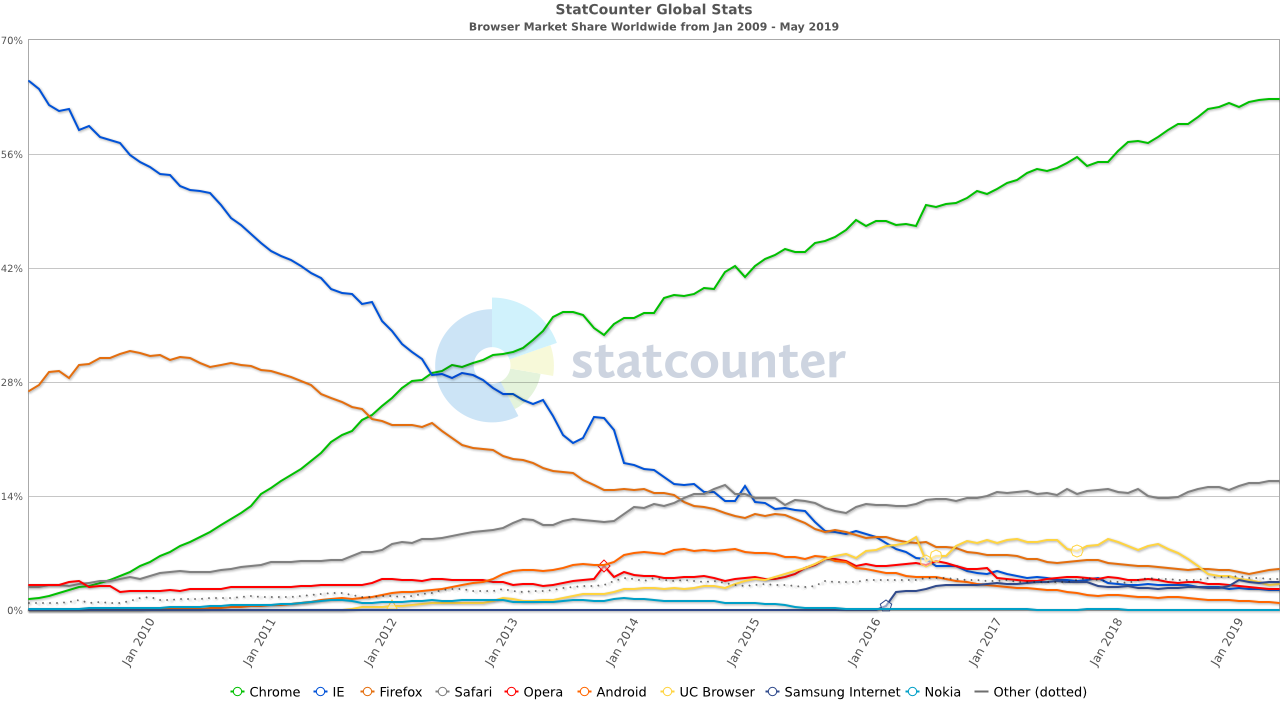
Meanwhile the market share for Firefox continues to sink like a lead balloon and the corporate clowns calling the shots at Mozilla continue to grapple for any and all gimmicks they can dream-up in an attempt to reverse the downward spiral they themselves are at least partly responsible for. I don't think the hardcore audience that has stuck with Firefox through the years cared much about how popular it was, but like any corporate behemoth, what their users care about is largely inconsequential. Growth, market share, revenue and influence over future of the web are the primary drivers of the Mozilla Foundation and this has clearly caused the gap between it and its user base to widen. The question is, how much more self-inflicted bloodletting can Mozilla endure before they pull the plug on Firefox. Mozilla cut its workforce by 250 in Aug. '20, allegedly due to the non-existent SARS-CoV-2 virus. I think Mozilla has stabbed its users in the back enough times that the demise of the Firefox brand may be imminent absent a radical shift in corporate clown-world ethics.
All that said, and as much as i hate to admit it, i currently use and recommend Firefox because i think it is still better suited to security and privacy hardening than anything the mainstream competition has to offer, at least for the time being. If you'd like to consider another web browser however, read Choose your browser carefully. I might also recommend LibreWolf which is a soft fork of Firefox which focuses on privacy by stripping out some of the stupidity that Mozilla bakes in. LibreWolf ships with uBlock Origin preinstalled and custom preferences which seem to be based on those provided by the venerable 'arkenfox' project.