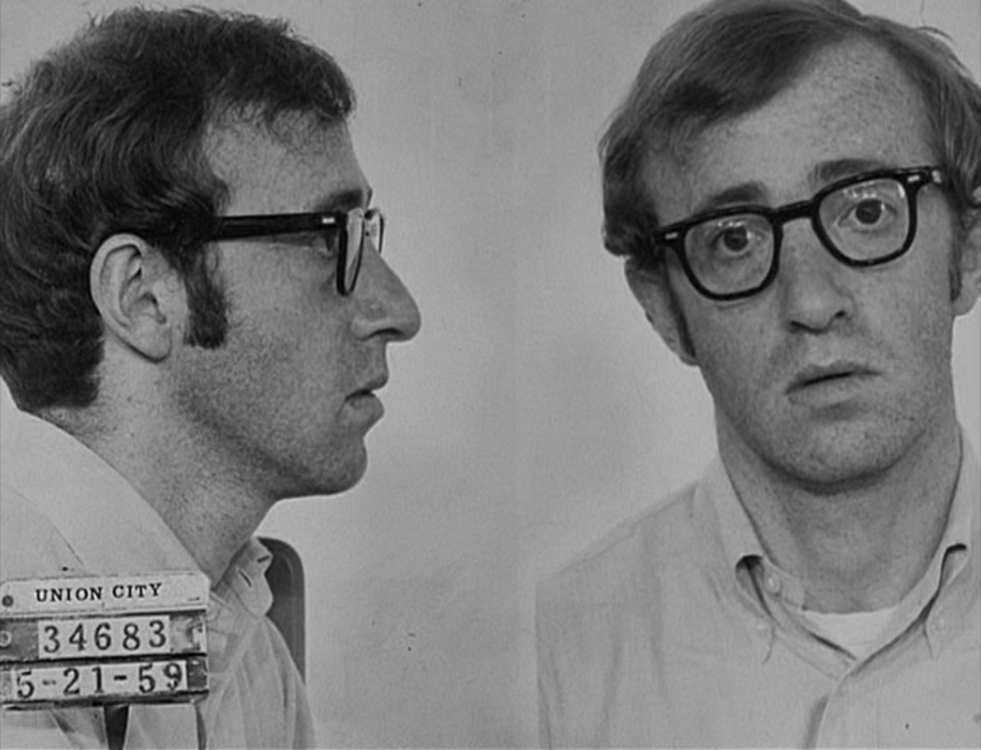
Allan Stewart Konigsberg (Woody Allen) and his stepdaughter, Soon-Yi Previn, who he would later marry.
"I have never been so upset by a poll in my life. Only 22% of Americans now believe "the movie and television industries are pretty much run by Jews," down from nearly 50% in 1964. The Anti-Defamation League, which released the poll results last month, sees in these numbers a victory against stereotyping. Actually, it just shows how dumb America has gotten. Jews totally run Hollywood." -- Joel Stein, 'Who runs Hollywood? C'mon', Los Angeles Times, 19-Dec-2008 (source)
Allan Stewart Konigsberg, better known as Woody Allen, has engaged in an unknown number extracurricular activities with young girls over a period of decades. Woody is of course an iconic and highly regarded Hollywood filmmaker. He is also a pedophile who seems to have no regret for the damaged women he's left in his wake, yet rather than being prosecuted and thrown in prison like you or i would be if convicted of such a heinous crime, he is honored and showered with awards, even holding a record for the most Academy Award nominations for Best Original Screenplay according to Wikipedia.
Woody Allen is a symptom of the unspoken rot that infects Hollywood. When one studies the underbelly of the Jewish-Zionist controlled entertainment industry, degenerate behavior seems to be closer to the norm rather than the exception. Wikipedia attempts to downplay the pedophile nature of Allen by suggesting there was only one incident and that the "experts" found the charges to be without merit.
In August 1992, American filmmaker and actor Woody Allen was accused by his adoptive daughter Dylan Farrow, then aged seven, of having sexually molested her in the home of her adoptive mother, actress Mia Farrow, in Bridgewater, Connecticut.[1] Allen has repeatedly denied the allegation.[2][3]
When the allegation was made, Allen and Mia Farrow had been in a 12-year relationship and had three children together: two adopted, Dylan and Moses, and one biological, Satchel (now known as Ronan Farrow).[1] The sexual abuse is alleged to have taken place eight months after Farrow learned that Allen had a sexual relationship with another of her adoptive daughters, Soon-Yi Previn, who married Allen in 1997; Previn was a first-year undergraduate and 21 years old when Farrow eventually found out about the relationship.[4] Allen alleged that the relationship prompted Farrow to concoct the molestation allegation as an act of vengeance.[3] The Connecticut State's Attorney investigated the allegation but did not press charges.[5] The Connecticut State Police referred Dylan to the Child Sexual Abuse Clinic of Yale-New Haven Hospital, which concluded that Allen had not sexually abused Dylan and the allegation was likely coached or influenced by Mia Farrow.[6][7] The New York Department of Social Services found "no credible evidence" to support the allegation.[8]
What Wikipedia fails to mention is the extent of Allen's pedophile activities which spans decades, including marrying his own step-daughter.
What's your favorite Woody Allen movie? Before you answer, you should know: when I was seven years old, Woody Allen took me by the hand and led me into a dim, closet-like attic on the second floor of our house. He told me to lay on my stomach and play with my brother's electric train set. Then he sexually assaulted me. He talked to me while he did it, whispering that I was a good girl, that this was our secret, promising that we'd go to Paris and I'd be a star in his movies. I remember staring at that toy train, focusing on it as it traveled in its circle around the attic. To this day, I find it difficult to look at toy trains.
For as long as I could remember, my father had been doing things to me that I didn't like. I didn't like how often he would take me away from my mom, siblings and friends to be alone with him. I didn't like it when he would stick his thumb in my mouth. I didn't like it when I had to get in bed with him under the sheets when he was in his underwear. I didn't like it when he would place his head in my naked lap and breathe in and breathe out. I would hide under beds or lock myself in the bathroom to avoid these encounters, but he always found me. These things happened so often, so routinely, so skillfully hidden from a mother that would have protected me had she known, that I thought it was normal. I thought this was how fathers doted on their daughters. But what he did to me in the attic felt different. I couldn't keep the secret anymore.
When I asked my mother if her dad did to her what Woody Allen did to me, I honestly did not know the answer. I also didn't know the firestorm it would trigger. I didn't know that my father would use his sexual relationship with my sister to cover up the abuse he inflicted on me. I didn't know that he would accuse my mother of planting the abuse in my head and call her a liar for defending me. I didn't know that I would be made to recount my story over and over again, to doctor after doctor, pushed to see if I'd admit I was lying as part of a legal battle I couldn't possibly understand. At one point, my mother sat me down and told me that I wouldn't be in trouble if I was lying - that I could take it all back. I couldn't. It was all true. But sexual abuse claims against the powerful stall more easily. There were experts willing to attack my credibility. There were doctors willing to gaslight an abused child.
After a custody hearing denied my father visitation rights, my mother declined to pursue criminal charges, despite findings of probable cause by the State of Connecticut - due to, in the words of the prosecutor, the fragility of the "child victim." Woody Allen was never convicted of any crime. That he got away with what he did to me haunted me as I grew up. I was stricken with guilt that I had allowed him to be near other little girls. I was terrified of being touched by men. I developed an eating disorder. I began cutting myself. That torment was made worse by Hollywood. All but a precious few (my heroes) turned a blind eye. Most found it easier to accept the ambiguity, to say, "who can say what happened," to pretend that nothing was wrong. Actors praised him at awards shows. Networks put him on TV. Critics put him in magazines. Each time I saw my abuser's face - on a poster, on a t-shirt, on television - I could only hide my panic until I found a place to be alone and fall apart.
Last week, Woody Allen was nominated for his latest Oscar. But this time, I refuse to fall apart. For so long, Woody Allen's acceptance silenced me. It felt like a personal rebuke, like the awards and accolades were a way to tell me to shut up and go away. But the survivors of sexual abuse who have reached out to me - to support me and to share their fears of coming forward, of being called a liar, of being told their memories aren't their memories - have given me a reason to not be silent, if only so others know that they don't have to be silent either.
Today, I consider myself lucky. I am happily married. I have the support of my amazing brothers and sisters. I have a mother who found within herself a well of fortitude that saved us from the chaos a predator brought into our home.
But others are still scared, vulnerable, and struggling for the courage to tell the truth. The message that Hollywood sends matters for them.
What if it had been your child, Cate Blanchett? Louis CK? Alec Baldwin? What if it had been you, Emma Stone? Or you, Scarlett Johansson? You knew me when I was a little girl, Diane Keaton. Have you forgotten me?
Woody Allen is a living testament to the way our society fails the survivors of sexual assault and abuse.
So imagine your seven-year-old daughter being led into an attic by Woody Allen. Imagine she spends a lifetime stricken with nausea at the mention of his name. Imagine a world that celebrates her tormenter.
Are you imagining that? Now, what's your favorite Woody Allen movie?
Mia Farrow has had a big life. After a childhood in Beverly Hills and London with a movie-star mother, Maureen O'Sullivan, and a writer-director father, John Farrow, she became famous at 19 on Peyton Place, a sensation when it premiered in 1964 as television's first prime-time soap opera. She lost her virginity to Frank Sinatra and married him when she was 21 and he was 50. Two years later he served her divorce papers on the set of Rosemary's Baby, the Roman Polanski film for which she earned a Golden Globe nomination in 1968. Frank and Mia stayed close, however, even when she was married to the composer-conductor Andre Previn, whom she divorced in 1979, after having three sons and adopting three at-risk Asian daughters. She also continued to see Sinatra throughout her 13-year relationship with Woody Allen, which suffered a jolt when she found lurid photographs taken by Allen of Soon-Yi Previn, one of her adopted daughters, then a sophomore in college, on the mantel in Allen's Manhattan apartment. Only a month earlier, in December 1991, Allen had formally adopted two of Mia's children, 15-year-old Moses and 7-year-old Dylan, even though he was in therapy for inappropriate behavior toward Dylan. In August 1992, after disappearing with Allen in Mia's Connecticut country house and reappearing without underpants, Dylan told her mother that Allen had stuck his finger up her vagina and kissed her all over in the attic, charges Allen has always vociferously denied.
Some reporters have drawn connections between the press' grudging evolution on Cosby and a painful chapter in my own family's history. It was shortly before the Cosby story exploded anew that my sister Dylan Farrow wrote about her own experiences - alleging that our father, Woody Allen, had "groomed" her with inappropriate touching as a young girl and sexually assaulted her when she was 7 years old.
Being in the media as my sister's story made headlines, and Woody Allen's PR engine revved into action, gave me a window into just how potent the pressure can be to take the easy way out. Every day, colleagues at news organizations forwarded me the emails blasted out by Allen's powerful publicist, who had years earlier orchestrated a robust publicity campaign to validate my father's sexual relationship with another one of my siblings.
[...]
In fact, when my sister first decided to speak out, she had gone to multiple newspapers - most wouldn't touch her story. An editor at the Los Angeles Times sought to publish her letter with an accompanying, deeply fact-checked timeline of events, but his bosses killed it before it ran. The editor called me, distraught, since I'd written for them in the past. There were too many relationships at stake. It was too hot for them. He fought hard for it. (Reached by The Hollywood Reporter, a spokesperson for the Los Angeles Times said the decision not to publish was made by the Opinion editors.)
When The New York Times ultimately ran my sister's story in 2014, it gave her 936 words online, embedded in an article with careful caveats. Nicholas Kristof, the Pulitzer Prize-winning reporter and advocate for victims of sexual abuse, put it on his blog.
Soon afterward, the Times gave her alleged attacker twice the space - and prime position in the print edition, with no caveats or surrounding context. It was a stark reminder of how differently our press treats vulnerable accusers and powerful men who stand accused.
[...]
I believe my sister. This was always true as a brother who trusted her, and, even at 5 years old, was troubled by our father's strange behavior around her: climbing into her bed in the middle of the night, forcing her to suck his thumb - behavior that had prompted him to enter into therapy focused on his inappropriate conduct with children prior to the allegations.
[...]
Here is exactly what charges not being pursued looked like in my sister's case in 1993: The prosecutor met with my mother and sister. Dylan already was deeply traumatized - by the assault and the subsequent legal battle that forced her to repeat the story over and over again. (And she did tell her story repeatedly, without inconsistency, despite the emotional toll it took on her.) The longer that battle, the more grotesque the media circus surrounding my family grew. My mother and the prosecutor decided not to subject my sister to more years of mayhem. In a rare step, the prosecutor announced publicly that he had "probable cause" to prosecute Allen, and attributed the decision not to do so to "the fragility of the child victim."
My mother still feels it was the only choice she could make to protect her daughter. But it is ironic: My mother's decision to place Dylan's well-being above all else became a means for Woody Allen to smear them both.
Woody Allen says his 23-year relationship with Soon-Yi Previn worked because of their previous parent-child relationship.
"I'm 35 years older, and somehow, through no fault of mine or hers, the dynamic worked," the 79-year-old director told NPR in an interview published Wednesday. "I was paternal. She responded to someone who was paternal."
"She deferred to me, and I was happy to give her an enormous amount of decision-making just as a gift and let her take charge of so many things," he continued. "She flourished. It was just a good luck thing."
But the couple holds contradictory views on why their relationship worked. Previn, 44, told Time in 1992, "To think that Woody was in any way a father or stepfather to me is laughable."
Woody Allen is wrapping up a new movie. Just kidding: He doesn't make new movies. What he's editing now, "A Rainy Day in New York," about a college-age love triangle, could, like any of his movies, instead be titled "A Woman Gets Objectified by a Man." This, in his view, is the pinnacle of art, its truest calling and highest purpose. Especially when it involves young women who are compelled to lackluster men merely by the gravity of the men's obsession.
[...]
Allen's work is flatly boorish. Running through all of the boxes is an insistent, vivid obsession with young women and girls: There's the "wealthy, educated, respected" male character in one short story ("By Destiny Denied: Incident at Entwhistle's") who lives with a 21-year-old "Indian" woman. First, Allen's revisions reduce her to 18, then double down, literally, and turn her into two 18-year-olds. There's the 16-year-old in an unmade television pitch described as "a flashy sexy blonde in a flaming red low cut evening gown with a long slit up the side." There's the 17-year-old girl in another short story, "Consider Kaplan," whose 53-year-old neighbor falls in love with her as the two share a silent, one-floor-long elevator ride in their Park Avenue co-op. There's the female college student in "Rainy Day" who "should not be 20 or 21, sounds more like 18 - or even 17 - but 18 seems better." That script includes a male college student but gives no description of his age. Another of Allen's male characters, in a draft of a 1977 New Yorker story called "The Kugelmass Episode," is a 45-year-old fascinated by "coeds" at City College of New York. In the margin next to this character's dialogue, Allen wrote, then crossed out, "c'est moi" - it's me.
[...]
He would rather talk about his art and his fiction than his life or his culture. But behold how quickly his writing veers in a draft of "My Apology," a short story: "Of all the famous men who ever lived, the one I would most like to have been was Socrates. Not just because he was a great thinker, because I have been known to have some reasonably profound insights myself, although mine invariably revolve around two eighteen year old cocktail waitresses and some rope handcuffs." (In the published version, the object of desire has become a stewardess whose age is omitted.) In another draft, titled "My Speech to the Graduates," he complains that "science has failed us. True, it has conquered many diseases, broken the genetic code, and even placed human beings on the Moon. And yet when a man of eighty is left in a room with two eighteen year old cocktail waitresses, nothing happens." A draft of "The Lunatic's Tale" contains a long section about a man cheating on his wife with a "photographer's model" before concluding that "the point is, my needs required the best of two women."
He does not restrict these urges to fictional women. In a fake interview, he writes of real-life actress Janet Margolin, who had roles in "Annie Hall" and "Take the Money and Run": "Occasionally I was forced to make love to her to get a decent performance. I did what I had to but in a businesslike way." (Margolin died in 1993.) And here is a riff he wrote to caption an imagined photo of the Spanish socialite Nati Abascal, who worked with Allen in "Bananas": "Could she act? Yes, I learned and especially in her defense. She blocked my [hand] as I reached for her thigh and brought her knee up sharply into my groin as we discussed show business . . . I pulled a contract out of my pocket and we both signed, but not until I told her about the sexual obligation that was a part of the job of any actress who worked with me." Allen goes on: "I came to appreciate her body for what it was as time went by, namely, a girl's body . . . Soon she got used to my ways. Aware of my position as father figure on the set (a director is just that) I allowed her to come to me with her problems. When she never showed up, I came to her with mine."
[...]
Sometimes Allen is in his work, but even when he isn't, his characters are often obvious stand-ins. In a story that takes place wholly in the mind of a man named Moses Rifkin, he writes: "Unlike the Jewish girl - the shiksa is not guilt-ridden - not a complainer - she is abandoned, fun-loving, and above all promiscuous. The shiksa will perform any sex act."
[...]
In one extremely revealing project that he never made, he seemed to show his real self. "The Filmmaker" is a screenplay co-written by Allen and Marshall Brickman in the late '60s or early '70s. It's about a down-and-out documentarian who has a side gig shooting porn "like Fellini" but only because he is "some kind of film genius who needs the cash." This fictional filmmaker's name? Woody Allen.
[...]
Fake Woody falls in love with Jennifer the only way Real Woody and his co-author know how to write it: at first sight, cosmically, instinctively, overwhelmingly and then - as if it's flattering - obsessively, in the pattern of that 53-year-old man in the elevator, who ends up sending his 17-year-old neighbor a valentine. The contents of that love note are instructive to Allen's sense of courtship and, in creative terms, to his sense of how chemistry forms between two characters. It reads, in full: "I saw you only briefly the other day and have not stopped thinking of you. Though we shared a casual and fleeting elevator ride - one floor, to be exact - I fear my life can never be the same. Please meet me for cocktails one night this week. I live in the penthouse. I implore you not to say no. If it turns out for one reason or another you can never share my feelings than [sic] the worst you will suffer is that I will tell you how lovely you are for the duration of a single martini."
Although the drinking age was raised from 18 to 21 in 1986, at any time in Allen's life it would've been illegal for a grown man to offer a 17-year-old a martini. But this is a man who, at 43, awarded himself 16-year-old Hemingway's first kiss - the actress's herself, not her character's - on the set of "Manhattan." (Afterward, she recalled in a talk show interview, she ran over to cinematographer Gordon Willis and cried, "I don't have to do that again, do I?") He is dressing up crime as art. Hemingway declined to comment for this story.
In many ways, Allen frustrates people because he seems to relish dancing on the edge of the outrage. There's nothing criminal about an 82-year-old's fixation with 18-year-olds, and it's not whip-out-your-penis, button-under-the-desk bad. But it's deeply, anachronistically gross. More than that, he seems not to care about bettering or changing himself in any way. He lives and thinks and creates as he did in the 1970s, nearly a half-century ago. He's a reminder that our future, however woke it becomes, will not be full of social-justice valedictorians quoting James Baldwin and Roxane Gay. There will be 22nd-century dunces lagging by a half-century or more. Allen is worse than an augury of those trolls of tomorrow; he is a model for them, a validation.
In this #MeToo era, a hackneyed moral argument has calcified for loving the art while hating the artist, and dancing around Walter Benjamin's idea that "at the base of every major work of art is a pile of barbarism." Allen looms large in those conversations, given the tragic inception of his current marriage, which began when he started a sexual relationship with his then-girlfriend's teenage daughter (now his wife of two decades). As he later described the affair: "I was paternal. She responded to someone paternal. I liked her youth and energy. She deferred to me."
Put any variation of "teenager" and "sex" in a headline, and you're going to get outrage. Yet sometimes, the nuances of each word get lost in the rush to be horrified. Witness the reaction to Mariel Hemingway's forthcoming memoir "Out Came the Sun," to be published April 7 by Regan Arts (along with a young adult-themed diary, "Invisible Girl"). Fox News published an excerpt titled "Exclusive: Young Mariel Hemingway had to rebuff Woody Allen's advances." Technically, according to the section of the book quoted in the piece, that is true; after the filming of "Manhattan," when she was 18 and he, 44, he asked her to go to Paris with him. But, given the allegations of abuse at age 7 by Allen's adopted daughter Dylan Farrow disclosed in an open letter in 2014, "young" seems misleading at best in this headline.
[...]
The more important question I see being raised by Hemingway is why, exactly, middle-aged men are so entranced with women over half their age. As Hemingway writes in her memoir, "Our relationship was platonic, but I started to see that he had a kind of crush on me, though I dismissed it as the kind of thing that seemed to happen any time middle-aged men got around young women." I'm actually more troubled by what she writes about Bob Fosse, who directed her in Star 80: "I let us into my room. And then, for the next fifteen minutes, I ran rings around the couch while Bob Fosse chased me for purposes of sex."
As girls and young women have become even more sexualized in the ensuing decades since Hemingway was 18, it's important to look at what their takeaway is from the message that they are fair game for men far older than them. Am I saying there's nothing fishy about a man in his 40s, who was already in a position of power as Hemingway's director, trying to seduce her? Of course not.
But the fault here doesn't lie solely with Allen. According to FOX, "She warned her parents 'that I didn't know what the arrangement was going to be, that I wasn't sure if I was even going to have my own room. Woody hadn't said that. He hadn't even hinted it. But I wanted them to put their foot down. They didn't. They kept lightly encouraging me.'"
That to me is just as horrifying as Allen flying to their home to ask if he could take Hemingway to Paris. So let's clarify what it is we are so sickened by when talking about age differences, and recognize that this is symptomatic of more than just Allen being a "dirty old man."
The mainstream media are helping to cover-up the decades of child abuse allegations against filmmaker Woody Allen, just in time for this year's awards season.
Lawyers and friends of are quick to argue that the latest rumors about Allen's sexual preference for young children are designed to destroy what should have been a rewarding awards season.
Afteractionreporting.org reports: But the real truth is that these allegations, these stories, and Allen's history with young women have been a matter of public record for at least 20 years.
Joe Coscarelli at The Daily Intelligencer undertook the unenviable task of rounding up a history of allegations against the actor as well as his inappropriate behavior with-and references to-young women.
[...]
From Jim Jerome's profile of Woody Allen in the October 4, 1976 People Magazine issue:
"I try to have sex only with women I like a lot," Woody explains solemnly. "Otherwise I find it fairly mechanical." (He has little interest in family life: "It's no accomplishment to have or raise kids. Any fool can do it.")
He goes on: "I'm open-minded about sex. I'm not above reproach; if anything, I'm below reproach. I mean, if I was caught in a love nest with 15 12-year-old girls tomorrow, people would think, yeah, I always knew that about him." Allen pauses. "Nothing I could come up with would surprise anyone," he ventures helplessly. "I admit to it all."
From the introduction to Maureen Orth's 1992 Vanity Fair article "Mia's Story": There was an unwritten rule in Mia Farrow's house that Woody Allen was never supposed to be left alone with their seven-year-old adopted daughter, Dylan.
From the September 21, 1992 New York Magazine article "Everything You Always Wanted to Know About Woody and Mia (But Were Afraid to Ask)," acquaintances discuss Allen's behavior toward his daughter:
From the start, Farrow's friends say, Allen seemed "obsessed" by the little girl. He would arrive at Mia's house at six in the morning and sit on the end of Dylan's bed, staring at her until she woke up. He insisted that she be kept up until he got home in the evening to tuck her in. He was reluctant to leave her alone at school. His behavior struck several parents of other children as odd.
From the May 1993 Sun-Sentinel article "Woody Allen, My Pen Pal," writer Nancy Jo Sales discusses her private correspondence with Allen, then 42, when she was a 13-year-old girl. She begins, "The year I was 13, my only friend was a famous man who lived far away and wrote me letters in plain brown envelopes that I told my mother were from "a girl from camp." He wrote:
Dear Nancy,
Hard to believe you're 13! When I was 13 I couldn't dress myself, and here you write about one of life's deepest philosophical problems, i.e., existential boredom. I guess it's hard for me to imagine a 13-year-old quoting anything but Batman - but T. Mann? Anyway, there's too much wrong with the world to ever get too relaxed and happy. The more natural state, and the better one, I think, is one of some anxiety and tension over man`s plight in this mysterious universe ...
Next time you write, if you ever do, please list some of the books you've enjoyed and movies, and which music you've liked, and also the things you dislike and have no patience with. And tell me what kind of place Coral Gables is. What school do you go to? What hobbies do you have? How old are your parents and what do they do? What are your moods like? Are you energetic? Are you an early riser? Are you "into clothes" ... At the moment, I am re- filming some parts of my next film, which have not come out so good.
Best, Woody.
Sales and Allen also met in person when she was young:
"I met Woody only once. I was visiting Manhattan with two older companions on a cold, clammy day, and I had left a note at his building. To my delight he called my hotel 10 minutes later asking me to come over. But at the last minute I became panic-stricken at the thought of seeing Woody Allen in person, knowing that an epistolary relationship is fragile, like a delicate fern that crumples when touched.
"My knees shaking, I finally tottered into his penthouse on a pair of too-tall Katharine Hepburn sandals. I remember how pale his skin was behind the trademark glasses, how translucent he looked, like a corpse or an angel. I couldn`t say a word, and my companions filled in the silence with aimless chatter while Woody, wearing his very same clothes from Annie Hall, sat Indian-style in an armchair, nodding politely and trying to catch my eye."
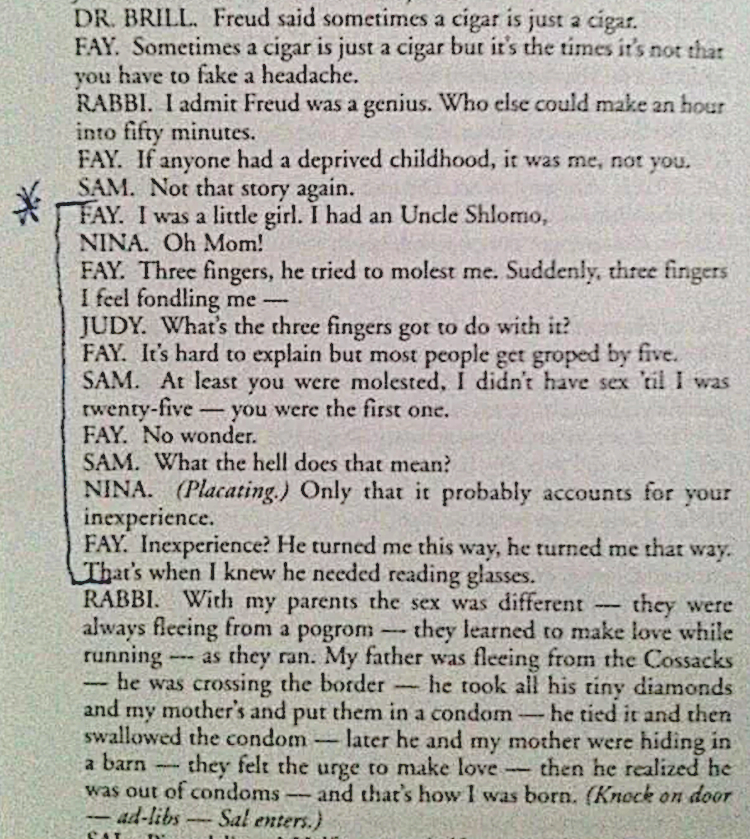
There's also this graphic molestation scene written by Allen in his 2011 play Honeymoon Hotel:
This week, a number of commentators have published articles containing incorrect and irresponsible claims regarding the allegation of Woody Allen's having sexually abused his adopted daughter, Dylan Farrow. As the author of two lengthy, heavily researched and thoroughly fact-checked articles that deal with that allegation-the first published in 1992, when Dylan was seven, and the second last fall, when she was 28-I feel obliged to set the record straight. As such, I have compiled the following list of undeniable facts:
1. Mia never went to the police about the allegation of sexual abuse. Her lawyer told her on August 5, 1992, to take the seven-year-old Dylan to a pediatrician, who was bound by law to report Dylan's story of sexual violation to law enforcement and did so on August 6.
2. Allen had been in therapy for alleged inappropriate behavior toward Dylan with a child psychologist before the abuse allegation was presented to the authorities or made public*.* Mia Farrow had instructed her babysitters that Allen was never to be left alone with Dylan.
3. Allen refused to take a polygraph administered by the Connecticut state police. Instead, he took one from someone hired by his legal team. The Connecticut state police refused to accept the test as evidence. The state attorney, Frank Maco, says that Mia was never asked to take a lie-detector test during the investigation.
4. Allen subsequently lost four exhaustive court battles-a lawsuit, a disciplinary charge against the prosecutor, and two appeals-and was made to pay more than $1 million in Mia's legal fees. Judge Elliott Wilk, the presiding judge in Allen's custody suit against Farrow, concluded that there is "no credible evidence to support Mr. Allen's contention that Ms. Farrow coached Dylan or that Ms. Farrow acted upon a desire for revenge against him for seducing Soon-Yi."
5. In his 33-page decision, Judge Wilk found that Mr. Allen's behavior toward Dylan was "grossly inappropriate and that measures must be taken to protect her." The judge also recounts Farrow's misgivings regarding Allen's behavior toward Dylan from the time she was between two and three years old. According to the judge's decision, Farrow told Allen, "You look at her [Dylan] in a sexual way. You fondled her . . . You don't give her any breathing room. You look at her when she's naked."
6. Dylan's claim of abuse was consistent with the testimony of three adults who were present that day. On the day of the alleged assault, a babysitter of a friend told police and gave sworn testimony that Allen and Dylan went missing for 15 or 20 minutes, while she was at the house. Another babysitter told police and also swore in court that on that same day, she saw Allen with his head on Dylan's lap facing her body, while Dylan sat on a couch "staring vacantly in the direction of a television set." A French tutor for the family told police and testified that that day she found Dylan was not wearing underpants under her sundress. The first babysitter also testified she did not tell Farrow that Allen and Dylan had gone missing until after Dylan made her statements. These sworn accounts contradict Moses Farrow's recollection of that day in People magazine.
7. The Yale-New Haven Hospital Child Sex Abuse Clinic's finding that Dylan had not been sexually molested, cited repeatedly by Allen's attorneys, was not accepted as reliable by Judge Wilk, or by the Connecticut state prosecutor who originally commissioned them. The state prosecutor, Frank Maco, engaged the Yale-New Haven team to determine whether Dylan would be able to perceive facts correctly and be able to repeat her story on the witness stand*.* The panel consisted of two social workers and a pediatrician, Dr. John Leventhal, who signed off on the report but who never saw Dylan or Mia Farrow. No psychologists or psychiatrists were on the panel. The social workers never testified; the hospital team only presented a sworn deposition by Dr. Leventhal, who did not examine Dylan.
All the notes from the report were destroyed. Her confidentiality was then violated, and Allen held a news conference on the steps of Yale University to announce the results of the case. The report concluded Dylan had trouble distinguishing fantasy from reality. (For example, she had told them there were "dead heads" in the attic and called sunset "the magic hour." In fact, Mia kept wigs from her movies on styrofoam blocks in a trunk in the attic.) The doctor subsequently backed down from his contention.
The Connecticut state police, the state attorney, and Judge Wilk all had serious reservations about the report's reliability.
8. Allen changed his story about the attic where the abuse allegedly took place. First, Allen told investigators he had never been in the attic where the alleged abuse took place. After his hair was found on a painting in the attic, he admitted that he might have stuck his head in once or twice. A top investigator concluded that his account was not credible.
9. The state attorney, Maco, said publicly he didhave probable cause to press charges against Allen but declined, due to the fragility of the "child victim." Maco told me that he refused to put Dylan through an exhausting trial, and without her on the stand, he could not prosecute Allen.
10. I am not a longtime friend of Mia Farrow's, and I did not make any deal with her. I have been personally accused of helping my "long-time friend" Mia Farrow place the story that ran in *Vanity Fair'*s November 2013 issue as part of an effort to help launch Ronan Farrow's media career. I have also been accused of agreeing to some type of deal with Mia Farrow guaranteeing that the sexual-abuse allegation against Woody Allen would be revisited. For the record, I met Mia Farrow for the first time in 2003, more than 10 years after the first piece was published, at a nonfiction play she appeared in for a benefit in Washington, D.C. I saw her and Dylan again the next day. That is the last time I saw her until I approached her in April 2013 to do a story about her family and how they had fared over the years. I talked to eight of her children, including Dylan and a reluctant Ronan. There was no deal of any kind. Moses Farrow declined to be interviewed for the 2013 piece.
Out in the leafy suburbs of Woodland Hills, California, in an OK house in an OK neighborhood, the actor Corey Feldman is wandering around, saying he soon might name the name of the man he says raped his like-a-brother best friend and frequent co-star, the late Corey Haim, back in 1985. He's been talking about naming this name for more than seven years now. But each time, Feldman has shied away at the last minute, citing lawsuit fears, further ostracism and derailment of a career already off the tracks, and possible physical harm to him and his family.
[...]
His wife of two years, a tall blonde named Courtney, nods. "People want to kill him. They don't want what he has to say to come out."
"I can tell you that the number-one problem in Hollywood was and is . . . pedophilia," Feldman says, as he often has. "That's the biggest problem for children in this industry. It's the big secret."
One possible, obvious reason for the keeping and hiding of this big secret: No one really wants to hear about children and rape if it involves the nation's number-one source of escapist entertainment. In 2013, Feldman went on The View to talk about how the pedophile numbers are larger than anybody knows and include a ring reaching up into the Hollywood elite that's been shielded for years by the establishment. Barbara Walters looked at him with disbelief, hands clasped across her belly, and snarled, "You're damaging an entire industry," as if to say that Hollywood itself was more valuable than the wrecked lives of a few youngsters.
[...]
About what allegedly happened to Corey Haim, though, Feldman has no doubts. "Not one," he says - much to the unending dismay of Haim's mother, Judy, who says her son was never raped by anyone and that Feldman is saying it happened only be cause he's still jealous of her boy's success, and that he's using Haim's name to scam the public out of crowd-funded money for a movie about industry pedophiles that'll never get made.
"He's desperately trying to destroy my son's history, his image, his memory," says Haim. "It's a very deep jealousy thing, that my son always got first billing. I'm sick of him, dragging my son's name through the mud for nine years. I mean, how shameful. The guy's a liar. The guy's sick. OK?"
To combat Feldman, she and her supporters, and there are quite a few of them, have formed an online gang that's come to be known as the Wolfpack. They produce YouTube videos with titles like "You Lowlife Feldman You Have Gone Too Far This Time" and send out tweets saying, "If longing to see @Corey_Feldman get gang raped in prison is wrong, I don't want to be right," and "I personally will never stop until CF is in prison or mental institution at best."
[...]
"They're plotting against me," he says. "There's been an assault charge pending against me, a labor-board charge, things that are ruining my life. They're trying to get my kid taken away. All this is what I'm up against. These are the stakes. I am fighting for my life. But I'm tired of being victimized and blackmailed. That's why I'm fighting back."
Which is what the film crew is about. He's producing a documentary titled Truth: The Rape of Two Coreys, about the two industry men who allegedly molested him at the age of 14 and about the A-lister and others who allegedly raped or molested his best friend. "We've got about seven [people] who were told firsthand that this person raped Corey," Feldman says, "and they're all being interviewed."
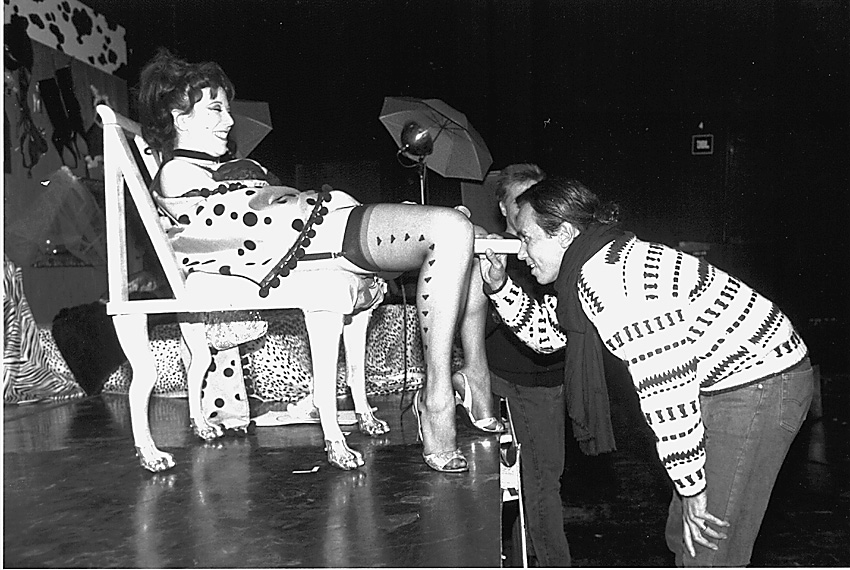
Ellen Steinberg, known as Annie Sprinkle, is a Jewish feminist, porn actress, sexologist, sex worker and lesbian. She is known to masturbate on stage and invite members of the audience to peer inside her vagina with a flashlight and speculum in a display she calls 'Public Cervix Announcement'.
"But as the Jew assimilates, acquires your languages, cultivates a certain intimacy, penetrates into your life, begins to handle your instruments, you are aware that his nature, once confined safely to his own life, now threatens yours." -- Maurice Samuel, You Gentiles, 1924, p. 144 (source)
"Goyim were born only to serve us. Without that, they have no place in the world - only to serve the People of Israel. Why are gentiles needed? They will work, they will plow, they will reap. We will sit like an effendi and eat. That is why gentiles were created." -- Rabbi Ovadia Yosef, head of Shas Council of Torah Sages during a sermon delivered Oct. 2010 in Jerusalem (source)
"We Jews, we, the destroyers, will remain the destroyers for ever. Nothing that you will do will meet our needs and demands. We will for ever destroy because we need a world of our own, a God-world, which it is not in your nature to build." -- Maurice Samuels in You Gentiles by Maurice Samuels, 1942, p. 155 (source)
"Whilst large sections of the German nation are struggling for the preservation of their race, we Jews fill Germany with our vociferations. We supply the press with articles on the subject of its Christmas and Easter. We ridicule the highest ideals of the German nation and profane the matters which it holds sacred." -- Dr. Manfred Reifer, well known leader of the German Jews, in Czernowitzer Allgemeine Zeitung magazine, Sep. 1933, as quoted in Witness to History by Michael Walsh (source)
"Because of the lack of productive capacities of its own, the Jewish Folk cannot carry out the construction of a State, viewed in a territorial sense, but as a support of its own existence it needs the work and creative activities of other nations. Thus the existence of the Jew himself becomes a parasitical one within the lives of other Folks. Hence the ultimate goal of the Jewish struggle for existence is the enslavement of productively active Folks. In order to achieve this goal, which in reality has represented Jewry's struggle for existence at all times, the Jew makes use of all weapons that are in keeping with the whole complex of his character. Therefore in domestic politics within the individual nations he fights first for equal rights and later for superior rights. The characteristics of cunning, intelligence, astuteness, knavery, dissimulation, and so on, rooted in the character of his Folkdom, serve him as weapons thereto. They are as much stratagems in his war of survival as those of other Folks in combat. In foreign policy, he tries to bring nations into a state of unrest, to divert them from their true interests, and to plunge them into reciprocal wars, and in this way gradually rise to mastery over them with the help of the power of money and propaganda. His ultimate goal is the denationalisation, the promiscuous bastardisation of other Folks, the lowering of the racial levy of the highest Folks, as well as the domination of this racial mishmash through the extirpation of the Folkish intelligentsia and its replacement by the members of his own Folk." -- Adolf Hitler in Hitler's Secret Book, New York, Grove Press (source)