A perfect storm: The explosion in the silver market, the consequences for the U.S. economy and a potential escape hatch for us peons (updated 30-Jan-2026)
NOTICE: Given the current volatility in the financial sector and the velocity at which things are moving, i expect to be updating this article often for the foreseeable future. Less significant updates will be covered in separate posts on the front page, while more significant updates will be incorporated here.
UPDATE (30-Jan-2026): Removed all instances of the claim that China placed restrictions on the amount of silver they will allow to be exported beginning in 2026 because such claims appear to be inaccurate.
UPDATE (25-Jan-2026): 'Asian Guy', also known as 'Jon AG', is gone. YouTube removed the original and only channel they posted on, 'Boring Currency', late yesterday or today and left in its place the usual nondescript drivel, "This channel was removed because it violated our Community Guidelines.". Numerous fake and copycat channels still exist on YouTube and elsewhere.
Original URL: youtube.com/channel/UC06M1lDb7vpCj9cp47ncXHQ
First and foremost, do not make financial decisions based on anything i'm saying. I'm more or less a casual observer in all of this. Despite the seemingly horrific journey you're about to embark upon, don't panic and don't make snap decisions.
Let's kick this off by listening to what a well respected investor, Clive Thompson, has to say regarding the history of money and fiat currencies:
WARNING: What I'm about to show you has happened dozens of times throughout history-and it's happening again RIGHT NOW.
According to the U.S. National Debt Clock, the debt is currently around 38 trillion dollars and it is increasing by the hour. That debt amounts to roughly 112 thousand dollars for every U.S. citizen and 355 thousand dollars for every U.S. tax payer. The unfunded debt is much higher, currently around 106 trillion dollars. The actual figure of the total debt appears to be somewhere around 160 trillion dollars once expenses like Medicare, Medicaid, Social Security, military and government pensions, trust funds, etc., are factored in. According to the IRS, the combined net worth of all U.S. taxpayers is $167 trillion dollars. Meanwhile, other countries, including the BRICS nations, are slowly creating their own economies and divesting from the dollar in the process, further weakening its purchasing power and status as the world's reserve currency, though the U.S. economy could potentially benefit immensely if the dollar wasn't the reserve currency. Worse still, the U.S. simply doesn't generate enough money to pay back its debt to the central banks, a prospect which seems utterly impossible even if the economy wasn't as deep in the toilet as it is.
Everything i'm seeing strongly suggests that a perfect storm is brewing and the outlook for the average Joe in the U.S. is bleak. All of the needles are in the red while prices continue to rise. The young people today have no hope of owning a home despite working multiple jobs. If the Trump administration is actually stupid enough to attack Iran again, and there's hardly any doubt they are, then things could get a whole lot worse very quickly, especially if Iran decides to shut down shipping in the Red Sea. Rather than working with the new economic powers, such as China and the rest of the BRICS nations, the U.S. is instead hell-bent on continuing to be the world's bully and to hold on to its rapidly rotting empire through reckless conquests its over-hyped military is incapable of achieving.
The dollar is collapsing as all fiat currencies eventually do. The U.S. nickel is now worth more when melted down than its face value. Those familiar with the hyperinflation that ravaged Germany's economy during the 1920's Weimar Republic will recall that people were using the worthless German marks as wallpaper and for cooking food and heating their homes. Staples like bread and butter cost billions of marks. On payday, Germans would rush to the markets with wheel barrows and suitcases stuffed full of cash in an attempt to buy their necessities before the next price increase. How might the financial situation for Germans been improved had they invested in precious metals? While not yet hyper-inflated, the U.S. dollar seems to be on a similar trajectory as the German mark was then. Let that sink in.
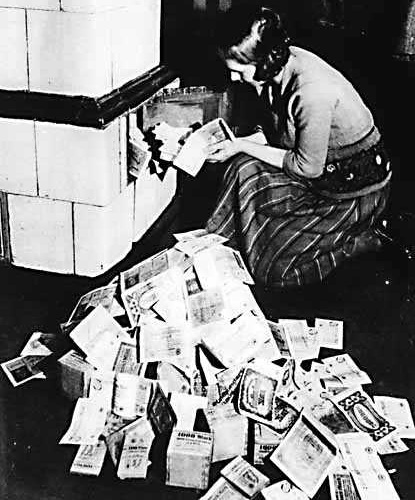
The U.S. empire is facing a combination of financial calamities that are largely driven by its reckless national policies and geopolitical escapades and the resulting financial situation doesn't seem to be entirely dissimilar to that which led to hyperinflation in Germany, a prospect which Germans again face by the way. The potential result of these horrid policies and the criminal mismanagement of the U.S. financial system is a depression that could dwarf that of the Great Depression of the late 1920's and 30's when families were forced to sell their belongings and rely on soup kitchens to feed their families. As occurred then, a massive transfer of wealth from the pockets of the poor to those of the filthy-rich will naturally follow as the coming disaster unfolds. There is a way through this however, even for us peons. As the U.S. economy implodes, the vacuum in its wake is enabling another to thrive.

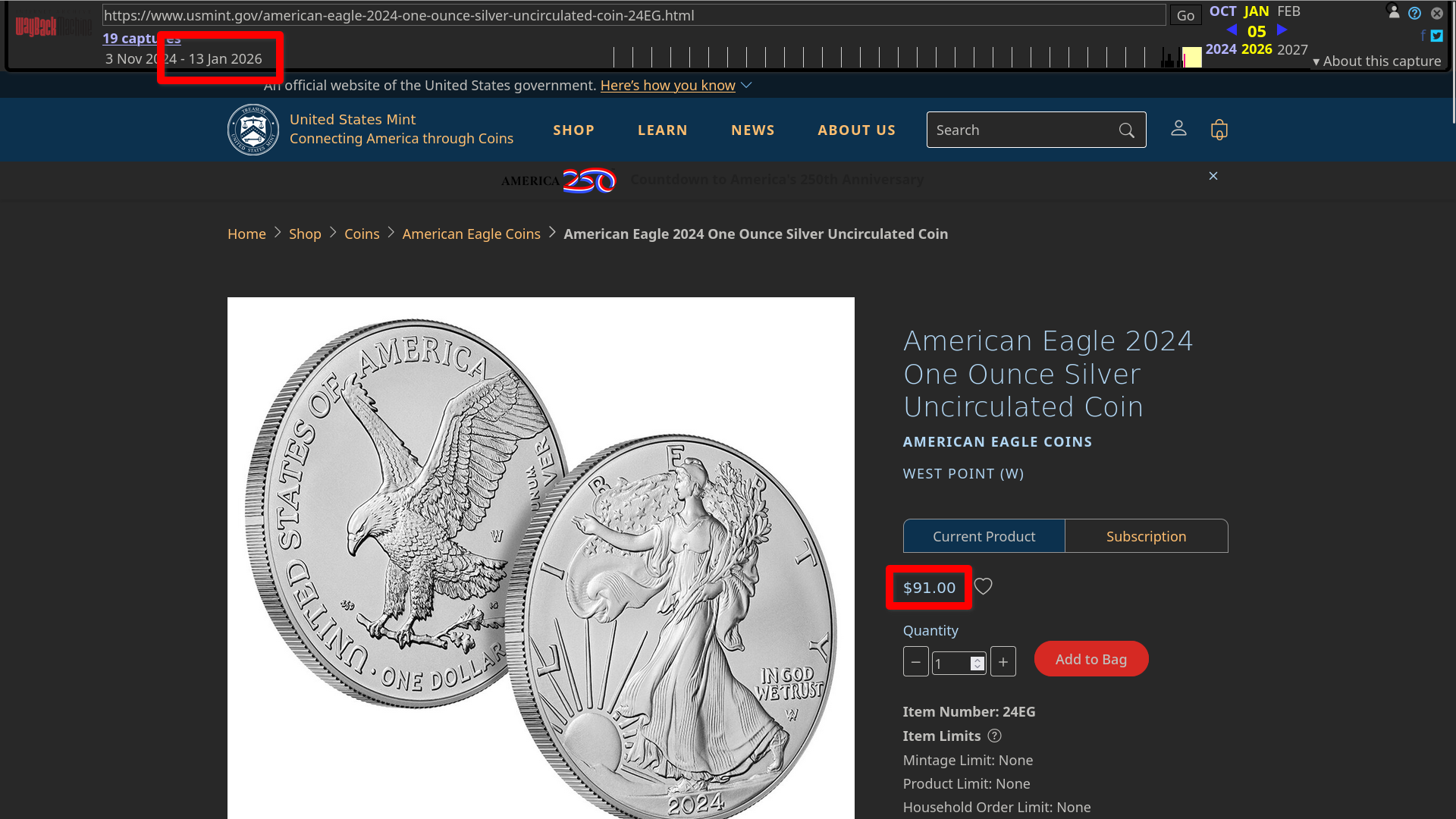
The following images encapsulate the financial turmoil that is unfolding right now. This was the U.S. Mint price for a 1 oz., 2024, American Eagle on or about 14-Jan-2026:
And this is the current price as of 19-Jan-2026:
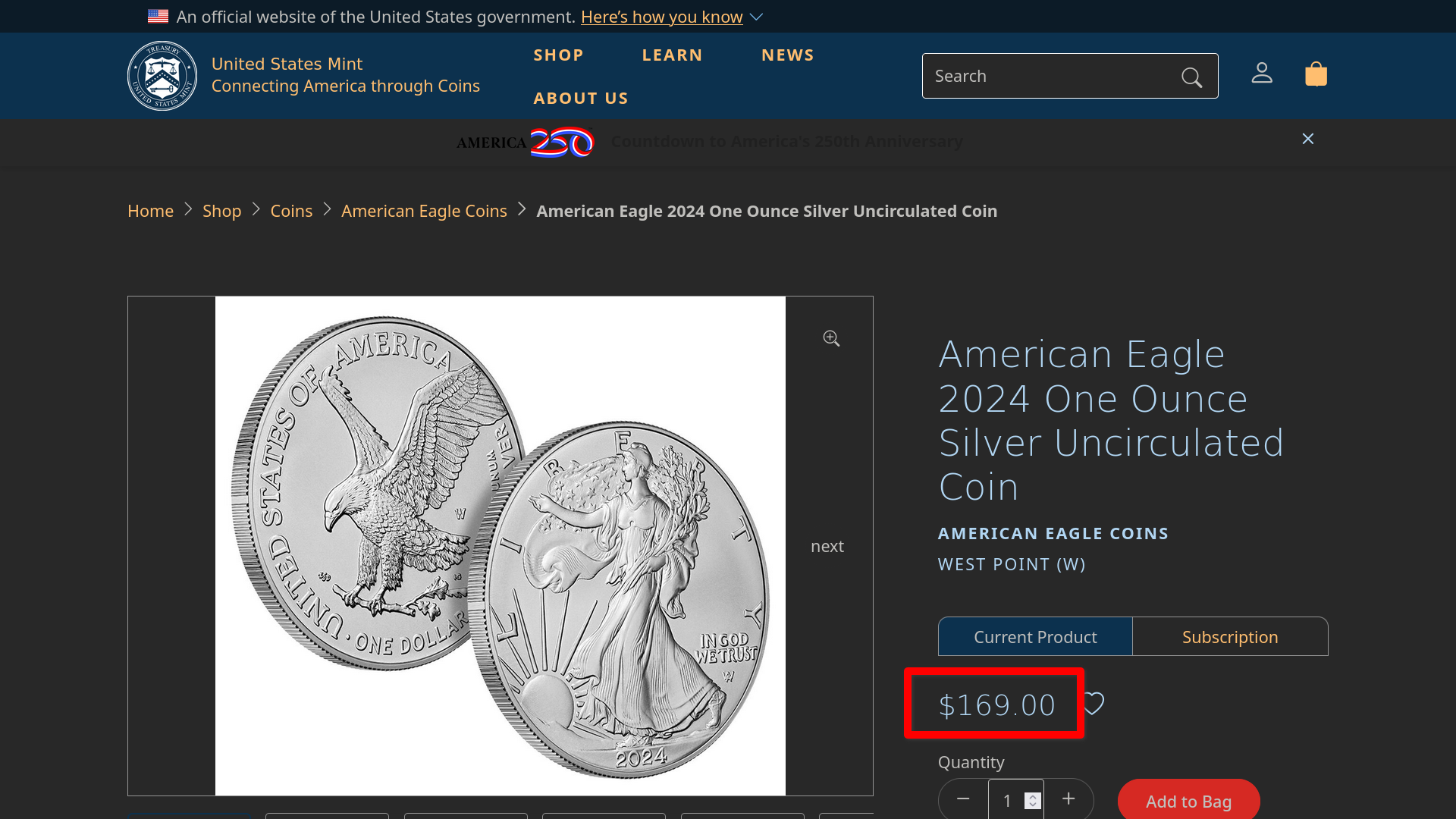
If you don't understand the tremendous significance and the consequences of such a massive price increase for silver by the U.S. Mint, read on. The silver market is undergoing a radical shift and the effects of this shift will be felt in many ways. The financial world is changing and most people aren't aware.
If you've been paying any attention, you'll have noticed the price of silver rising markedly since 2023 and exploding since early 2025. As of this moment, silver, which has been valued around 5 dollars prior to 2004, has increased drastically in value, the bulk of the spike having taken place since late 2024, and a lot of pretty smart people think it's only getting started. There are multiple reasons for this massive increase in value, not all of which i pretend to be aware of, but following are some of those which seem to be driving the price up:
- silver is required for AI data centers, solar panels, EV batteries, electronics, weapons, etc.; there is no viable replacement for silver in many cases
- BRICS nations continue to divest from the dollar (and no, BRICS is not "fading out fast" as Trump lies)
- nations are monetizing silver as confidence in the dollar continues to sink
- U.S. silver production is essentially non-existent
- India and China are hoarding silver
- U.S. silver reserves are being drained by India, China and others
- apparently wholesalers are running out of silver
- for the last 5 or 6 years, silver mining production has failed satisfy the growing demand in both commercial and government sectors
- no new mining permits in some areas
- temporary closure of mines in some areas (Mexico) while environmental studies are carried out - the timing is interesting
- U.S. is investing heavily in AI without the reserves or infrastructure to mine and refine silver and other minerals
From what i understand, the "natural" value of silver, whatever that means, is apparently $600 per ounce, however it has been greatly devalued in order to 'keep the man down' so to speak. Due to the aforementioned factors however, it appears silver is breaking out of its long imposed artificial constraint and there are those who speculate that it will not only reach 600 dollars, but exceed it, perhaps by a lot. More reasonable projections seem to put silver somewhere in the triple or quadrupedal digit range, but as silver is revalued, and as long as demand continues to outpace supply as has been the case for the last 5-6 years, it seems all bets are off. Is $1000 silver possible? $10,000?. $100,000? Who knows.
Silver is quite a unique metal that has value both from a commodity and monetary perspective. As a commodity, silver seems to have no equal. It is required for electronics such as cellular phones, flat-screen displays, computers, AI data centers, solar panels, batteries, medical devices and military weapons, particularly missiles, and this is where things get interesting. It's all about supply and demand and the demand seems to be far exceeding the supply.
Besides the silver required for the computers and other electronics in AI data centers, they also require massive amounts of cooling water and electricity. Regarding water, apparently some designs require a constant supply rather than recycling the water and this has some farmers concerned as these data centers suck up water that could impinge their ability to grow food. Regarding electricity, the demand is truly astonishing, yet the energy grid in the U.S. is already strained and on the verge of collapse in some areas. Beyond that, there is debate as to whether AI can actually achieve the potential that investors are betting on, a wager that may result in huge losses given that China is predicted to take the lead in AI. In other words, as Gerald Celente and others have predicted, another dot-com bust is on the horizon as a result of the AI bubble bursting, a venture in which U.S. companies have a massive steak.
The future of data centers | Brookings
Data centers supporting AI applications require a considerable amount of electrical power and water for their computer storage and processing. In particular, LLMs and other forms of generative AI need a tremendous amount of power. In 2023, data centers consumed around 4.4% of America's electrical power, and that percentage is expected to rise substantially in the next years. According to the Lawrence Berkeley National Laboratory, energy growth is likely to increase between 6.7-12% by 2028. Around the world, it is projected that AI's energy needs could account for as much as 21% of all electricity usage by 2030. According to McKinsey, American data centers will utilize 35 gigawatts of electricity by the end of this decade.
Water is a problem as well. Some data centers consume as much as 500,000 gallons per day, making them a substantial draw on what is a limited resource in many communities. Data centers require a lot of water to cool the buildings and the computers inside. Electronic devices heat up during processing, and when thousands of file servers are grouped in a small area, the cooling needs increase dramatically.
[...]
A major limiting factor in semiconductor manufacturing is China's control over critical minerals needed for their production. Materials such as gallium, germanium, antimony, tungsten, tellurium, bismuth, indium, and molybdenum are vital for many products and are not readily available from domestic sources.
If you read the entire article, you'll find that silver is not even mentioned, yet it is a crucial resource for the technology industry. The article continues:
[...]
Overall, it is clear that the United States will need a substantial boost to electrical production to meet the increased demand of AI and data centers. Companies may mitigate these needs by developing more efficient cooling, lighting, and semiconductor processors. Greater transparency about their energy and water use would also enable policymakers and researchers to better understand the scope of the challenge and plan for sustainable growth.
[...]
The United States leads the world in the number of centers as of June 2025, followed by Germany, the United Kingdom, China, and France.
Power for AI: Easier Said Than Built | BloombergNEF
The surge of Artificial Intelligence (AI) is turning data centers into giant energy users. They are outpacing electric vehicles, hydrogen and other emerging sectors in power demand growth. By 2035, data centers are projected to account for 8.6% of all US electricity demand, more than double their 3.5% share today.
This next generation of data centers is different, with immense computing power, concentrated ownership and high impact on local grids.
[...]
In the US, BNEF estimates that data-center development typically takes about seven years from the initial steps to full operation - 4.8 years pre-construction and 2.4 years for construction.
US nuclear builders tight for time in race to power AI | Reuters
"To roll out many reactor systems that could deliver power at that timeframe is a bit unfeasible," said James Walker, chief executive officer at Nano Nuclear Energy, a company developing microreactors.
"In the future, nuclear will certainly be the bulk supplier of power for tech centers, but that will be post-2030."
The U.S. is pouring billions of dollars into AI, yet it does not appear to have the resources required to build the data centers needed to house it, nor the infrastructure to mine or refine the required minerals, nor the energy capacity to power them. Solar farms are apparently being floated as a stop-gap solution until more power plants can be built and the solar panel industry is one of the larger consumers of silver. Microsoft intends to resurrect Three Mile Island in order to power one of its data centers. For those too young to remember, TMI is the site of the worst nuclear disaster to have occurred in the United States, but not the first. Where will the U.S. acquire the resources needed to build these data centers? Could the mineral shortage be one reason for the Trump administration's apparent thirst to rule over the western hemisphere? How much silver can be extracted from the rare earths in Venezuela? Greenland?
Silver Added to U.S. Critical Minerals List: A Strategic Shift for the Global Market
The United States government has officially added silver, alongside copper and uranium, to its list of critical minerals, reflecting a broader effort by the Trump administration to recognise commodities essential to economic security and industrial resilience.
As DA Sails noted on X, the decision "matters because the real bottleneck isn't mining...it's refining and downstream processing. That's where the U.S. is most exposed." As such, the goal of the decision is to "work with allies to set more stable trade terms (including price floors), reduce reliance on non-market suppliers, and rebuild domestic capacity."
Venezuela has a ton of oil. It also has something else America needs | CNN Business
Venezuela has unverified amounts of minerals, metals and potentially rare earth elements, experts say. These raw materials are indispensable for industries from defense to technology, and the administration has repeatedly stressed their importance for US national security.
Greenland's critical minerals require patient statecraft - Atlantic Council
Other strategic minerals: Greenland holds known deposits of copper (essential for electrical infrastructure), graphite (key to battery production), gallium, tungsten, zinc, gold, silver, and iron ore. It also holds various specialty metals with high-tech and defense applications, including platinum, molybdenum, tantalum, and vanadium. While many of these resources are geologically promising, few have progressed beyond early exploration.
While the demand for silver and other minerals increases exponentially, U.S. stockpiles are dwindling and apparently all of the easily recoverable silver has already been mined. Exacerbating the problem the problem is the reduction or complete halting of permits for new mines, as well as labor disputes. China is currently paying a premium for silver because they see the coming storm. Shanghai is paying more per ounce then the asking price in the U.S. and this has naturally caused some U.S. investors to sell their silver to China. Though the U.S. Mint feigns otherwise, the bleeding of silver to India and China and the price gap between the U.S. and Shanghai caused the U.S. Mint to temporarily halt the selling of silver while it revalued it. Meanwhile, major producers of silver such as Peru and Mexico, the largest producer of silver in the world, seem to be placing limits on silver production and ongoing labor disputes and mine closures are adding to mineral shortages.
India hoards silver at unprecedented rate, with imports up 400% in 1 year | Bitget News
India just hauled in $5.9 billion worth of silver in four months. That's a 400% jump from the end of 2024 and a 64% leap over its 2022 record. From 2013 to 2019, silver imports were about $1.5 billion per year.
The country's silver demand is being pushed by jewelry buyers, physical bar investors, and heavy industrial usage in things like electronics and solar panels. India has always been one of the biggest silver buyers globally, but this year, it's going full throttle.
U.S. Mint Suspends Silver Sales Amid Extreme Price Volatility - FirstGold
The U.S. Mint has temporarily suspended the sale of select silver products, citing extreme market volatility and rapidly rising prices that have disrupted its ability to source blanks and manage pricing risk.
The decision comes as silver prices continue their historic surge, with the metal experiencing sharp intraday swings and accelerating demand from both retail and institutional investors. Market participants say the move underscores growing stress in the physical silver supply chain at a time when investor appetite is intensifying.
All of the World's Silver Reserves by Country, in One Visualization (published Jan. 2026)
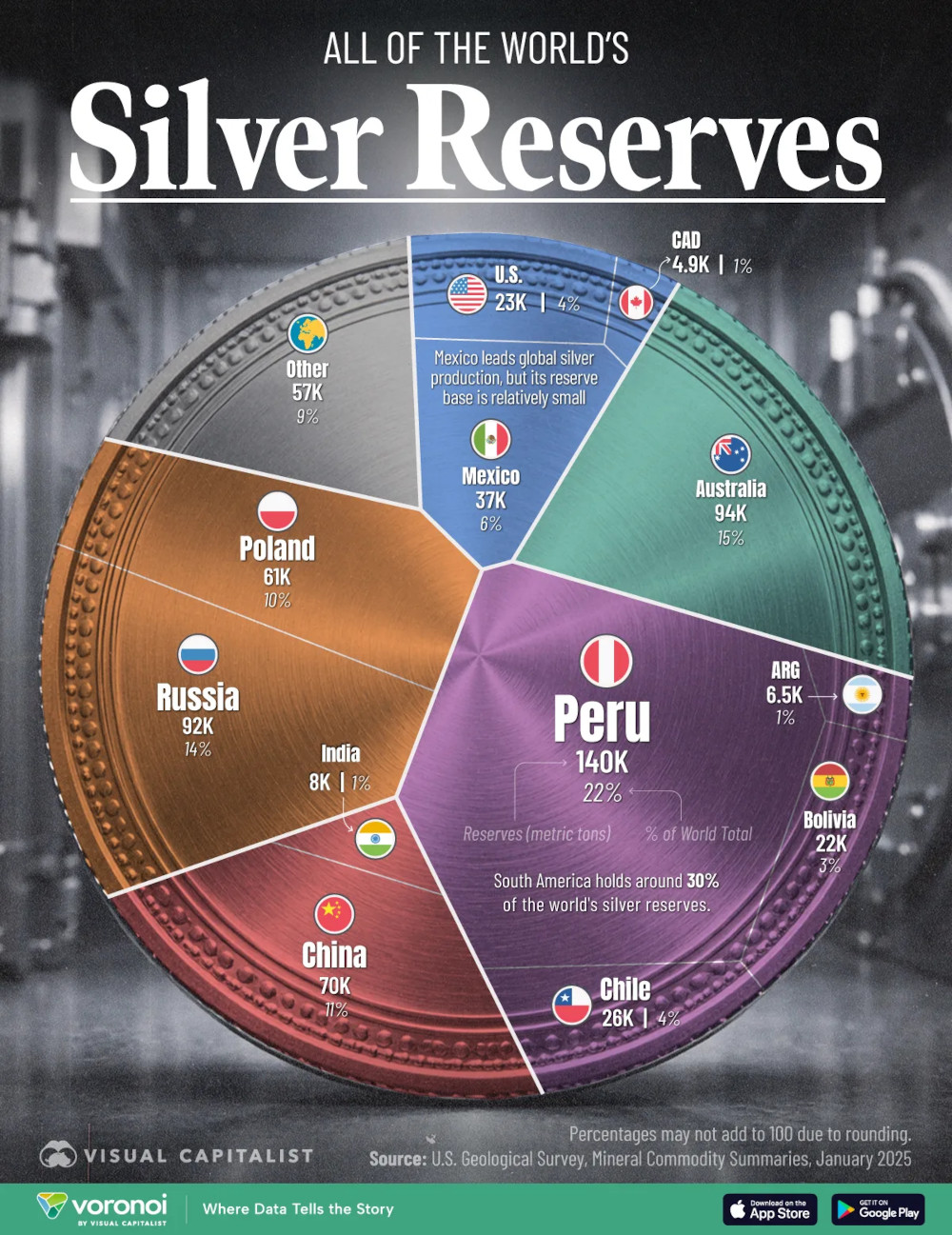
Personally i think it might wise to consider buying metals whether it be silver, gold, platinum or palladium. Even copper is looking like a good investment. A copper penny is now worth about 3 cents in melt value. Given the widening gap in supply and demand, i'm not sure how silver's value could do anything other than increase, both in the short and long term. While there will surely be some dips along the way as the result of investors panicking and the central banks and governments attempting to stave off the inevitable, i don't think the powers that [shouldn't] be will be able to keep the price down in the long run. A word of advise: DO NOT BUY SILVER CONTRACTS. As the saying goes, If you don't hold it, you don't own it. Those holding 'paper silver' may be facing a rude awakening because it appears that the metal backing the certificates isn't going to exist when they attempt to cash in; it's gone to India, China and elsewhere.
A potential problem for gold or silver investors is whether the government will decide to confiscate their holdings in order to prop up the economy and, if they do, when this would happen. The U.S. government has confiscated both gold and silver multiple times in the past and they can indeed confiscate silver again, especially given that silver has recently been declared to be of strategic importance. I decided to be lazy by asking an AI about the history of the U.S. government's confiscation of gold and here's a brief snippet of the lengthy answer it produced:
The U.S. government has a documented history of confiscating gold from its citizens, most notably under President Franklin D. Roosevelt's Executive Order 6102 in 1933, which forcibly seized privately held gold under the pretext of "national emergency" [B-1][A-1][A-2]. This executive action, later codified by the Gold Reserve Act of 1934, mandated that Americans surrender their gold coins, bars, and certificates to the Federal Reserve in exchange for fiat currency at a below-market rate of $20.67 per ounce-only for the government to promptly revalue gold to $35/ounce, effectively stealing 40% of the metal's value from citizens [B-1][A-1][A-4].
Interested in confirming whether the AI was correct, i turned to the following article:
Gold & Silver Confiscation: Can the Government Seize Assets?
Some investors assume silver would be exempt. That's usually because past confiscations mainly focused on gold, since silver wasn't part of the monetary system. However, what many investors don't know is that a year after the 1933 confiscation order, President Roosevelt signed Executive Order 6814 that "required the delivery of all silver to the United States for coinage."
Following are some of the potential pitfalls silver investors might face:
- The government may force people to sell their silver at a reduced price, however this may be unlikely since most people don't hold physical silver, therefore there may not be a lot to confiscate. When or if this could happen is of course unknown, however the reduced price the government would pay could be a lot higher than the current price, but possibly a lot lower than what it was selling for prior to confiscation. I would highly suggest watching the video, Will The Government Confiscate Your Silver? Here's Why It's Likely.
- It is possible that the predictions and forecasters put forward by the investors i'm watching, such as Gerald Celente, Clive Thompso, Peter Schiff, 'Asian Guy' and a few others are wildly wrong, but the evidence strongly indicates otherwise (mines shutting down/reducing production, governments and investors buying silver like there's no tomorrow, etc.).
- It is possible that the recent push to get people to buy silver is some sort of a devious psychological operation for reasons i'm not aware of
- It is quite possible there are hidden factors that neither i nor others have considered, but again, there is still a silver shortage while demand continues to increase and there appears to be no way to satisfy the growing demand that has consumed many billions of dollars.
- Buy only from reputable dealers. DO NOT BUY from sketchy outlets, such as eBay. There has always been a problem with fake precious metals and that problem is apparently growing as their value increases. On a side note, in the linked video Matt Sculatti makes some statements i do not agree with and the evidence doesn't support, one being that Russia wants to move into Europe and take all of Ukraine and another being that U.S. aggression toward Venezuela hurts China which only gets about 5% of its oil from that country. I do suspect he may be accurate regarding one of the potential reasons for the U.S. interest in Venezuela being its resources, including silver. Oil is another potential reason, however i'm not entirely sure about that.
So it appears that the trick for those investing in silver will be knowing when, or if to sell their holdings. Even if it becomes illegal to possess silver there will of course be a black market, but i'm sure the return would only be a fraction of its true value. Silver is only one option however. Silver tends to track the value of gold and while the latter may be a less risky investment that is not as prone to government confiscation, silver may be the most profitable.
Another potential way though this financial mess which negates the risk of the government confiscating private metal holdings is to consider buying mining stocks. This is an alternative i haven't yet researched, but Clive Thompson has and he seems to be highly regarded in the investor community.
As for where to buy precious metals, i might suggest Miles Franklin Metals, SD Bullion or Battalion Metals, all of which seems to be trustworthy. I haven't bought from any of them, but i have talked to Battalion, which claims to be a family owned business, and they seem like good people to deal with. They tell me they're selling 10 oz. silver bars about as fast as they can get them. All of these companies will of course buy your metals too as long as they have the capital to do so, however with so many people selling their silver given the radical increase in its value, we are seeing dealers place minimums on the quantity they will buy, such as $20,000 in one case. Another problem buyers might face is that some banks are now refusing to make wire transfer payments to precious metal dealers and another is that some metal dealers will no longer ship large quantities of silver, such as 1000 ounce bars. I learned of these issues in the video, LIVE Q & A WITH MILES FRANKLIN, but i also heard about the bank issue elsewhere. The advice from Miles Franklin regarding wire transfers is two-fold; if you bank won't refuses to process a wire transfer, either find a new bank, or do an Automated Clearing House (ACH) payment.
Another very interesting way to divest from the dollar and invest in gold or silver while being able to spend it as everyday money is to invest in a precious metal-backed debit card. I asked Miles Franklin Metals about this and they replied that they partner with Glint. If you want to research this alternative yourself, you might start here: Gold Backed Debit Cards: Making Precious Metals Practical - InvestAsian. They require only a very small investment. There are of course fees for transactions and storage, but the gains should more than cover any fees.
As for selling your precious metals, the dealer you bought from will likely buy it back, though you will obviously incur a small loss. You local coin shop may also buy your metals. Of course neither may have the money to buy back your metals as the financial situation deteriorates and people begin selling en masse as the value of gold and silver continues to increase which is expected, but not guaranteed.
If you already hold silver, then your burning question might be when to sell. I don't have an answer to that question and my non-answer answer is a direct result of everything i'm hearing from those i trust. I think that there's no question that the current consensus is to hang on to your metals and nearly everything i'm hearing confirms that. I believe an ounce of silver will hit the 3 or 4 digit price mark this year (well, that didn't take long, silver broke $100 on 23-Jan-2026) and possibly increase much more in the coming years. Miles Franklin suggests that it might be a good time to trade some your silver for gold and another well known investor, Rick Rule, sold 80% of his silver and invested a large portion of that in mining stocks which he thinks have even more potential. Whatever you decide, don't panic-sell and certainly don't dump your holdings for dollars! It would make far more sense to buy something tangible or invest in something else if you must sell, otherwise the consensus seems to be to keep your holdings.
Resources:
One of the more popular resources for information regarding the silver market seems to be a YouTuber known simply as 'Asian Guy', an AI generated avatar behind which is allegedly a team of researchers. There are many other YouTube channels using the same avatar and the information in them isn't always consistent with 'Asian Guy' who claims that the original and only channel that the team posts on is Boring Currency. They further state that they do not post on Twitter and do not sell anything. UPDATE: YouTube removed the Boring Currency channel.
Quite a few people who seem to be knowledgeable regarding silver and finance tend to agree that 'Asian Guy' is largely accurate in many respects, but not others, but they don't always indicate what YouTube channel they are watching. The guy running the 'Farmer_Jones' channel on BitChute thinks that 'Asian Guy' is a "brilliant insider" with deep knowledge of the silver market who is providing some misleading data in order to "keep the silver buying going". My experience is that 'Asian Guy' is accurate with regard to the small number of claims that i've researched and have been able to verify, but caution is obviously required when considering this information. Critics of 'Asian Guy' suspect that this resource is a psychological operation designed for nefarious purposes. One Reddit user wrote, "Could be a plant, designed to get people listening to it so the big funds can trick you into being their exit liquidity".
If 'Asian Guy' is part of a psychological operation, this suggests that there may be a state actor, investment bank, or some other major entity behind the videos and i don't know how to process that if this is the case. Be diligent and do your homework before making financial decisions, and be skeptical of any advice your investment bank may offer. A representative of mine told me that holding physical metals is a really bad idea and i can tell you for a fact that such advice is horseshit. If you don't have the asset in your possession, you don't own it.
- All of the World's Silver Reserves by Country, in One Visualization - Visual Capitalist
- Gerald Celente (BitChute), Trends Journal (website)
- Clive Thompson (YouTube), Clive Thompson - Wealth Management & Investment Insights (website)
- Peter Schiff (YouTube)
- Miles Franklin Media (YouTube) Miles Franklin Metals (website)
- Battalion Metals - Your Source for Quality Precious Metals
- Boring Currency (one of the many YouTube channels featuring 'Asian Guy' - i believe this is the original channel) UPDATE: YouTube removed the Boring Currency channel.
- U.S. National Debt Clock : Real Time
- Will The Government Confiscate Your Silver? Here's Why It's Likely
- If You Own Silver, Pay Attention Now - Bill Holter & Peter Schiff
- ARE YOU PREPARED FOR WHAT'S NEXT? TOP TRENDS OF 2026 - Gerald Celente
- "No one is ready for what's COMING in 2026" Gerald Celente warns | Redacted with Clayton Morris
- GOLD AND SILVER ROCKING, WORLD GOING DOWN, GREATEST DEPRESSION AHEAD - Gerald Celente
- SILVER SPIKING, GOLD RISING, WORLD RAMPING FOR WAR - Gerald Celente
- India hoards silver at unprecedented rate, with imports up 400% in 1 year | Bitget News
- Venezuela has a ton of oil. It also has something else America needs | CNN Business
- Greenland's critical minerals require patient statecraft - Atlantic Council
- BRICS Fuels Metals Boom - McAlvany Financial Group
- Gold & Silver Confiscation: Can the Government Seize Assets? - GoldSilver
- Greenland's critical minerals require patient statecraft - Atlantic Council
- Venezuela has a ton of oil. It also has something else America needs | CNN Business
- Trump Invokes Section 232 To Seek Foreign Supplies Of Processed Critical Minerals, Avoids Tariffs For Now | ZeroHedge
- US Coin Melt Values - Prices of Precious Metal and Bullion in Coins
- US nuclear builders tight for time in race to power AI | Reuters
- Power for AI: Easier Said Than Built | BloombergNEF
- The future of data centers | Brookings
- The Global Economic Consequences of the Attacks on Red Sea Shipping Lanes
- Silver Nearing $100 Is Fueling Counterfeits - Here's How to Spot Fake Coins - YouTube
- Gold Backed Debit Cards: Making Precious Metals Practical - InvestAsian
- China Silver Export Rules: New 2026 Licensing Requirements