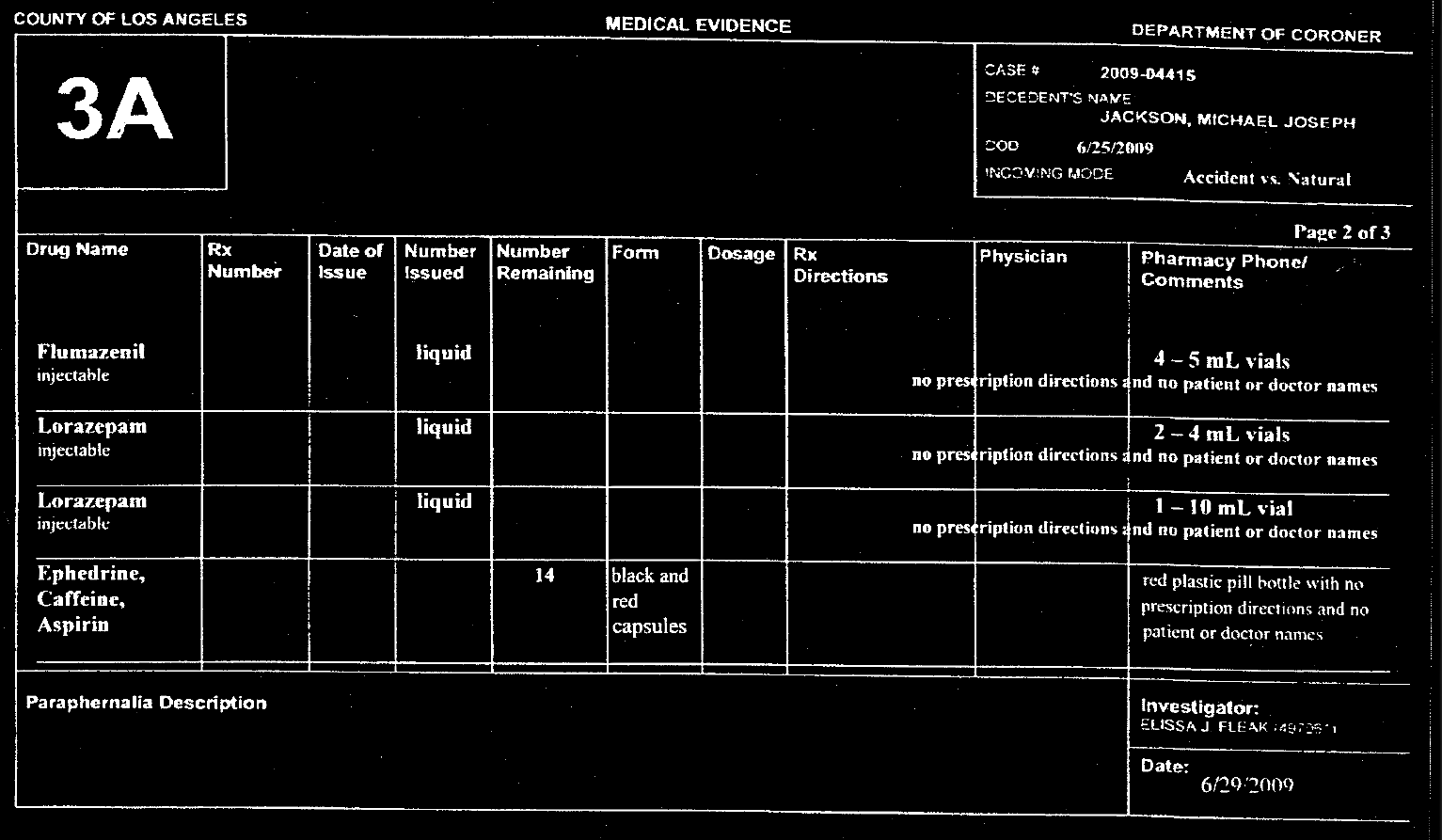
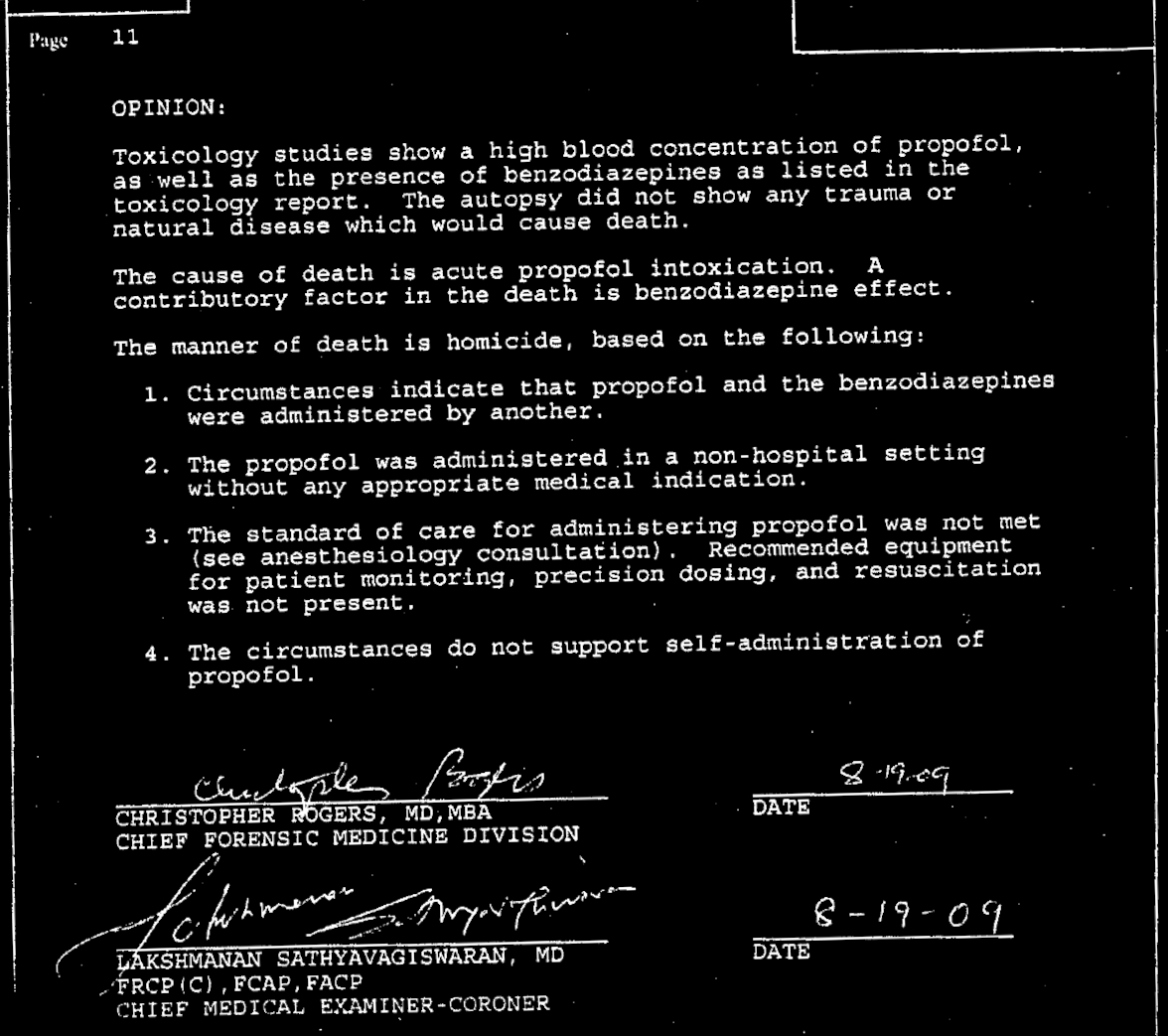
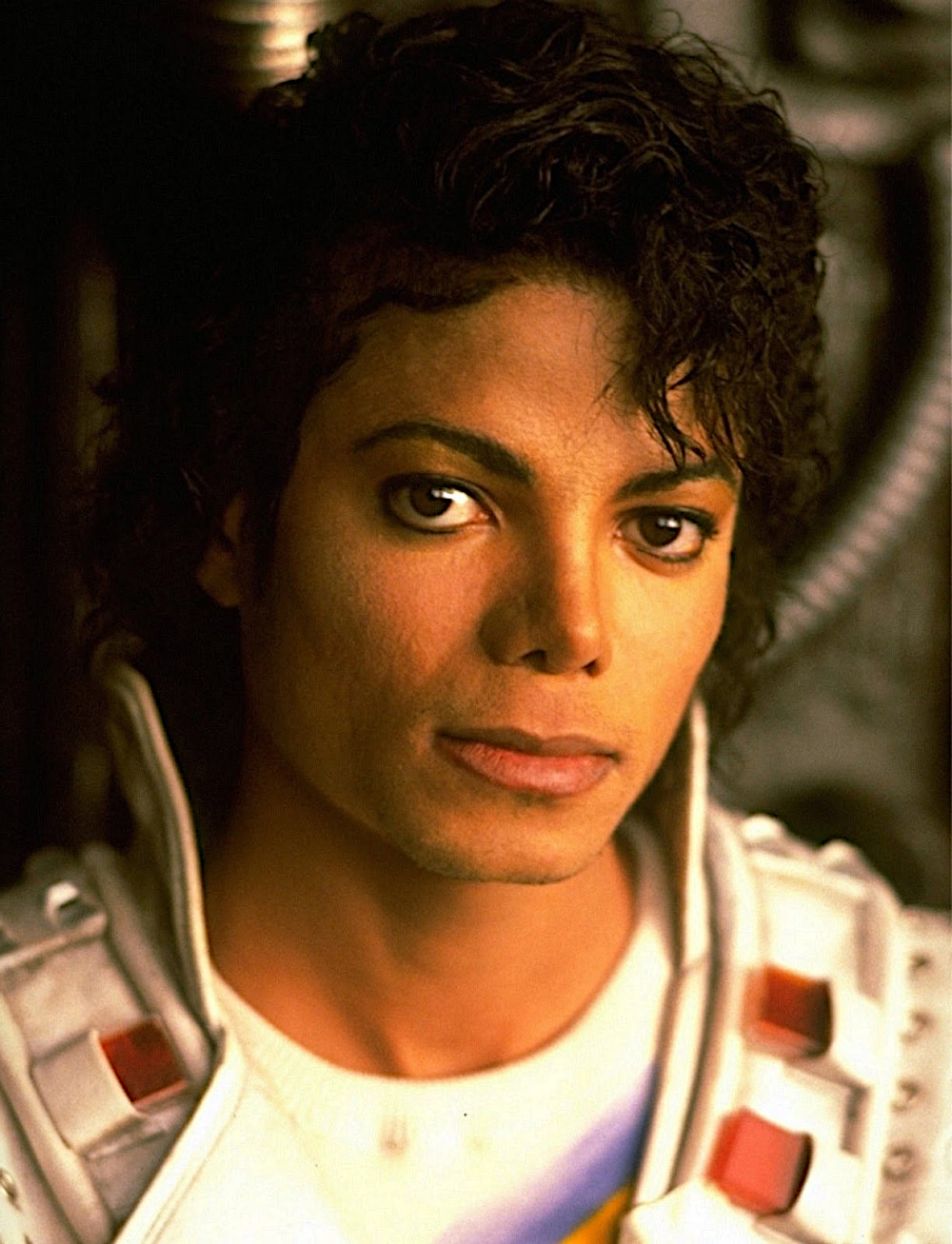
"Since Michael Jackson entered the entertainment industry at the age of 10, rumors about him have never stopped swirling: no one has missed an opportunity to talk about the artist who, year after year, dominated the charts and stages around the world, becoming recognized as the greatest entertainer of all time.
And yet, there's one thing they've remained silent about, and continue to remain silent about: the TRUTH, first about his life, and now about his death. -- Truth 4 MJ website (translated from Italian)
[...] i'm a sucker for a good conspiracy when it's accompanied by supporting evidence and, in Jackson's case, there appears to be multiple conspiracies to whet ones appetite. The million dollar question is whether they are connected in a linear and premeditated fashion.
I wasn't particularly fond of Michael Jackson. I remember seeing his music videos on the boob-tube back in the day and maybe even liking some of them, but later in life i found myself switching stations upon recognizing one of his songs on the radio. The stories of bleached skin, drug abuse and child molestation didn't strike me as unusual for a big-shot pop-star and so i found no reason to disbelieve them. Recently someone mentioned in conversation that Jackson was, as a matter of fact, a pedophile and without hesitation i agreed, but then i wondered exactly how i knew that to be true. My father once told me, "Don't believe anything you read or hear and only half of what you see.". In other words, always do your own research before forming an opinion.
Shortly after talking with that person i happened to run across a video by Candace Owens, What Really Happened To Michael Jackson? which she published in 2024 on the anniversary his birth. Candace is a pretty sharp young lady and a capable researcher, so with nothing better to do i decided to listen to what she had to say. Her video roused my interest about a subject i hadn't cared about an hour before and so i decided to poke around to see what i could find, and what i found was that the mainstream version of Jackson's story that i held in my head all these years didn't jive with the evidence, at all. The public was never made fully aware of the whole story and even today many people still believe the tabloid version that painted Jackson as a pedophile, a judgement that opportunistic grifters and film makers continue to capitalize upon.
While the allegations of child abuse are somewhat less interesting to me in the context of the events leading to his death, they appear to be an integral part of Jackson's battles with Sony Music, his label at the time, and they may have contributed to his death, therefore the subject must be addressed, even if only topically. I'm not about to dissect the man's life beyond the scope of my particular interest since that's surely been done by many people far more knowledgeable than i, but i do want to focus on his battle with Sony, the music industry in general and the events leading up to his dearth. I also want to highlight a caustic omnipresence that permeated Michael Jackson's career that few people are aware of, or at least are hesitant to discuss. Lastly, i'm a sucker for a good conspiracy when it's accompanied by supporting evidence and, in Jackson's case, there appears to be multiple conspiracies to whet ones appetite. The million dollar question is whether they are connected in a linear and premeditated fashion.
THE PROTEST
"So I'm leaving Sony, a free agent,... owning half of Sony! I own half of Sony's Publishing. I'm leaving them, and they're very angry at me, because I just did good business, you know."
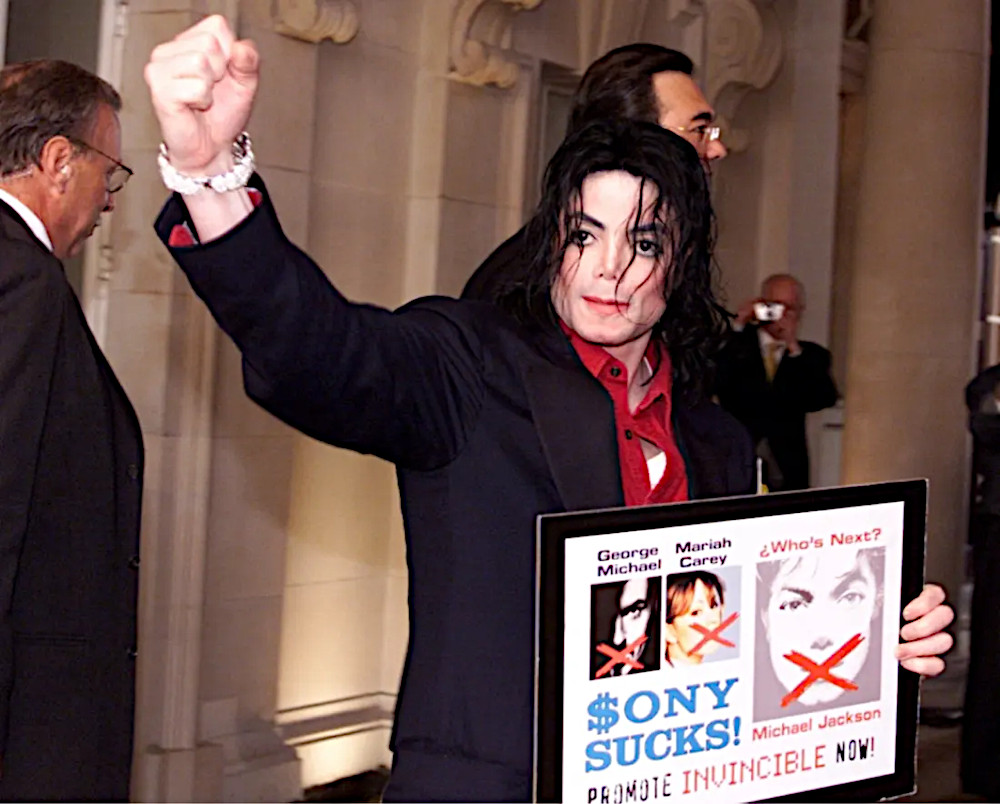
Having made billions of dollars for Sony by the time he was 43, Michael Joseph Jackson was an incredibly lucrative investment for his label, but he was also becoming a pain in the ass, and one who had something Sony Music coveted. Michael maintained that Sony wasn't treating him and other Black artists fairly and he was quite open about this at times. During a public protest against Sony in London on the 15th of June, 2002, his pointed comments spilled out into the public discourse like molten lava when he made his damning 'Killer Thriller' speech in which he attacked Sony Music, the company's Jewish CEO at the time, Tommy Mottola, and the music industry at large. I wonder if he thoroughly understood the potential repercussions of his comments?
At one point in Oliver Stone's film, Platoon, Sargent Barnes comes across the corpse of a North Vietnamese soldier and remarks, "That's a good gook. Good and dead.". The same can be applied to iconic music artists whose album sales sink, or who are unable to continue recording, or are unwilling to tour, or who break their contracts, etc.. In such cases an artist's music catalog can become significantly more valuable upon their death, one reason being the massive spike in record sales that follows their passing, and Michael Jackson fits squarely into that category; sales of his latest album, Invincible, tapered off after the first few months and he didn't like to tour and he broke free of his label, but the threat he presented to Sony, and possibly others, didn't begin that day in London.
In 1980, after Jackson's lawyer, John Branca, helped him regain ownership of his master recordings, Jackson founded the Mijac Music catalog which included most of his songs as well as the masters. While owning ones masters and controlling the publishing rights is a logical and lucrative move to be sure, it was also an unusual and potentially dangerous one at that time, especially for an artist as valuable as Michael Jackson. Then, in 1985, Jackson acquired the Beatles' publishing company, Sony/ATV Music Publishing, for approximately 47 million dollars and in the process became half owner of Sony Music. Jackson's decision to acquire ATV was apparently influenced by Paul McCartney in the early 1980's, around the time they recorded the song, Say Say Say. McCartney, who owned the publishing rights for many songs, said to Michael, "This is the way to make big money", "Every time someone records one of these songs, I get paid. Every time someone plays these songs on the radio, or in live performances, I get paid.". Jackson's smart business deals seemed to be putting him on a path to becoming a serious threat, not only to Sony Music, but potentially to the music industry at large, an industry that has a lot of ties to organized crime.
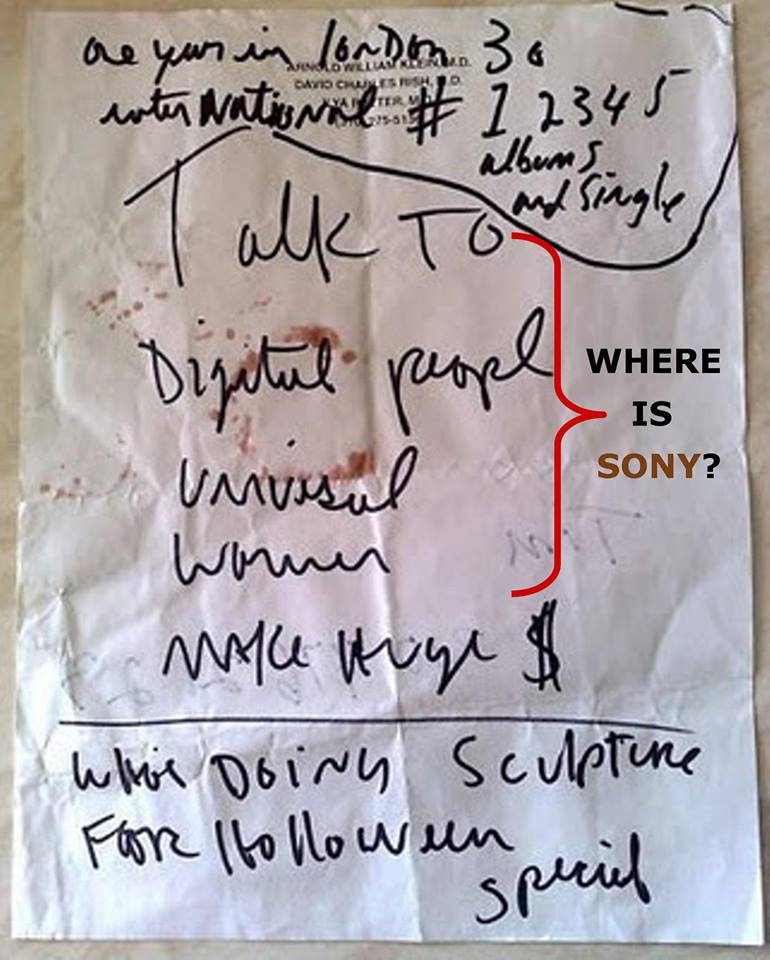
Jackson's comments during the London protest were largely rooted in the allegation by both himself and his fans that Sony intentionally under-promoted his last studio album, Invincible, released in 2001, claiming the company had done so because he refused to tour in the United States, among other excuses. Jackson had racked up a massive amount of debt by then, around 500 million dollars, as a result of borrowing a lot of money from Sony as well as other lenders. It has been posited that the real reason Sony torpedoed the sales of the Invincible album was to force Jackson to default on the loans which he apparently intended to repay, at least in part, with the profits from the sale of the album. The collateral he used to secure the loans was ATV Music Publishing which, in addition to the Beatles catalog, also included the catalogs of many of the most popular music artists of the day and Sony would be in a position to acquire ATV if Jackson failed to repay the loans. Whether he was aware of the alleged scheme at the time of his London speech, or whether he ever became aware, is unknown to me. Following is the bulk of that speech (emphasis added):
[...] from Sammy Davis Junior, to James Brown, to Jackie Wilson, to Fred Astaire, Gene Kelly. The story is usually the same though. These guys worked really hard at their craft, for the story ends the same. They are usually broken, torn and usually just sad, because the companies take advantage of them, they really do.
And... Sony...Sony... Being the artist that I am, at Sony I've generated several billion dollars for Sony, several billion. They really thought that my mind is always on music and dancing. It usually is, but they never thought that this performer -- myself -- would out think them.
So, we can't let them get away with what they're trying to do, because now I'm a free agent... I just owe Sony one more album. It's just a box set, really, with two new songs which I've written ages ago. Because for every album that I record, I write -- literally, I'm telling you the truth -- I write at least 120 songs every album I do. So I can do the box set, just giving them any two songs.
So I'm leaving Sony, a free agent,... owning half of Sony! I own half of Sony's Publishing. I'm leaving them, and they're very angry at me, because I just did good business, you know.
So the way they get revenge is to try and destroy my album! But I've always said, you know, art -- good art -- never dies. ...Thank you.
Michael paused, apparently intending to end his speech there, however he decided to continue and, in so doing, revealed an even more personal view regarding the music industry:
And Tommy Mottola is a devil!
I'm not supposed to say what I'm going to say right now, but I have let you know this. Please don't videotape what I am going to say, ok? Turn that off please. Do it, do it, I don't mind! Tape it!
Mariah Carey, after divorcing Tommy, came to me crying. Crying. She was crying so badly I had to hold her. She said to me, "This is an evil man, and Michael, this man follows me." He taps her phones, and he's very, very evil. She doesn't trust him. He's a horrible human being. And we have to continue our drive until he is terminated. We can't allow him to do this to great artists, we just can't.
I recall visiting the Wikipedia article for the '27 Club' in 2011 while poking around the death of Amy Winehouse which also seemed potentially suspicious to me (i recall reading an article about a neighbor who heard screams or yelling coming from her residence around the time of her death). Upon revisiting the article during my research, i was surprised to see how many more people had been added to the '27 Club'. As of this writing, there are 93 entries for people involved in music who died at the age of 27. Michael Jackson, having died when he was 50, is of course not one of them, but he was a victim of the music industry nonetheless. There are other lists related to music artist deaths on Wikipedia as well, including a list of murdered musicians containing 62 names and another 70 in the list of murdered hip-hop musicians. Combined, there are 222 unique names. The point is that there seems to be something inherently dangerous lurking within the music industry, at least that's how i'd phrase it if i were being conservative. The reality however, is that 'seems to be' can be replaced with 'is'.
THE ALLEGATIONS
the Chandler affair
"Michael Jackson told me, in no uncertain terms, that settling that case in 1994, was the biggest mistake he'd ever made."
In 1993, Jackson was accused of molesting 13 year old Jordan 'Jordie' Chandler by his absentee father, Evan Chandler (pictured above), who owed his ex-wife, June, 68 thousand dollars in child support. The Chandler vs. Jackson case would serve as a template for those that would follow.
Evan Chandler was born Evan Robert Charmatz to Jewish parents in the Bronx section of New York City. At some point he changed his name to Chandler because he thought his family name sounded "too Jewish" according to Wikipedia, but i suspect there may have been a more sinister reason. Evan was a short-lived screen writer and dentist who was given 5 years probation and had his California license to practice dentistry suspended for 90 days after being accused of malpractice.
From the outset it was transparently obvious that the sexual abuse claims made by the Chandler's on behalf of their son were, shall we say, problematic. Evan, who seemed to have bipolar disorder, became thoroughly obsessed with destroying Jackson and enriching himself in the process, at first demanding 20 million dollars in return for not going public with his claims.
Dimond told ABCNews.com that Chandler was suffering from a rare metabolic disorder called Gaucher disease, a hereditary condition most prevalent in the Ashkenazi Jewish population.
The disease causes a slow, painful deterioration and if left untreated can be excruciating. Dimond said Chandler, who was also bipolar, did not take care of his condition. Moreover, Chandler was estranged from Jordie, his two ex-wives, his children from his second marriage, and his two brothers. "He had pushed everybody away," Dimond said. "He was very sick. He needed crutches to get around. He couldn't earn money on his own. He had spent all his money. All he had was a monthly stipend from the son (Jordie) who wouldn't talk to him."
When the deals Evan offered Jackson were refused or failed to meet his changing demands, the Chandlers then turned to suing Jackson in a civil case. Evan made his intention to extort money from Jackson abundantly clear on several occasions, including during several phone conversations with Jordan's stepfather, David Schwartz, which Schwartz recorded without his knowledge.
To say the supposed victim's father, Evan Chandler, was shady, is a colossal understatement. There are taped conversations of him making it clear that he intends to extort as much money as he can get from Michael. He was furious about the time Michael, Jordan, and Jordan's biological mother were spending together, but yet encouraged his son to spend as much time as possible with Michael. Under investigation for extortion, he was found to be 70 thousand dollars behind in child support payments to his previous wife. Before the allegations were made, he had pressed Michael for a film deal, asked Michael to build an extension onto his house so his son Jordan could spend more time with Michael, then asked Michael to buy him and his family a house, all of which Michael refused. After all that he started complaining that his stepson Jordan was spending too much time with Michael. Then one fateful day he used sedatives to coerce his stepson Jordan to 'admit' what Michael had supposedly 'done to him', and it should be known and understood that upon getting the revelation he wanted, he brought no criminal charges against Michael, only civil, which is what would have allowed him to collect money.
At one point June Chandler-Schwartz, Evan's former wife, hired attorney Michael Freeman who later dropped the case against Jackson because he "did not like to be involved in cases [he] didn't believe in". Freeman would later describe Evan as disinterested in Jordan until his son and ex-wife started spending a great deal of time with Michael Jackson at Neverland Ranch at which point he "became the most interested parent in the world." (22:50 mark in the video).
The Chandler's first hired Jewish attorney Barry K. Rothman who Evan proudly described as "the nastiest son of a bitch I could find" after interviewing several others. Rothman appeared to live up to Evan's expectations, but then threw in the towel after Jackson sued him for extortion. The Chandler's then hired the well known Jewish civil rights attorney, Gloria Allred, who has been called "the ambulance chaser of feminism", then promptly dismissed her upon learning that she intended to have Jordan testify. Larry Feldman, another Jewish civil rights attorney who also served in the later Arvizo child molestation case against Jackson, was next in line. Feldman filed a 30 million dollar lawsuit against Jackson on September 14, 1993, and the case was eventually settled out-of-court for reasons we'll get into shortly. The accompanying criminal case was never tried due to an anemic lack of evidence.
In a textbook example of narcissistic behavior, Evan Chandler drugged his 13 year old son with sodium amytal while extracting a tooth, presumably with the intent of extracting a confession as well, one which implicated Jackson in the sexual abuse of his son. This event occurred on August 2, 1993, a date which is crucial for reasons that will soon become apparent.
"[...] And he had to pull my tooth out one time, like, while I was there. And I don't like pain, so I said could you put me to sleep? And he said sure. So his friend put me to sleep; he's an anesthesiologist. And um, when I woke up my tooth was out, and I was alright - a little out of it but conscious. And my Dad said - and his friend was gone, it was just him and me - and my dad said, 'I just want you to let me know, did anything happen between you and Michael?' And I said 'Yes,' and he gave me a big hug and that was it."
"And you never gave him the details?"
"No."
As though the timing of Evan's question to his son wasn't out-of-park bizarre, he apparently didn't bother to follow up by asking what had happened, nor did he contact the police.
Sodium amytal, a powerful drug which seems to have no legitimate application in dentistry, can render the patient semi-conscious and place them in a highly suggestible state. The only conceivable reason Evan chose this particular drug can be found in the following article from BBC Radio 4, published in 2016, and the earlier False Memory Syndrome research paper published in 1995 (emphasis added):
Some experts believe Dr Milner was trying to help his young patients talk about a sexual trauma they had either repressed or were uncomfortable talking about when fully conscious.
But because patients under the influence of sodium amytal are semi-conscious, in a highly suggestible state, there is a danger that asking leading questions can make them believe something happened that, in fact, didn't.
In the 1980s and 90s, the drug was at the centre of a number of law suits of so-called false memory, where patients mistakenly believed they had been the victims of abuse. In one notorious case, an executive from California sued a psychotherapist and was awarded half a million dollars after his daughter accused him of sexually abusing her following therapy. Sodium amytal had been used as part of the treatment.
"It is not a truth serum," says Prof Elizabeth Loftus, an expert in memory from the University of California, Irvine. "When it comes to the recovery of pristine, accurate, allegedly repressed memories, it's a danger."
Abstract In the spring of 1994, the Waterloo Courier (1994) reported two cases entitled, "Jury Sides with Father Who Says Therapists 'Implanted' Abuse Memories," and "Author of Repressed Memory Book Sued." In December of that same year, another case was reported by the Waterloo Courier entitled, "Nightmare Over Abuse Claims Results in $272,000 Settlement" (1994). At issue in each of these cases, and in many others, is the "implanting" of "false" abuse memories in clients' minds by their therapists. Thus, the debate that began with the inception of the "False Memory Syndrome" Foundation in 1992 entered the courtroom and sparked new fears of litigation and malpractice suits against therapists who treat both children and adults affected by child sexual abuse.
Apparently it was only after Chandler administered sodium amytal to his son that Jordan 'remembered' Jackson having molested him. Prior to that moment there appears to be no evidence of Jordan ever having made such a claim and, in fact, he stated several times that Jackson had never molested him.
On August 2, Chandler extracted one of Jordan's teeth. While Jordan was under the effects of Amytal, a sedative with hypnotic properties, Evan asked him if Jackson had ever touched his penis; Jordan said yes. Chandler and his legal team approached Jackson asking for $20 million, threatening to take the dispute to a criminal court. A few weeks later, Jackson's legal team made a counter-offer of $1 million; this was declined by Chandler, who then requested $15 million. Jackson refused and lowered his offer to $350,000, which Chandler also refused. According to some sources, Evan unsuccessfully sought a $20-million film production deal with Jackson to avoid going to court.
Jordan, who claimed to have seen Jackson's penis several times after being subjected to what has been described as "aggressive investigative techniques" used by authorities, was asked to describe the feature upon which he produced a crude sketch of a circumcised penis and a description to match, however Jackson's penis was not circumcised as was revealed in photographic evidence collected by investigators, an event Jackson would describe as "the most humiliating ordeal" he had ever experienced. The remainder of Jordan's description of the penis was incorrect as well. The Wikipedia article continues:
On July 15, the child psychiatrist Mathis Abrams wrote to Rothman, who was seeking an expert opinion to help establish the allegations against Jackson. Abrams wrote that there was "reasonable suspicion" of sexual abuse without having met Evan, Jordan or Jackson.
Investigation
On August 18, the Los Angeles Police Department's Sexually Exploited Child Unit began a criminal investigation into Jackson. June Chandler-Schwartz initially told police that she did not believe Jackson had molested her son; however, her position wavered a few days later. On August 21, a search warrant was issued, allowing police to search Neverland Ranch. Police questioned 30 children who were friends of Jackson; all stated that he was not a child molester.
[...]
Testimony from staff and other children
Brett Barnes, aged 11, publicly stated that he had shared a bedroom with Jackson, and insisted that no sexual abuse had taken place. The dancer and choreographer Wade Robson, then aged 10, told Fox Television that he too shared a bedroom with Jackson and that nothing sexual had happened. Several parents presented details of aggressive investigative techniques by police; they explained that the police had frightened their children with lies such as "we have nude photos of you", and told parents their children had been molested even though their children had denied it.
The controversy has always been that boys and girls slept with Jackson in his bedroom at Neverland Ranch which conjures up images of inappropriate behavior, however this does not match the reality described by nearly all of the witnesses, nor even by his accusers, at least not initially. While the bedroom in most homes is a rather private space used primarily for sleeping and enjoying sex, Michael's bedroom might be more accurately described as a living room that happened to have a bed in it. The room occasionally served as a gathering place where children, along with their parents at times, hung out and enjoyed playing games, watching movies and doing all the fun things that children do. The article continues:
In September 1993, police officers traveled to the Philippines to interview two of Jackson's ex-housekeepers. However, the ex-employees lacked credibility due to a back salary argument they had with Jackson. A former security guard made various allegations about Jackson, saying he had been fired because he "knew too much", and alleged that he was ordered by Jackson to destroy a photo of a naked boy. Instead of reporting this alleged event to the police, he sold the story to Hard Copy for $150,000. On December 13, 1993, Jackson's maid, Blanca Francia, alleged that she "quit in disgust" after seeing Jackson in a shower with a child, but did not inform the police. Lisa D. Campbell reported that Francia had been fired in 1991 and had sold her story to Hard Copy for $20,000. However, when Diane Dimond interviewed Francia on the show, she denied being fired but acknowledged being compensated by Hard Copy.
[...]
Aftermath
[...]
Jordan Chandler legally emancipated himself from his parents in 1994, at age 14. In 1996, Evan Chandler sued Jackson for around $60 million, claiming Jackson had breached an agreement never to discuss the case "in his interview with Diane Sawyer and in the lyrics of a song from the HIStory album". In 1998, at age 18, Jordan filed a complaint against Jackson for the same reason. The arbitrations were consolidated. In 1999, a court ruled in Jackson's favor and threw out the lawsuit. In 2006, Jordan accused his father of attacking him with a barbell, choking him and spraying his face with mace. The charges were dropped. On November 5, 2009, 14 weeks after Jackson's death, Evan Chandler was found dead from suicide.
Chandler's real motive for suing Jackson was again revealed in the 31 phone calls which were recorded by Jordan's stepfather and owner of Rent-A-Wreck, David Schwartz, who then provided the cassette tapes to Jackson's private investigator, Anthony Pellicano. Apparently Schwartz didn't believe the allegations the Chandler's were making despite the appearance of them being friends. The timing of the phone calls and Jordan's alleged confession of sexual abuse is crucial: Evan extracted his sons tooth on August 2nd, 1993, at which time Jordan 'confessed' that he was molested by Jackson, but the phone calls, which were recorded nearly a month prior, reveal that Evan had already initiated a plan to extort money from Jackson before any allegations of sexual abuse had been made. Prior to Jordan's visit with his father, he had been living at his permanent home with his mother and stepfather and had maintained that Jackson had never molested him.
The transcripts of the phone calls were introduced as evidence in the 1994 Schwartz vs. Chandler case in the Superior Court of Los Angeles, case number SC031774. Here i'll provide only a few key excerpts, however the WordPress blog, The Michael Jackson Allegations, contains the full transcripts along with important comments by the author. As i did here, the author also highlights the crucial importance of the timing of Jordan's coerced confession of sexual abuse and the date which the recorded conversations between Schwartz and Chandler took place:
It has to be emphasized that these conversations took place before Jordan allegedly "confessed" to his father about the alleged abuse [...] and they took place while Jordan himself denied any wrongdoing by Jackson. This is very important to keep in mind throughout reading the conversation.
I edited the text of the transcripts to make them easier to read by removing many of Schwartz's 'yeah' interruptions and combining Chandler's comments where appropriate. The following excerpts are interspersed with those of the article's author whose comments are not preceded with a name (emphasis added):
CHANDLER: I have to make a phone call. As soon as I leave the house, I get on the telephone. I make a phone call. Say "Go" or I say, "Don't go yet," and that's the way it's gonna to be. I've been told what to do, and I have to do it.
[...]
This again supports that Evan was coached by a lawyer about what to do and how to do it. This lawyer, as we know by now, was Barry K. Rothman. Evan had more to tell about his lawyer in the conversation:
CHANDLER: He's willing to meet with them. Right now he'd like to kill them all. I picked the nastiest mother-fucker I could find.
Details of the meetings between Chandler's lawyer, Barry Rothman, and Evan and Jordan Chandler, are provided in the 2019 documentary, Square One: Michael Jackson, wherein Rothman's secretary implies that these particular meetings seemed to be unusually secretive. At one point she states she opened a door and saw Jordan in the back of the office and says that "he kinda looked a little startled" upon seeing her and that "Nobody in the office knew that he was even there. You know, we're like how did he even get here? And i opened up the door- so i had a few encounters with Jordi Chandler coming into the office and to me it just looked like a coaching session.". Referring to his attorney, Barry Rothman, Chandler continues:
CHANDLER: - this guy will certainly get it. That's the next step. And you want to know something? I even have somebody after him if he doesn't [tape irregularity]. But I don't want [tape malfunctioned]. I'm not kidding. I mean what I told you before. It's true. I mean, it could be a massacre if I don't get what I want. But I do believe this person will get what he wants. So he would just really love [tape irregularity] nothing better than to have this go forward. He is nasty, he is mean, he is very smart [tape irregularity], and he's hungry for the publicity [tape irregularity] better for him.
[...]
CHANDLER: All I can think about is I only have one goal, and the goal is to get their attention so that [tape irregularity] concerns are, and as long as they don't want to talk to me, I can't tell them what my concerns are, so I have to go step by step, each time escalating the attention-getting mechanism, and that's all I regard him as, as an attention-getting mechanism. Unfortunately, after that, it's totally out of [tape irregularity]. It'll take on so much momentum of its own that it's going to be out of all our control. It's going to be monumentally huge, and I'm not going to have any way to stop it. No one else is either at that point. I mean, once I make that phone call, this guy's just going to destroy everybody in site in any devious, nasty, cruel way that he can do it. And I've given him full authority to do that.
[...]
CHANDLER: I don't know where it'll go, but I'm saying is that when people - when you - when people cut off communication totally, you only have two choices: To forget about them, or you get frustrated by their action. I can't forget about them. I love them. That's it. I don't like them. I still love Jordy, but I do not like them because I do not like the people that they've become, but I do love them, and because I love them I don't want to see them [tape irregularity]. That's why I was willing to talk. I have nothing to gain by talking. If I go through with this, I win big time. There's no way that I lose. I've checked that out inside out.
SCHWARTZ: But when you say "winning," what are you talking about, "winning"?
CHANDLER: I will get everything I want, and they will be totally - they will be destroyed forever. They will be destroyed. June is gonna lose Jordy. She will have no right to ever see him again. That's a fact, Dave. That's what -
[...]
SCHWARTZ: And does that help Jordy?
CHANDLER: It's irrelevant to me.
[...]
SCHWARTZ: You gotta tell me why you think he's being screwed up.
CHANDLER: I have the evidence.
[...]
CHANDLER: You show up in court and you'll see it on the big fucking screen and then you'll know what I'm talking about. And you'll hear in on tape recordings. You'll hear it all. You'll see it all, just like I have. It cost me thousands, tens of thousands of dollars to get the information I got, and I - you know I don't have that kind of money and I spent it, and I'm willing to spend more, and I'm willing to go down financially to -
[...]
SCHWARTZ: I mean, do you think that he's fucking him?
CHANDLER: I don't know. I have no idea.
Here Evan talks about having physical evidence against Jackson that can be shown on a big screen and tape recordings. No such evidence was ever produced during the Chandler investigation.
[...]
The following exchange is also quite interesting. What was it that Chandler says he set in motion and why the specific time of 8:36? And who might have been the person who he was no longer in contact with? Could his statements have been all smoke and mirrors, or was there substance to them? The author of the article also highlights this part of their conversation:
SCHWARTZ: Could you and I go to one of these shrinks and talk it over?
CHANDLER: No.
SCHWARTZ: Why not?
CHANDLER: Because it's too late, after 8:30 tomorrow.
SCHWARTZ: But why not? Why couldn't we go talk it over -
CHANDLER: Because the thing's already - the thing has already been set in motion. It's happening at 8:30. 8:36 tomorrow - it's out of my hands. I do nothing else again after 8:36 tomorrow. It's all been automatically set in motion. I'm not even in contact anymore with this person. This thing is -
[...]
CHANDLER: (Simultaneous, inaudible) Michael Jackson - Michael Jackson's career, Dave. This man is gonna be humiliated beyond belief. You'll not believe it. He will not believe what's going to happen to him. Beyond his worst nightmares. [tape irregularity] not sell one more record.
[...]
CHANDLER: But if they don't show up - and I've made it very clear - I've tried to make it really clear on that answering machine, "This is the last chance to talk. If you talk, we have a chance. If we don't talk, it's all over." It's out of my hands. I mean, what else can I do?
Chandler then goes on and on about being cut out of his relationship with Jordan, whom he apparently ignored prior to his son spending time at Neverland Ranch, and blaming Jackson and his ex-wife for splitting up his family (they were divorced before Jordan ever met Jackson) and how he is going to make them listen to him. Referring to Jackson and possibly his ex-wife, Chandler continues with another alarming comment:
[...]
CHANDLER: Appealing to the motherly [tape irregularity] nothing worked. So what else is left? You threaten. If that doesn't work, you've basically tried everything there is that you could possibly try. I didn't threaten him physically. I didn't say I was going to kill them. Michael can show up with all his bodyguards with guns and surround me if he wants to. I'm not killing anybody tomorrow. It's not the next step. His death is not the next (inaudible), so I mean I will talk to them tomorrow, but that's for their - they can't possibly feel threatened.
[...]
Chandler's next statement is again damning, assuming it isn't a lie, however whether it was truthful or not is irrelevant insomuch as it clearly demonstrates that he was pursuing Jackson for his own benefit, not Jordan's:
CHANDLER: There are other people involved that are waiting for my phone call that are intentionally going to be in certain positions - [tape irregularity]. I paid them to do it. They're doing their job. I gotta just go ahead and follow through on the time zone. I mean the time set out. Everything is going according to a certain plan that isn't just mine. There's other people involved - But if they are there, it's going to be far better than if they're not - I mean, they're going to have a chance to make things a lot better if they're there. My instructions were to kill and destroy [tape irregularity], I'm telling you. I mean, and by killing and destroying, I'm going to torture them, Dave. Because that's what June has done to me. She has tortured me and she's gonna know that you can't [tape irregularity]. [...]
Chandler's comments imply the involvement of a third party and that party does not seem to be his lawyer, so who are the "other people" he references?
The Chandler case was eventually settled out-of-court on January 25, 1994, with Jackson paying the Chandler's approximately 20 million dollars. Jordan's biological parents were reportedly awarded 1.5 million each and 15,331,250 million was put into a trust fund to be released to their son upon becoming an adult. The settlement agreement was not an admission of Jackson's guilt:
"This Confidential Settlement shall not be construed as an admission by Jackson that he has acted wrongfully with respect to the Minor, Evan Chandler or June Chandler, or any other person or at all, or that the Minor, Evan Chandler and June Chandler have any rights whatsoever against Jackson. Jackson specifically disclaims any liability to, and denies any wrongful acts against the Minor, Evan Chandler or June Chandler or any other persons."
Richard C. Neal, the judge in both the civil and criminal cases, allowed the civil case to be heard first which could have been devastating for Jackson's defense during the later criminal case for a couple of reasons; 1) if the civil case were tried first, it would have implied that Jackson was guilty of child molestation and 2) the prosecution in the criminal case would have learned what strategy Jackson's defense would pursue and thus tailor theirs accordingly. By hearing the civil case first, Judge Neal violated Jackson's constitutional right to a fair trial in the criminal case and this left Jackson's defense with what they apparently thought was the only option available which was to settle the civil case out-of-court so that it wouldn't contaminate the more important criminal case (California has since made it illegal for a civil case to be heard first when there is an accompanying criminal case). For more detail regarding Richard Neal's improper handling of the civil case, see the 2019 documentary, Michael Jackson: Chase the Truth. The obvious problem with settling the civil case out-of-court is that it was capitalized on by the media as an admission of guilt, but it also painted Jackson as an easy target for future extortion schemes, a prospect made even more attractive when several 'news' organizations began offering substantial monetary rewards to anyone who would come forward with similar stories of being sexually abused by Michael Jackson, as did his former employee, Blanca Francia, who changed her story when she was deposed:
December 15, 1993: Jackson's ex-maid makes allegations on Hard Copy
In the months after the allegations are made public, a flurry of former Jackson employees - security guards, housekeepers - claim to have stories of impropriety to sell to tabloids. One of the more prominent accusers is Blanca Francia, who worked as Jackson's maid from 1986 to 1991. As later described by GQ, Francia appears on tabloid TV program Hard Copy and alleges that she saw a nude Jackson showering and in a Jacuzzi with boys, and that she also observed the singer having inappropriate contact with her own son. According to GQ, Francia is paid $20,000 for the segment. The magazine also reports that Francia apparently gives a different account of events under deposition, saying she never actually witnessed Jackson shower with anyone and that Jackson and the boys always had swimming trunks on when they were in the Jacuzzi.
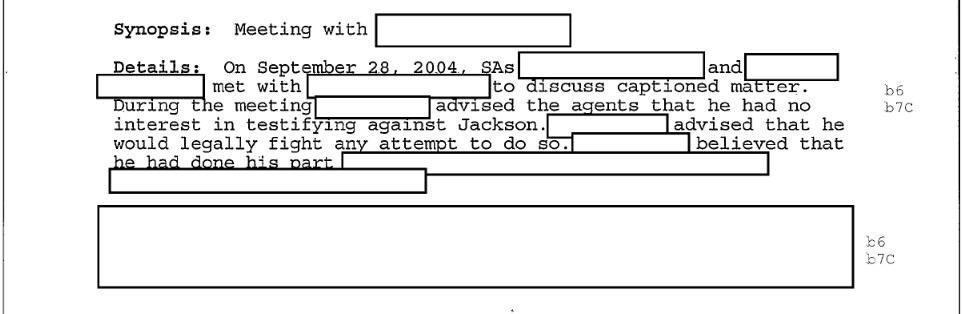
Jackson's defense couldn't have known at the time they settled the civil case that the criminal case would implode after Jordan Chandler refused to testify. According to an FBI document (see part 7), Jordan said that he "had no interest in testifying against Jackson" and would "legally fight any attempt to do so". Absent Jordan, the criminal case fell apart since no other witnesses could be produced who could corroborate his claims of abuse or, more accurately, those made by his father.
The Chandlers never actively sought a criminal conviction or psychological help for their allegedly damaged son who, after Jackson's death, admitted that Jackson had never abused him:
Under the influence of a controversial father who told his son to tell that Jackson had touched his penis. Jordan Chandler then told a psychiatrist and later police that he and Jackson had engaged in acts of kissing, masturbation and oral sex, as well as giving a detailed description of what he alleged were the singer's genitals.
"Now for the first time I can't bare to lie anymore. Michael Jackson didn't do anything to me, all was my father's lies to escape from being poor."
In 2006, Jordan Chandler filed a restraining order against his father Evan Chandler, after he reported that his dad hit him from behind over the head with a twelve and a half pound weight.
the Arvizo affair
From 2000 to 2003, more allegations of crimes involving children were leveled against Jackson and in 2004 he was again charged with multiple offences including child sexual abuse, furnishing alcohol to a minor, extortion and child abduction, all stemming from Gavin Arvizo who was also 13 when the alleged crimes occurred at Jackson's Neverland Ranch property. The Arvizos also claimed that Gavin and his mother, Janet, were being held at Neverland Ranch against their will, however this claim fell apart when it was revealed they had left and returned to the ranch several times during shopping excursions. As with the Chandler case, the evidence again clearly dictated that the Arvizo family fabricated the charges and did so almost immediately upon having been asked to leave Neverland Ranch upon wearing out their welcome, one reason being that Michael didn't trust them according to La Toya Jackson, his sister. When Gavin was finally interviewed by authorities, he stated he had been abused fewer than 5 times, exactly 5 times, and exactly 7 times, sometimes changing the number during the same interview. During the criminal trial the number was changed to 2 and when specifically asked whether there had been any other incidents of abuse, Gavin said there were not.
Like the Chandlers, who have been described as "brazen opportunists", the Arvizo family clearly saw Jackson as an easily tappable money spigot, however their extortion scheme failed when Jackson was acquitted of all 14 charges in the People vs. Michael Jackson criminal case. Nevertheless, the damage to his reputation and career had been done and the fallout continues to this very day, long after his death. Jackson suffered greatly emotionally as a result of the false allegations and would never return to Neverland Ranch, choosing instead to live abroad for several months before returning to the United States. Thomas Mesereau, Jackson's attorney during the 2005 trial, stated the following during an interview regarding the 1994 case:
Michael Jackson told me, in no uncertain terms, that settling that case in 1994, was the biggest mistake he'd ever made. He should never have settled it. He should have fought it, through a trial, he would've won. It was an absurd case. But he was advised, he told me, by lawyers, by business advisors, to settle it and get rid of it, that he had bigger fish to fry, bigger projects to get involved in, that the money would be a drop in the bucket compared to what he was capable of making around the world, and that diverting everybody's attention because of the publicity attached to this, civil case, was a mistake. Uh he followed his advisors, you know, suggestions, he paid money, and what it really did was it opened Pandora's Box because suddenly everybody on the planet began suing him thinking they could make an easy buck, suing Michael Jackson.
The Trial of Michael Jackson page on Wikipedia includes a timeline of events regarding the allegations make by the Arvizo family before the 2005 criminal trial began and several are quite revealing:
August 2000 - The Arvizo family informs Michael Jackson that their son is dying of cancer and makes a request through a charity organization to meet him at Neverland Ranch. This is the night later referenced in the controversial documentary Living with Michael Jackson. The documentary does not mention that Jackson had slept on the floor with one of his associates that night as he did not trust the Arvizo family, and never shared the bed with the children, due to director Martin Bashir editing Jackson's statement out of the documentary.
September-November 2000 - Janet Arvizo tells her co-workers that she exploited her son's cancer for money, a claim that's supported by reports that were published detailing how she begged a newspaper organization to raise enough money for a donation drive to help with medical expenses resulting in a fund of $965 and asking to have it donated to her home address. However, an investigation revealed that all of her family's medical bills were covered by insurance.
September 2001 - Janet Arvizo and her family reach an out-of-court settlement with J. C. Penney. The subject of the case is an allegation by the Arvizo family that in 1998 J.C. Penney guards assaulted Janet, David and her children in a parking lot and they sexually abused Janet. However investigation reveals that the family had stolen items from the store which prompted security officers to follow them and later lied under oath regarding the events that took place.
September 2002 - Michael Jackson meets with Martin Bashir during the filming of Living with Michael Jackson. However, controversy arises later as Bashir is accused of manipulating the broadcast by selectively editing footage to misrepresent Jackson, with later allegations that he forged Jackson's signature to secure the rights to cover him. Bashir refuses to respond to questioning by objecting under Shield Law.
February 14-27, 2003 - Prompted by backlash to the Living with Michael Jackson documentary, a school official contacts the Department of Children and Family Services and requests that they investigate Jackson. Social workers interview the Arvizo family, who all maintained that Jackson had never acted inappropriately around them. Janet Arvizo later stated that her children had never been left alone with Jackson and they had never slept in a bed with him. According to the report: "The investigation by the Sensitive Case Unit concluded the allegations of neglect and sexual abuse to be unfounded.
February 21 - March 12, 2003 - The revised period of abuse claimed by prosecutor Tom Sneddon, alleging that Michael Jackson didn't begin abusing Gavin Arvizo until after being accused of abusing Gavin Arvizo and subjected to an investigation into potential abuse between February 14 to February 27. Janet Arvizo later claims that Michael Jackson was holding her and the family hostage at Neverland even though log books showed how she had willingly left and returned to Neverland multiple times during this period.
November 2003 - Tom Sneddon has 70 police officers raid Neverland Ranch in search of evidence. Over 100 sanctioned raids of the property were conducted, making it one of the largest criminal investigations in history.
On a side note regarding Gavin reportedly "dying of cancer", he is still alive as of this writing.
An important and independently produced 2019 documentary, Square One: Michael Jackson by Danny Wu, addresses the Neverland Ranch bedroom controversy, the sexual allegations made by the Chandlers and Arvizos, as well as other matters and people of interest, including Victor Gutierrez who coached several of Jackson's alleged victims. The following synopsis was provided by WatchDocumentary.com:
"Square One: Michael Jackson" is a compelling documentary that dives deep into the allegations of child sexual abuse against the King of Pop, Michael Jackson. Directed by Danny Wu and produced independently, this documentary offers a critical examination of the accusations that have surrounded Jackson for decades.
Released in 2019, "Square One: Michael Jackson" presents a thorough investigation into the timeline of events, legal proceedings, and media coverage surrounding the allegations. Through interviews with legal experts, journalists, and individuals close to the case, the documentary sheds light on the inconsistencies and lack of evidence in the accusations against Jackson.
This thought-provoking film challenges viewers to reconsider the narrative surrounding Michael Jackson and encourages a closer examination of the factors that have influenced public perception. By presenting alternative viewpoints and scrutinizing the media's portrayal of the allegations, "Square One: Michael Jackson" invites audiences to question the validity of the accusations and the role of sensationalism in shaping public opinion.
Many people seem to believe that Jackson settled numerous child molestation cases out-of-court, however the Chandler and Francia cases appear to be the only ones and both were clearly motivated by greed, but could there have been something even darker lurking beneath the surface of their claims?
the La Toya affair
In what must have been a tremendously devastating blow at the worst possible time, Michael's own sister, La Toya, also accused her brother of pedophilia and added that her father was a sexual abuser as well, and she did so very publicly in several televised interviews, sometimes stating that she could no longer remain a "silent collaborator". She would later rescind her accusation against her brother, stating she had been forced to incriminate Michael by her Russian-Jewish immigrant manager and husband at the time, Jack Leon Gordon, a convicted felon with ties to the Genovese crime family who had used several names, including Samuel Isaac Gordon and Clifford William Johnson. Gordon had been convicted of statutory rape, attempting to bribe Nevada state gaming officials and pandering.
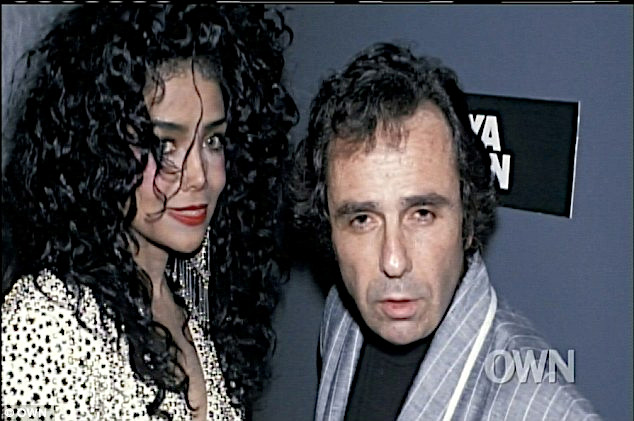
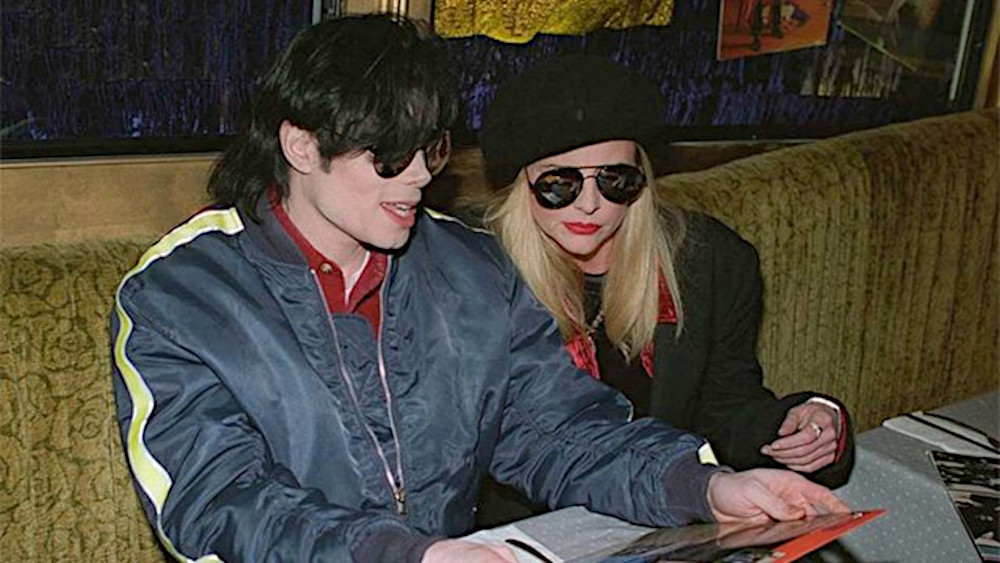
La Toya described her 9 year marriage to Gordon (pictured above), who was 20 years her senior, as "forced" and stated that the arrangement was solely for business reasons, existed only on paper, and was never consummated. According to La Toya, Gordon was a violent and powerful man who was extremely controlling and physically abusive. She said that he isolated her from her family who attempted, but failed to rescue her, that he prevented her from using the phone, locked her in a closet for hours at a time, forced her to appear in pornographic videos, used her as a drug mule without her knowledge, physically beat her and, most importantly in the context of this article, threatened to kill her and Michael if she didn't publicly implicate her brother in the child abuse crimes for which he had been accused. If her statements were true, was the child abuse scheme hatched solely by Gordon, or was there a wider conspiracy?
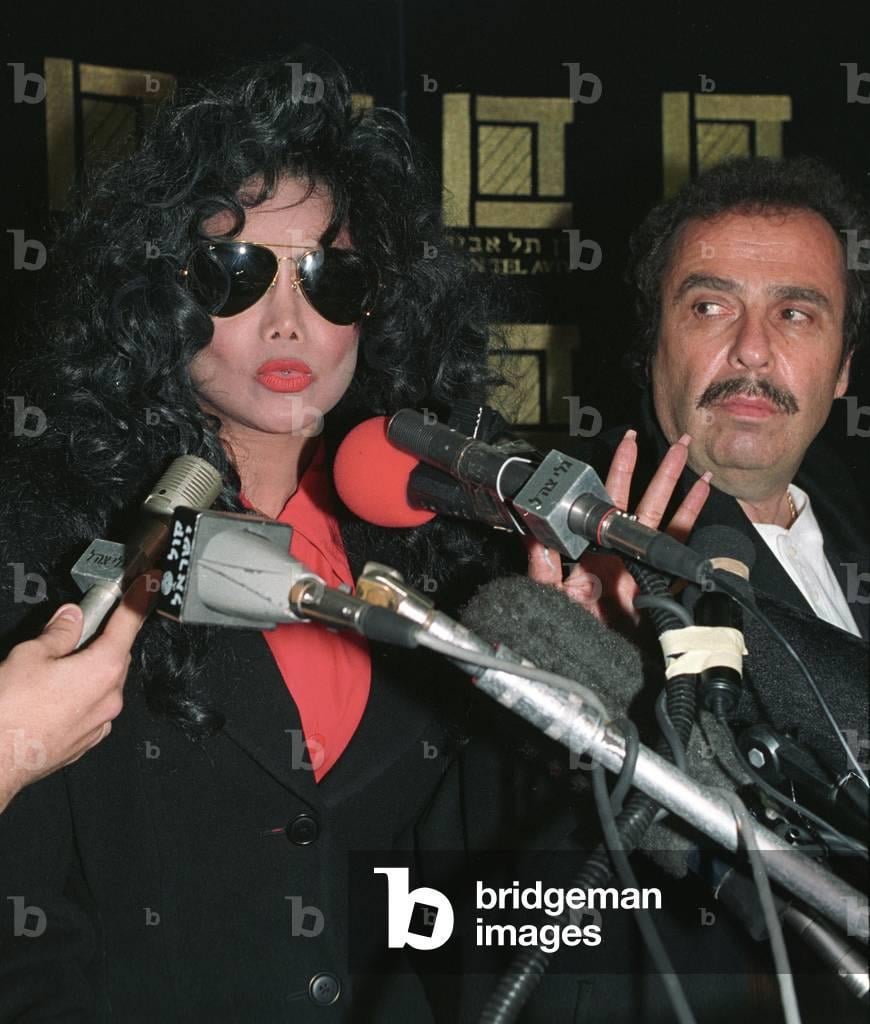
La Toy's first public accusation against Michael occurred on December 8, 1993, when she addressed reporters in a late night press conference in Tel Aviv, Israel, after allegedly being instructed on what to say by Gordon. Although the press conference was held indoors, La Toya wore dark sunglasses which does not appear to be typical during such occasions. I can imagine a few reasons why she might have worn them; 1) a style choice, or 2) to shield her eyes from camera flashes, or 3) she was hiding physical damage to her face, potentially inflicted by Gordon, or 4) she didn't want people to see her eyes because she knew she wasn't being truthful.
During another interview in Australia, La Toya was suspected of wearing an earpiece and being coached by someone in the audience, presumably Gordon.
The video, La Toya Jackson Chronology: Michael Jackson Allegations [1991-2020], provides an excellent chronology of her interviews which demonstrate how her initial claims of her brother being a pedophile were dropped after she managed to escape her marriage to Jack Gordon.
the Robson-Safechuck affair
The latest accusations of child sexual abuse against Michael Jackson are currently circulating in the California courts. Wade Robson and James Safechuck also didn't remember -- or did remember, but didn't realize -- that they too were molested by Michael Jackson until years after his death, which of course freed the duo from having to endure a criminal trial and deposition. Their stories were the focus of the 2019 'documentary' produced by Dan Reed, Leaving Neverland, which reignited the child sexual abuse claims against Jackson and caused radio stations to stop playing Jackson's songs.
Robson, a semi-successful choreographer and writer, was having significant financial and emotional problems at the time due to his inability to manage some of the projects he was involved in. Prior to filing a civil suit in 2013, he stated many times, including under oath, that Jackson had never molested him. Safechuck, who filed his civil suit in 2019, stated the same. As with the other accusers in Jackson's past, the evidence proves to a high degree of certainty that the charges in both cases were fabricated for the purposes of notoriety and monetary gain. Safechuck even went to far as to claim that Jackson had bought him an engagement ring and held a mock wedding. Unfortunately the cash isn't rolling in as fast as the duo had hoped; the civil suits were twice thrown out by the California District Court and now reside in the California Court of Appeals for the second time. The case is slated to go to trial late in 2026, assuming it isn't thrown out a third time. A short documentary that details the Robson case is Michael Jackson And Wade Robson: The Real Story and another is a 2019 documentary, Neverland Firsthand: Investigating the Michael Jackson Documentary.
Neverland Firsthand: Investigating the Michael Jackson Documentary is a mini-documentary which further explores allegations made in HBO's Leaving Neverland, that the King of Pop sexually abused two young boys. Through interviews with those closest to the situation, as well as members of Jackson's family, the film sheds light on information that was excluded from HBO's broadcast.
There is obviously much more that could be said about the Robson and Safechuck cases, however they are so obscenely ludicrous on their face that it isn't worth elaborating upon these clowns who make the Chandlers and Arvizos look creditable by comparison. Those wanting to know more about these cases can visit the The Michael Jackson Allegations playlist on YouTube. I also created a searchable list of all 388 videos contained in the playlist where one can find 30 instances of 'Robson' and 10 instances of 'Safechuck' (use Ctrl + F to search the list). Finally, i would also suggest the short documentary, Entering Neverland:
The rebuttal to "Leaving Neverland" and exposing the truth about Michael Jackson. Entering Neverland will cover who the King really is, why the media lies about him, and the lies Wade Robson and James Safechuck are telling.
the Jacobshagen affair
Finally we'll look at our last character, Michael Jacobshagen, a con-artist and grifter who insists he was very close friends with Jackson for decades, during which time he says Michael wrote him dozens of letters. Jacobshagen capitalized on Jackson's fame by selling items that he claimed belonged to his 'close friend', such as one-of-a-kind items for which he seemed to have a limitless supply, including articles of clothing and forged documents. He apparently made enough money form his illicit business that he was able to hire a lawyer to threaten anyone attempting to expose his scam. When Jacobshagen's grifting was finally exposed in a documentary that aired on German television, his retail business apparently dried up and so he quickly jumped on the sex abuse money train, claiming that he too was a victim of Jackson ... just 2 days after stating he wasn't. Jacobshagen apparently met Michael Jackson only once and never set foot on the Neverland Ranch property where he claims the abuse occurred. For a detailed breakdown of the investigation into Jacobshagen, see the following video:
This interview made on the 7th of March 2019 with Chantal Obrist recounts the criminal investigation which is currently active against Michael Jacobshagen.
Chantal is 1 part of an Investigatory team which also includes leader Matthias Frank and partner Jochen Haug all of whom have been working in the background on bringing light to what Michael Jacobshagen's criminal acts in defrauding Michael Jackson fans and also now... Making up child abuse claims and changing his story to fall in line with those unbelievable claims of Wade Robson and James Safechuck.
The media is not interested in the truth or portraying facts accurately so it is up to us to put in the effort and make sure the truth gets out there. We also need to always be on guard community because the media has got used to this despicable level of journalistic integrity and not mean to do well by Michael Jackson as this has been clear since the 1980s.
The media has a vested interest in protecting abuse claimants and destroying the legacy of Michael Jackson, a man cleared of all charges in 2005!
THE INDUSTRY
the death clause
"They suck. They're like leeches. I'm so tired of it. I'm so tired of it. They start out the most popular person in the world, make a lot of money -- big house, cars and everything -- end up with penniless. It's a conspiracy. The Jews do it on purpose."
Within music artist contracts with their label is what is sometimes referred to as a "death clause" which addresses how an artist's assets and publishing rights are handled by their label should they die. To better understand the lucrative "death clause", watch the excellent documentary by 'Barely Sociable' linked below. This intriguing and shocking documentary provides a comprehensive understanding of a portion of the systemic criminality and corruption that exists within the music industry. On a side note, the title obviously hints at a second volume, however more than 3 years have passed since the first volume was published in mid 2022 and apparently there has been no mention of a followup which causes me to wonder whether the author may have been persuaded to abandon his research.
The Music Industry has an infamous history as one of the shadiest. Within this new docuseries we will be take a look at it's dark side. Between the ties to organized crime to the rigging of the charts, the goal of this series is to be a walkthrough, and tour through the stories the industry would probably like to ignore.
During an interview of La Toya Jackson by Barbara Walters for ABC's 20/20 in 2009, she was asked why her husband and manager, Jack Gordon, forced her to incriminate Michael and her response was, "He had this hatred towards my brother, that i can never explain to you why it was ...". Unfortunately her answer seems to have been cut off. When asked who murdered her brother, she said, "I don't know exactly who. I think there're more players involved than we know. This is just my opinion. This is what i feel. I know what Michael was afraid of. I know that when you're ...". Walters interrupts again and asks what it was that her brother was afraid of to which La Toya replies, "He was afraid of his life. He would say 'i'm afraid of my life', 'i'm afraid they're gonna assassinate him', 'afraid they're gonna kill me'. He would always say that Barbara.". Walters then states, "La Toya said that Michael was murdered by people who would benefit financially from his death, but she never made it clear who she thought was involved, or how they would profit.". Walters then asks, "Will you name names?" to which La Toya responded, "I think within time it may just come out and people will know.".
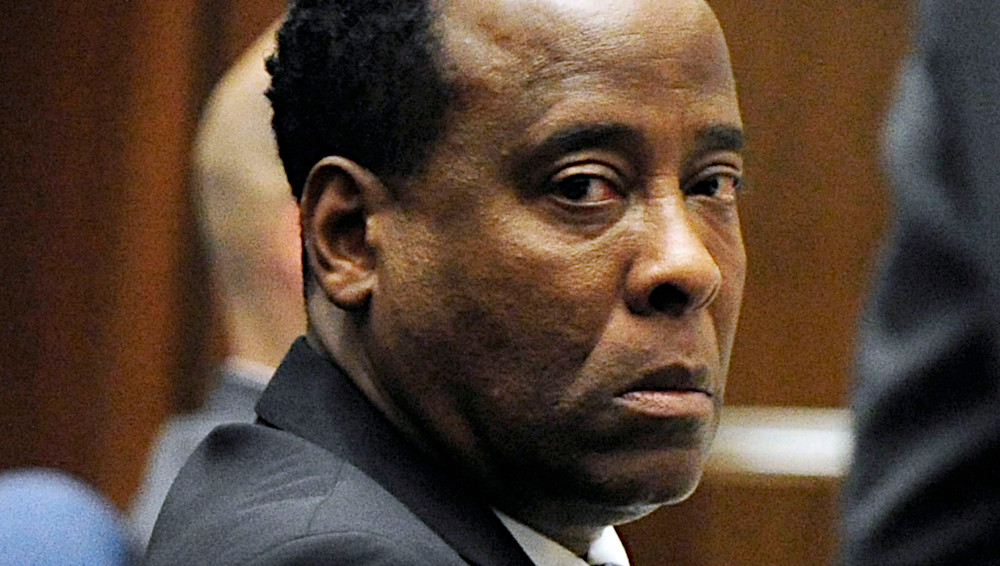
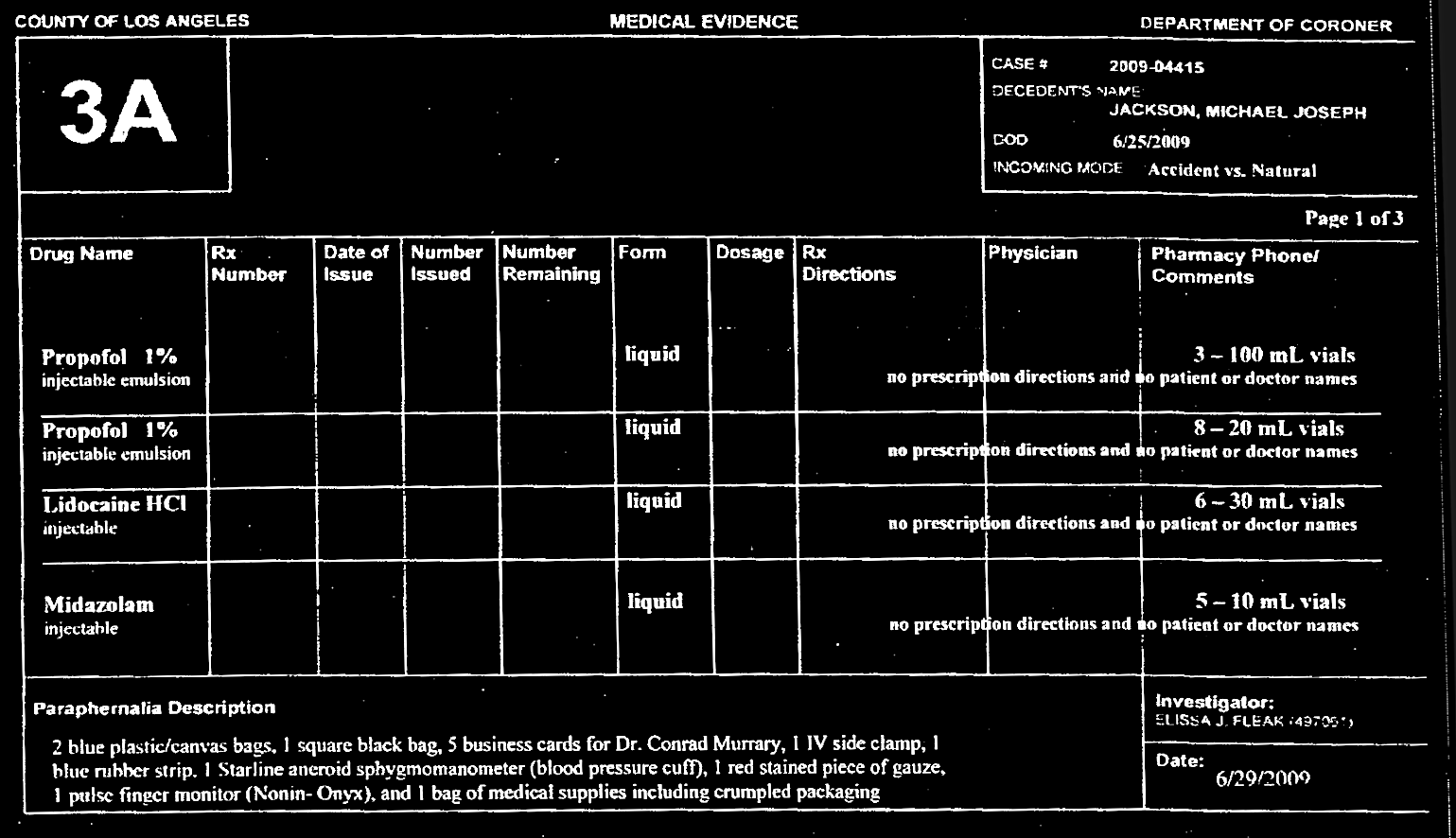
The interview then turns to Michael's doctors and La Toya states that she signed her brothers death certificate because Dr. Conrad Murray failed to do so despite him being the attending physician responsible for her brother's death for which he was convicted of involuntary manslaughter. Later, Walters states that "Michael hired his doctors himself." to which La Toya replies, "That's what we've been told. We don't know that to be sure, do we?". Walters than asks, "What's the alternative?" and La Toya responds, "That someone else around Michael hired those doctors and i've been told that over and over and over again.".
In an interview by KTLA 5 News, La Toya Jackson on KTLA talking about Starting Over, La Toya is more forthcoming and when asked what she thinks the reason was for her brothers death, she responds, "It was pure murder. I don't care what anyone says. This was pure murder. This was a controversy. This was all manipulated to do this. And Michael knew that and he mentioned it over and over and over again to me; told me who was going to do it, why they were going to do it, the reason for doing it ...". La Toya is interrupted and asked, "What was the motive?", to which she replies, "The motive was to get his publishing- I don't know if you guys are aware of it but Michael had one of the biggest catalogs in the world." After a brief interruption she continues, "Everybody's biggest- every artist basically out there. [...] It's over billions of dollars.", referring to the value of Michael's Sony/ATV Music Publishing catalog.
The conversation then shifts to Dr. Conrad Murray and La Toya emphatically states that "Dr. Murray was a fall guy. Bottom line, that's what he was. And they knew this. These people entered into his life when [Michael] did not want them there.". Later she says, "You must understand. These people, according to [Michael], they came into his life- and according to the staff that worked around him- they came into his life probably a week, some of them, before he passed, and they were inquiring about the [ATV Music Publishing] catalog. Mind you, Michael told me about the catalog years ago, how they were after him for it. So, it's very interesting. And you have to keep this in mind too, when my- when my brother passed that- well actually it's really early in the morning, and of course everything was reported later and they hid all the evidence, as much as they possibly could, but when he passed, do you know the people that were working with him went in there and fired every single staff that work with Michael and made them sign a confidentiality contract. You can't- you can't tell anything. Disclosure. That's something you don't do.".
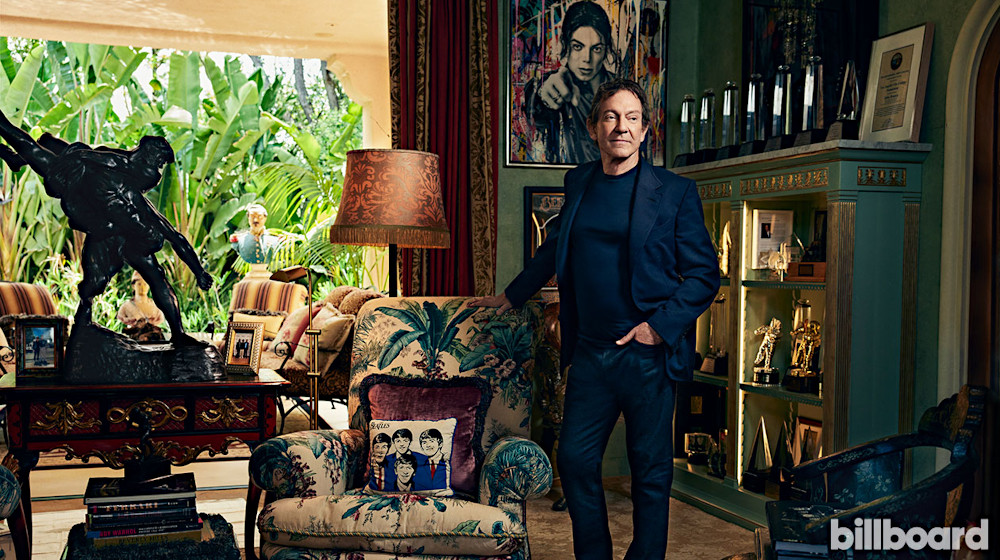
One of the people that reentered Michael's life in the days before his death was the iconic Jewish lawyer, John Branca (pictured above), who was featured as one of the top 15 lawyers in the world. Despite Branca having had a close relationship with Sony and having been hired and dismissed twice by Jackson, though there exists a controversy regarding his dismissal, he would later be appointed as co-executor of Michael's estate which included the ATV Music Publishing catalog.
As the interview comes to a close, La Toys is asked her final questions, "What do you hope happens now?", to which she responds, "I want justice.". When asked what justice would be, she replies, "I want justice for all of those who are responsible for my brother's death...". The interviewer interrupts, "And they are?", to which Lo Toya replies, "And those people are the ones that they know who they are. It wasn't just Dr. Murray and I'm telling them to look to the right and left, but they choose to look [La Toya motions with her hands that the investigators would only look in a very narrow direction] ... and it's not fair. It's totally unfair and they know that.".
the executives
The music industry is a fantastically corrupt, abusive and parasitic one which, like most of the entertainment industry, including the pornography sector, is largely controlled by Jewish criminals whose motives and methods are far more sinister and brutal than most people would or could imagine. While that statement may strike one as selectively hateful, it is not. I am simply highlighting a fact that is easily discoverable by anyone who cares to look. The problem is not the human being, rather it is one of brainwashing and, in this case, the adoption of an extremely toxic religion and ideology, one which promotes the belief that Jews are "God's chosen people" while non-Jews, the "Goyim", are little more than non-human animals to be raped and plundered. Michael Jackson, not being Jewish, was therefore fair game.
Discussion of the tremendous influence and corrosive and parasitic nature that many Jewish executives have upon the entertainment industry is a taboo subject for obvious reasons. There have been many celebrities that immediately regretted having spoken out about this elephant in the room. Black people may be more outspoken than non-Blacks as evidenced in The Antisemitism of Michael Jackson documentary during which a number of intriguing bits of information are revealed. N.W.A. rapper, Ice Cube, accurately summed up the situation in a single sentence:
For me to be anti-Semitic, in the business i'm in, would be ... economical disaster and suicide.
Obviously it is not exclusively Jewish people who are responsible for the woes befalling artists in the entertainment business, but Ice Cube clearly hints that their presence and influence is overwhelming to a degree that cannot be ignored. While Jews represent just 0.2% of the worlds population and roughly 2% of the population of the United States, they permeate all major institutions in the U.S. and elsewhere from government, finance and publishing to technology and the media. I doubt that anyone in the entertainment business is oblivious to their presence and behavior, but for obvious reasons, very few are able to harness enough guts to speak out publicly, even after having been victimized, though privately they are often more open.
As a result of Israel's ongoing genocide of the Palestinians which dates back to 1948, as well as the recent exposure of Jewish criminals such as Harvey Weinstein, Jeffery Epstein and Ghislaine Maxwell, it has become more acceptable to openly criticize Zionism and Israel and to highlight the criminal activities in which a portion of Jewry indulge and the institutions they influence. This renewed wave of criticism is precisely why there is a push to subvert the 1st Amendment to the U.S. Constitution in order to censor speech on social media platforms, of which the U.S. portion of TikTok is the latest victim having been bought by Oracle, a Jewish owned company sympathetic to Israel which has an interest is curtailing criticism of the Jewish state while it engages in an ongoing genocide of non-Jews in occupied Palestine and elsewhere, a genocide that is funded largely by U.S. taxpayers. While Michael Jackson obviously did not hate Jews for being Jewish, he seemed to be keenly aware of the corrosive nature a portion of Jewry has upon the entertainment industry and he made his displeasure starkly evident in a phone call that was recorded by his doctor who would later be convicted of murdering him. Not only was the call recorded by Dr. Conrad Murray, but the content was leaked to the public, perhaps intentionally, which suggests that Murray's motive may have been to subject his patient to ridicule and smear him as an anti-Semite, potentially at the request of a higher authority.
They suck. They're like leeches. I'm so tired of it. I'm so tired of it. They start out the most popular person in the world, make a lot of money -- big house, cars and everything -- end up with penniless. It's a conspiracy. The Jews do it on purpose.
Pop star Michael Jackson was caught on tape making anti-Semitic remarks, calling Jews "leeches." In a series of audio tapes broadcasted Wednesday on ABC's "Good Morning America," Jackson is heard using anti-Semitic language in a voice message to one of his former advisers. "They suck, they're like leeches," Jackson is heard saying. "It's a conspiracy. The Jews do it on purpose."
Jackson again was viewed as attacking Jews in the lyrics of his powerful song, They Don't Care About Us. Following is an excerpt of the often censored lyrics (emphasis added):
[...] All I wanna say is that They don't really care about us
Beat me, hate me You can never break me Will me, thrill me You can never kill me Jew me, sue me Everybody do me Kick me, kike me Don't you black or white me
All I wanna say is that They don't really care about us [...]
While the lyrics of the song are seen by some as anti-Semitic and others as open to interpretation, what is not open to debate is that the lyrics implicate a class of powerful, narcissistic people that hold positions of great power and influence over those under their control.
I have never been so upset by a poll in my life. Only 22% of Americans now believe "the movie and television industries are pretty much run by Jews," down from nearly 50% in 1964. The Anti-Defamation League, which released the poll results last month, sees in these numbers a victory against stereotyping. Actually, it just shows how dumb America has gotten. Jews totally run Hollywood.
But it is true that Hollywood has a lot of Jewish people in it, right?
It should not be controversial to admit this. After all, Adam Sandler sang in 1994 that "so many Jews are in showbiz." And, speaking here as someone who's worked as a rabbi, queer activist, and journalist for the last twenty years, I don't think it's helpful for us to deny this reality, or refuse to discuss it. Doing so just shoves people's questions underground, where they often ferment into doubts or misgivings, aided by the shit-filled fertilizer of online conspiracy mongers.
On several occasions Jackson also commented publicly that our history books are full of lies which leads me to ponder whether he had studied Germany's role in World War II beyond what we were taught in government schools and by the mainstream media and in Hollywood films. Following is his response to those who insist that the lyrics of They Don't Care About Us are "anti-Semeitc":
The idea that these lyrics could be deemed objectionable is extremely hurtful to me, and misleading. The song in fact is about the pain of prejudice and hate and is a way to draw attention to social and political problems. I am the voice of the accused and the attacked. I am the voice of everyone. I am the skinhead, I am the Jew, I am the black man, I am the white man. I am not the one who was attacking. It is about the injustices to young people and how the system can wrongfully accuse them. I am angry and outraged that I could be so misinterpreted.
The timing of Jackson's battles with his label and the sexual abuse scandals is notable and begs the question of whether the allegations may have percolated from within the bowels of Sony in order to destroy Jackson's public image in connection with his legal disputes with Sony Music which, among others, sought to acquire his coveted ATV Music Publishing catalog. In 2019, a person claiming to be a corporate attorney with experience in acquisitions, venture capital and family trusts, left a rather lengthy post on Reddit in this regard. Following are some excerpts:
To be honest I have been on and seen the other side of such tactics before. Lawyers advise and work on "under the table" arrangments all day long. I am tired of comments that this is a "conspiracy theory". Please. It is only naive to believe the world works at all the way it appears at the public level...... Everything is about MONEY - follow the money.
[...]
People are suspicious of the money motives behind the allegations - from both sides
But the main $$$ in this issue is the music catalog...
When I follow the money and compare the timelines... I start to question:
Are Wade/James allegations part of a tactic by Sony to drive down the value of MJ's music catalog, in order to put pressure on the MJ Family/Trustees to sell?
Note that the catalog is controlled by outside trustees - NOT the beneficiaries/family members (i.e. NOT MJ's children)
If the MJ song titles become less valuable, to my legal knowledge, it may be justification for the Trust to sell the entire catalog to Sony.
As this may be the REAL subject here which everyone is clawing for.
The trust may be allowed/required to sell the remaining catalog rights... if the value in the titles drop - which will happen if MJ is banned from the air. [...]
(and to purely speculate -- Sony may also have some level of influence over the media outlets which are banning MJ.. and may have some control over lifting the bans....?)
FULL BACKGROUND:
My reasoning is...
after MJ's death, a group of investors took control of Sony/ATV in 2012 and they then also purchased EMI..
Sony/ATV/EMI became the largest music publisher administrator company in the world with more than 3 million songs and estimated revenues of over US$1.25 billion per year.https://en.wikipedia.org/wiki/Sony/ATV_Music_Publishing
This is around the same time as Wade reportedly realised he was abused (2012), and started to pursue his claims in court in 2013. The case was not heard and public attention died down.
Subsequently in 2014 James also launched his court claims and are quickly dismissed.
In 2016, MJ family trust then sells its 50% ownership of the Sony/ATV to SONY (for 750Mill)
Why was this decision made?
[...]
We should also note Wade's court claim was for 1.7 Billion (exactly the 1.5B value of the shares/catalog + 200M left in MJ's estate). It is unusual to quantify your claim this way... you usually claim for how much you value your pain and suffering to be (as caused by the alleged sexual abuse), NOT your estimate of the defendant's total assets.
It is also astronomically high compared to how much other victims/plaintiffs in such cases may claim.
So why was the MJ Family Trust able to sell its 50% ownership to Sony in 2016?
Normally no asset can be sold from a trust unless it can be justified to be a PRUDENT INVESTMENT DECISION or due to a legal requirement (e.g. asset is subject to a lawsuit)
Is it possible that the trustees were pressured to sell the shares by Sony - with Sony alleging that the company/catalog was under the constant threat of litigators/alleged victims like Wade & James... thereby using Wade's and James's claims conveniently as a justification?
[...]
Now Sony thus now controls the company and has (almost) 100% ownership of Sony/ATV/EMI
However MJ Family Trust still holds some of the music catalog rights (only MJ's own music now) and own 10% of EMI. However, last year.. 2018... MJ family trust sold their last remaining shares (10% of EMI) to Sony too.
That means the only thing left in the MJ estate are the rights to MJ's own songs titles.
And now in 2019.. Wade/James's allegations have resurfaced again in Leaving Neverland. The alleged victims and the doco has been subject to WIDE MEDIA PUBLICITY... and its impact has started to cause the banning of MJ's songs.
[...]
Trusts can only dispose/sell its assets if its the BEST FINANCIAL DECISION. This could mean if the value of the MJ catalog drops (MJ being banned from the air etc), it is possible for the Trust (or even mandatory for it) to justify that the risk of continuing to hold a depreciating asset is too high.. and that it is best to, e.g., sell the catalog to Sony and give a lump sum payment to Paris (who is now over 18)
- Sony/ATV company shares (the most important asset/profit generator is the beatles/MJ music catalog) is owned 50% by MJ
- Reportedly MJ's 50% share goes to MJ Family Trust upon his death (seems the main beneficiaries of the trust are his children and charities) - the total estimated asset worth of the shares/catalog is $750millon however it pays out $80million per year (so if it were you -- would you sell it??? more likely you would prefer to keep taking royalties for ongoing basis)
2012
- Reportedly a "group of investors" take control and leads Sony/ATV to acquire EMI - Sony, Michael Jackson Estate (about 10% ownership), US media billionaire David Geffen, US investment firm Blackstone and Abu Dhabi state-owned investment fund Mubadala.
- Now Sony/ATV/EMI not only owns beatles/mj catalogue, but essentially most of the world's published music titles
- Reportedly Wade realises he was abused with his therapist
2013
- Reportedly Wade visits lawyer and realises the estate has been administered. He launches civil suit and creditors claim for 1.7Billion (being the value of total assets of the Trust - 1.5B for the catalog and 200M other assets incl Neverland) - case does not proceed
2014
- Reportedly James Safechuck also launches his court claims, they are quickly dismissed.
2016
- Reportedly MJ Family Trust sells its 50% share in Sony/ATV/EMI to Sony
- MJ Family Trust still retains to my understanding 1) MJ's own music catalog rights despite sale of company shares and 2) retains 10% of EMI
2018
- Reportedly MJ Family Trust's sells 10% of EMI to Sony
- Sony now owning 100% of shares
- MJ Family Trust now holds only the MJ "Mijac" publishing rights
2019
- Leaving Neverland is released
Next development..?
Speculating only... potentially... the estimated value of the catalog of MJ is lowered due to the public reaction... and the trustees of the MJ Family Trust sells the catalog... to Sony...???
Although the person who made the Reddit post did not identify themselves, the conspiracy they posited is indeed plausible and in fact the prediction they made regarding Jackson's estate selling the ATV Publishing catalog materialized in 2024 which further reinforces my suspicion that the child molestation claims may have been part of a larger conspiracy. If my suspicion is correct then my question is, once again, where did the conspiracy originate?
Sony's agreement with Michael Jackson's estate will remain intact despite pushback.
As AFROTECH™ previously mentioned, Sony Music Group reportedly closed a sale related to the late "Rock With You" singer's legendary catalog, which encompassed half of his publishing and recorded masters catalog. In total, the assets were worth between $1.2 billion and $1.5 billion.
Sony Music Group reportedly paid at least $600 million in the deal to claim its portion of the stake in Michael's assets.
However, there was allegedly some pushback surrounding the deal from his mother, Katherine Jackson. Billboard reports that she attempted to stop the deal. This was because his executors, John Branca and John McClain, had appeared to privately go to Judge Mitchell Beckloff to get the green light for the deal. Katherine argued that it would "violate Michael's wishes" and that the catalog's valuation would still rise if the estate maintained its ownership.
Beckloff turned down the notion in April 2023 and permitted the deal to proceed. Katherine moved forward with an appeal, and on Wednesday, Aug. 21, 2024, a court ruling stated that Branca and McClain were not in the wrong for selling a portion of Michael's assets to Sony Music Group.
After Jackson's death, John Branca and John McClain were appointed as co-executors of his estate in accordance with Michael's will, however the authenticity of the will was challenged by Jackson family members who claimed that Michael could not have signed the allegedly fraudulent document because, among other reasons, he was in New York at the time the revised will was signed in Los Angeles:
Five of the Jacksons, in a letter to the estate's executors, have called the will of the late pop star "fake, flawed and fraudulent." They claim its signature is false: That though the document gives Michael's location on the day he signed as Los Angeles, they know him to have been in New York. They accuse the two executors of everything from coercing family matriarch Katherine Jackson, to mishandling business deals, to getting too juicy a cut for themselves from those same deals.
Was John Branca protecting Michael Jackson - or protecting himself?
From his rise as MJ's lawyer to controlling the estate after Michael's death, Branca remains one of the most powerful and controversial figures in MJ's story. This is the truth fans have been debating for decades.
After being released the first time we are told that Jackson brought Bronca back on board to solicit his advice on merging his ATV Publishing catalog with Sony. Bronca, who was earlier denied a 5% share in the catalog, helped negotiate the 600 million dollar deal and received the 5% share he sought earlier. Some members of Michael's family tried to stop the deal, but the court permitted it.
Branca helped Jackson purchase ATV Music Publishing in 1985 for $47,500,000 (which held the copyrights to The Beatles' and Little Richard's songs). Within a few years the catalog was worth more than $400,000,000. In 1990, Jackson terminated Branca's services due to perceived proximity to Walter Yetnikoff, the CEO of CBS Records, and a consultant to Sony Corp. Jackson also expressed concerns about Branca's representation of other artists such as the Rolling Stones and Aerosmith. Additionally, Branca requested a 5 percent interest in the Beatles catalog. Three years later, Jackson sought Branca's advice on merging his ATV catalog with Sony, resulting in Branca rejoining Jackson's team in exchange for a 5% share of the ATV catalog. In 1995, Branca proposed a merger of Sony's music publishing operations and ATV, resulting in Jackson becoming a significant owner of a larger company and receiving $150 million from Sony. Branca received 5 percent of this, amounting to $7.5 million.
In what could be the largest valuation ever of a musician's music assets, Sony Music Group has closed an agreement to buy half of Michael Jackson's publishing and recorded masters catalog in a deal that sources say valued those music assets somewhere above $1.2 billion. Other sources have suggested it might be as much as $1.5 billion. At those valuations, Sony will pay at least $600 million for its stake of the legendary rights.
Sony was not the only company that sought to acquire Jackson's music catalogs. The following is an excerpt from a 2010 article by The Wrap and, here again, we see the tenuous position Jackson's music would be left in had he failed to repay his loans (emphasis added):
But did Branca, who had a hand in nearly all of MJ's most brilliant career and financial moves, always have his client's best interests at heart? According to documents obtained by TheWrap, the lawyer tried to help along a deal that would have dispossessed Jackson of the music catalogue he held most dear -- while making Branca considerably richer.
Branca has never embraced the limelight. But in a months-long investigation that included secret documents and two dozen interviews - one with Branca himself - TheWrap reveals the complicated relationship between the singer and the lawyer that Jackson would hire for the last time within a week of his death.
In that short, final tenure, Branca was left permanently in charge of one of the most important music legacies of our time.
It is punctuated by moments of brilliance, such as when the lawyer orchestrated Jackson's purchase of the Beatles' song catalogue, ATV Music, perhaps the most important deal of Jackson's life.
But some might conclude that Branca is no hero at all. A proposal in 2003 that would have sold Jackson's interests in the Beatles' and Mijac catalogues to the investment bank Goldman Sachs would lead some to question Branca's role in Jackson's business affairs.
Either way, his importance in the constellation of Michael Jackson's firmament cannot be dismissed. The release within days of Jackson's first posthumous album comes on the heels of record-setting income of $275 million in the year since Jackson died. According to Forbes magazine, the sum topped the year's list of entertainer's posthumous earnings.
This summer, however, Branca became preoccupied with Jackson's massive $300 million bank loan from the British banking giant Barclaysagainst the estate's crown jewel - half interest in Sony/ATV Music Publishing.
At the core of Sony/ATV's enviable collection of rights to songs by the likes of Elvis, Bob Dylan and Eminem is to be found the Beatles song catalog, a 20th century musical treasure that Branca famously arranged for Jackson once to own outright. Today, Sony/ATV, which Sony Corp. co-owns, is worth at least $1.6 billion, a valuation substantially attributable to the Beatles.
The due date for the mammoth loan loomed this month, and missing it might have meant a loosening of the estate's grip on its half of Sony/ATV. But Branca beat the clock by months, arranging to refinance the loan in September through the Swiss financial services giant UBS.
Branca had a previous encounter with the songs and the debt. From 2003 to 2004, virtually the identical financial crisis -- almost $300 million of debt, with the songs at stake -- was met with a momentous initiative led not by Branca but by a power cast that included Wall Street-savvy Goldman Sachs, veteran music entrepreneur Charles Koppelman and a Florida entrepreneur dogged by mob suspicions, Alvin Malnik (pictured below, with Jackson).
A cache of confidential documents from the seven-year-old episode -- a copy of which was provided by a member of the group -- reveals an intriguing inside look at the far-reaching effort, which long has been an object of media fascination and Internet-based conspiracy theorists.
[...]
In the documents, Goldman's master financial alchemists began proposing a venture to position Jackson as "the Bill Gates of the music industry" and described how not only the $300 million debt might be whittled but also detailed how the beleaguered legend could walk away with perhaps $1.3 billion -- with the Wall Street firm exiting even richer.
But only if he would sell his interest in Sony/ATV and in Mijac, the catalogue of Jackson's own hits. According to the secret documents, Goldman was prepared even to "drag" Jackson along into a deal to sell them.
As the proposal evolved during more than a year, its fundamental flaw -- that Jackson all but surely would forfeit his songs -- remained clearly obvious to Branca. More than anyone, Branca knew that owning the songs was one of his client Jackson's great passions and that the singer worried intensely about them slipping from his grasp.
So why then had Branca worked so hard, as the secret files appear to indicate, for an outcome most feared by his client?
According to entrepreneur Malnik, Branca stood to collect $17 million from the Goldman dealings for a 5 percent interest that he held in Jackson's stake in the Beatles' catalog.
In a July 2003 missive on his firm's letterhead, Branca essentially put Goldman on notice that it ultimately must ensure Jackson's ongoing obligations - including "direct payment of this firm's 5%" - if the proposal progressed.
Alas, the Goldman deal, more than a year in the making, got no further than the paper on which it was written. Rather, it was scuttled by Jackson against a backdrop of behind-the-scenes hijinks that seemed to mirror his final sad decade, which roiled with scandals, a criminal trial, epic debt and an ever-rotating inner circle.
[...]
As for Branca, by the time the deal collapsed, the superlawyer had been fired.
It was not the first time. Jackson repeatedly fired Branca (pictured in 2009 after being named an estate co-administrator), whose firm Ziffren, Brittenham, Branca, Fischer, Gilbert-Lurie, Stiffelman, Cook, Johnson, Lande & Wolf is one of the entertainment industry's most powerful.
Indeed, in June 2009, within a week of Jackson's death, Branca -- nominated in the singer's will to be the steward of his estate -- returned to the fold after a three-year break-up.
Six days after Jackson's drug-fueled death -- having spoken to him only once in three years -- he, along with longtime Jackson family friend John McClain, emerged as co-executor of the tragic icon's extraordinary holdings.
With the Goldman Sachs proposal torpedoed by Jackson, "superlawyer" John Branca would be missing out on millions of dollars, unless of course something happened that could rejuvenate his interest and, whether intentionally or not, Jackson's death did exactly that.
As i alluded to earlier, Michael Jackson may have become a threat beyond the music industry. In 2013, Piers Morgan interviewed Michael's father, Joseph, along with Michael's former manager, Dieter Wiesner. The interview includes a very interesting audio recording of Jackson discussing his plan to purchase Universal's Marvel Comics:
Piers Morgan: "I was struck that there was another Michael Jackson here, the businessman. And I want to play a tape before I come to you. This is him discussing with you, I think, about a plan to buy Marvel, the comic business, back in 2001/2002... Let's listen to this..."
Audio clip of Michael Jackson: "We could easily go into Universal and buy it. We would own Jaws, ET, Close Encounters, you know, all the classics from Universal on all that stuff that will allow us to do a Universal, I mean a channel. The part of the Marvel channel can be not only the Marvel characters, but Marvel films, like the catalog. We could do anything we want from restaurants, to retail, theme parks."
Piers Morgan to Dieter Wiesner, Michael's former Manager: "Now you actually got the financing in place I believe for this deal. Then came the scandal, court cases, and it all got put on the back burner. Disney ended up buying Marvel and doing exactly what Michael had predicted and making a fortune at it. Tell me about this."
Response from Dieter Wiesner: "That was the second part of his life. He did want to do this and he knew exactly every single detail what he wants to do. And he was absolutely right because he was saying, 'so the music career, I cannot do more with that than what I did, that's it and I have the Beatles catalog on one side. If I buy this Marvel catalog...' - he has a second part, a big part, in his life. He would be the richest person in the world."
Piers Morgan: "Yeah, he understood the power of owning rights to things. I mean, I remember Paul McCartney giving an interview saying he couldn't even play some of his own songs because Michael had bought them... He realized the power of publishing rights which is the same in music and movies and television and all of it."
Understanding the criminality and corruption in the music industry and the lengths to which these criminals will go in their pursuit of profits and control, and factoring in capitalism of course, it isn't illogical to suggest that Sony would never accept the financial loss of one of its biggest investments deciding to go solo without acting upon the threat. Furthermore, considering the industry's many intricate ties to organized crime, it isn't outrageous to suggest that Sony had a motive to want Jackson erased and a debt-ridden and potentially corruptible doctor could provide the means to achieve that end after which Sony could capitalize on the windfall provided by a massive spike in record sales along with other lucrative business deals, including complete acquisition of the ATV Music catalog which was valued at more than 1 billion dollars at one point.
The passing of notable artists such as Prince, David Bowie, and Tom Petty has generated a surge in music sales associated with them. However, the impact of the death of these artists on sales that follows their deaths is not well understood. We aim to understand what happens to long-term effects on post-death sales and whether there is a return to pre-death levels. We use standard fixed effects panel estimations to assess the impact of an artist's death on the sales of the artist's albums and the rate at which album consumption decreases thereafter. We leverage a dataset of daily album sales for 81 artists, associated with 109 bands, who died between January 31, 2015 and December 1, 2017. Our findings show that the rate of sales does not return to pre-death levels but instead is in most instances persistently higher even several years after the death shock occurs.
In the year of his death, a record 11.3 million tracks by the artist were downloaded in the USA, and 2.8 million albums were sold in the UK. From his death to the end of November 2009, he sold 7 million albums, 10.2 million downloaded tracks and 1.3 million DVDs in the USA. The first morning after his death saw over 1 million YouTube plays of "Beat It", and in the first week 2.6 million Michael Jackson downloads were sold in the USA.
In the 12 months that followed his death Jackson sold nine million albums in the US, and 35 million albums worldwide. By the end of 2013, album sales alone totaled 50 million worldwide according to Billboard. Other reputable sources has since published other figures tallies. His estate also generated revenues of $1 billion. In 2010, Sony Music Entertainment signed a $250 million deal with Jackson's estate to retain distribution rights to his recordings until 2017 and to release seven posthumous albums of unreleased material over the decade following his death.
As if Sony hadn't made enough money off the back of Michael Jackson, the company allegedly went so far as to sell songs under his name in which he wasn't the singer:
California-based consumer Vera Serova contends in her class action lawsuit that millions of consumers have been defrauded since the Jackson Estate and Sony Music Entertainment released the Michael album, including three songs-"Breaking News," "Keep Your Head Up" and "Monster"-with fake vocals sung by a Jackson soundalike.
[...]
In December 2016, lawyers for Sony Music and the Estate conceded that the songs might actually be forgeries.
"We are submitting now it may have turned out not to be [Michael Jackson], but there is no stipulation that at the time we made the statements we knew," conceded one of Sony's lawyers, Andrew Demko, in court.
The person who recorded the vocals for these 'Michael Jackson' songs is believed to be Jason Malachi, a well known Jackson vocal imitator:
At the time of their release in 2010, thousands of fans raised their voice in protest of the Cascio tracks, with many believing that a soundalike singer named Jason Malachi the actual vocalist. When Malachi's longtime producer Tony Kurtis heard the tracks, he agreed, stating in a barrage of YouTube comments that he knew "without a shadow of doubt" that Malachi was singing on the Cascio tracks.
More detail regarding Sony's release of the fake Michael Jackson songs can be found in Episode 8 of the Faking Michael podcast, an "investigative true-crime podcast series" produced by Damien Shields and Dan Villalobos:
In this episode we go over the build-up to the release of the Cascio tracks again, this time through the actions of Eddie Cascio, James Porte and their team. Then, after their release, the alleged singer of the Cascio tracks, Jason Malachi, is confronted by his longtime producer regarding the vocals.
The following video by Ashley Kaira offers a detailed history regarding Jackson's battles with Sony:
With the news of Drake suing Universal Music Group for defamation in the aftermath of his loss to Kendrick Lamar during their 2024 rap beef, it led me to think about other instances of when artists went against their label and came out on top.. OR suffered the brutal consequences of fighting the machine that has the power and resources to make or break your career. One of the most infamous examples of this was the vicious feud between Michael Jackson and his label Sony in the early 2000s. This is a battle I have always heard about and have read about the various conspiracy theories about how people believe Sony, among other powerful entities conspired against Michael, which ultimately led to his untimely demise, but I never knew the actual details. Before we dive in the actual dispute between the two entities, we first need to go back to the early 80s when Michael was beginning to take a keen interest in music ownership and finding ways in which he could expand his business portfolio.
What Michael didn't mention during his speech to those protesting Sony in London in 2002, a year prior to the Arvizo child molestation allegations, is the extent of his disputes with his label which dated back to at least 2001 and this brings us back to a very revealing document which better explains Sony's alleged motive for suppressing the success of Jackson's Invincible album:
Internet campaign aims to help superstar in his power struggle with Sony Music.
(April 16, 2002)
Making its way to press and news agencies globally via the Internet is a document that meticulously outlines a nasty legal battle between Sony Music and its most famous superstar, Michael Jackson. If the allegations mentioned in the release are true, then Sony, in a move that is unusual but not unheard of in the high stakes world of pop music, is playing hardball to wrest control of ATV Music publishing company from Jackson in retaliation for the star's reported attempt to leave the label for which he has recorded since 1975. The circulation of the email, the origins of which we haven't been able to trace but which contains information only insiders would be privy to, chronicles all the ways Sony has allegedly set out to keep Jackson's Invincible CD from turning a profit and why, and appears to be a campaign designed to bring attention to Jackson's plight. EUR contacted Epic Records, the Sony Music division/label that released Invincible, but at deadline time, we had not received a response. Below is the communique in its entirety.
The document referred to in the article was formatted as one giant paragraph, making it annoying to read, so i took the liberty of reformatting it and adding some missing punctuation, otherwise it is the same as the copy provided by EURweb.com.
Today, only five months after the release of INVINCIBLE, Michael Jackson is invisible...
His new album has disappeared from the charts around the world. This situation is quite unusual for the King of Pop, an artist whose albums have always been hot items in terms of promotion for at least two years after their release.
Today, only five months after its release, INVINCIBLE has become invisible. It did sell an astonishing 5 million copies in less than 3 months though, a record-breaking figure in such a short time, even by Michael Jackson's standards. But after enjoying a successful launch, Jackson's best ever, INVINCIBLE suddenly dropped out of the charts and became yesterday's news.
What are the reasons behind the fall of INVINCIBLE? How come a successful album with a huge potential suddenly stops being promoted?
THE TRUTH: The reason why INVINCIBLE is no longer being promoted by Sony Music is because the record company is fighting with Michael Jackson over a financial matter.
A few years ago, as an advance on payments on the forthcoming sales of INVINCIBLE, Michael Jackson negotiated a loan from Sony Music, a common transaction between artists and record companies. In order to validate the loan, Michael Jackson had to put his ownership in the ATV Music Publishing catalog (including the 251-song Beatles' catalog) as collateral. The ATV Music catalog was bought by Michael Jackson in 1985. In 1995, it was merged with Sony Music's Sony Music Publishing catalog to become ATV/Sony Music Publishing. When merging his ATV catalog with Sony's, Michael Jackson pocketed a sum estimated to be 95 million dollars. Today, Sony Music is pressuring Michael Jackson to refund the loan he took from them. And they have the means to do so.
The problem is that Sony Music are simultaneously preventing Michael Jackson from repaying the money he owes them by sabotaging the promotion of the INVINCIBLE album, Jackson's main source of income to refund the loan. So far, the INVINCIBLE album has sold 5 million copies worldwide. Sony Music need to reach the 7 million copies mark before they can make money from sales of the album. As for Michael Jackson, he is recouping the outstanding cost of the recording of the album on his portion of the money generated by the sales of the album. That means he hasn't been getting any money from INVINCIBLE up to now.
In order to generate monies for Sony Music and Michael Jackson, the INVINCIBLE album needs to make sales beyond the 7 million mark. It shouldn't be difficult for the King of Pop to reach that mark. Thriller sold 52 million copies, Bad 25, Dangerous 26 and HIStory, a double-CD, 14 million copies. However, INVINCIBLE is not selling anymore. Except in the USA, where Sony Music is not shipping more than they can sell, in other parts of the world, including European markets, Sony Music have been receiving massive returns since January. In Germany, France and the UK, Europe's biggest markets, wholesalers are returning unsold copies of INVINCIBLE by the thousand. Indeed, nobody was expecting the promotion of the album to end so suddenly.
But why would Sony sabotage an album they paid for? And Why would they put down their biggest-selling artist? Simply because they could get Michael Jackson's half of ATV Music Publishing by doing so.
If Michael Jackson fails to reimburse his loan, the ownership of his share of the ATV Music Publishing catalog will fall into the hands of Sony Music. Sony/ATV Publishing is currently the third largest music publishing company in the world. The money it generates and represents goes beyond Michael Jackson's loan from Sony or possible revenues generated by the INVINCIBLE album. Besides, a music catalog is easier to deal with than an artist with strong opinions on how his career should be managed. Sony Music is thus trying to sabotage the INVINCIBLE album. But it is important to the record company that the maneuver be not obvious. It is essential for Sony Music that the public and media be not aware of the matter. Bad publicity is a menace they are afraid of.
The goal of our association MAKE INVINCIBLE VISIBLE is to make people aware of the situation between Michael Jackson and Sony Music. As Michael Jackson fans, we have been watching helplessly the killing of the INVINCIBLE album. Until now.
Unlike previous feuds between record companies and artists (Prince vs Warner, George Michael vs Sony Music, etc...), the Michael Jackson vs Sony Music situation is different in the sense that the artist wants his album to sell and is ready to promote it, but the record company isn't. INVINCIBLE is Michael Jackson's last album with Sony Music, despite what the record company says. This is his last album with them. Here is a chronology of facts that documents the feud between Sony Music and Michael Jackson with detailed examples.
June 2001: Sony Music pick "You Rock My World" as the first single off of INVINCIBLE. Michael Jackson favored "Unbreakable" and had already started to conceive the video for the song. The last-minute change of single forces him to rush the conception of a new video to accompany "You Rock My World." Sony Music contact director Hype Williams who comes up with a treatment for the video. Michael is not satisfied with it nor with the budget Sony propose for the video. Paul Hunter, a new director, is hired. After numerous disputes on the budget of the video, filming finally starts.
August 2001: Michael Jackson is working on his forthcoming Madison Square Garden concerts. Sony Music learned the news of the events in the media. They are displeased with the fact that they are not involved with the project and decide to boycott it. Sony Music offices around the world receive a memo that forbids them to organize any kind of promotional activity in connection with the Madison Square Garden concerts. The shows will eventually be sold out and will become hugely popular TV events in the USA, despite the absence of promotion and implication from Sony Music. Moreover, Sony Music show no interest in acquiring the rights to the concerts to be used worldwide as a tool for the promotion of INVINCIBLE. As a consequence, less than five countries around the world will broadcast the concert. The fee concert producer David Gest is asking for the show is so high that even big markets like Germany, France or the UK can't afford it.
September 2001: "You Rock My World," the first single from INVINCIBLE is a strong radio hit in America. Billboard Magazine analysts and music industry observers predict the song could easily reach the #1 slot in Billboard's HOT 100 provided there was a single commercially available (American charts are based on radio airplay and sales combined together). However, Sony Music repeatedly delay and postpone the commercial release of the "You Rock My World" single. Ultimately, the single will not be commercially released at all in the USA, in spite of a strong demand from record-buying customers. To justify their decision, Sony Music claim the release of a commercial single could harm the sales of the album. But the singles market in the USA is a small one. A single like "You Rock My World" would have sold a few thousand copies, enough to gain crucial points for the Billboard charts, but not enough to harm the sales of the album. Besides, the promotional impact of a #1 single on the public is strong. Sony Music's decision not to release the single was clearly biased.
Jay-Z, who remixed "You Rock My World" at Jackson's request, refuses to let Sony Music use his remix on the commercial singles of "You Rock My World" worldwide because the record company refused him the right to use Jackson's vocals on a remix of his hit song "Girls, Girls, Girls" they recorded together.
After "You Rock My World," "Cry" is the new single released from INVINCIBLE in America. Director Nick Brandt is hired to film the video. However, from the beginning, Michael Jackson is not happy with the low-budget project Sony Music is proposing. He becomes so displeased with Sony Music's stiffness on the video situation that he decides not to appear in the video. The video will eventually be released without his participation.
October 2001: INVINCIBLE is released around the world. In the USA, the album is released with a minimum of promotion. When the album becomes a success in America despite the modest promotion, Sony Music takes credit for it by conveniently claiming the low-profile promotion was a plan to have people focus on music.
November 2001: Michael Jackson finalizes the production of "What More Can I Give," a charity song for the families of the victims of September 11, featuring an all-star cast of singers (including Mariah Carey, Celine Dion, Ricky Martin, Gloria Estefan, Britney Spears, Carlos Santana). Unfortunately, Sony Music refuse Michael the right to release it. Due to contract obligations, Michael Jackson can't release the record with another company without Sony's approval.
Since Sony Music doesn't want to make things easy on an artist they are in constant fight with, they use the "What More Can I Give" project to pressure him. If he wants to release it, he has to let go on more financial interests. After trying each and every legal way to release his charity single, Michael Jackson finds out he is cornered and eventually gives up the project.
"Butterflies" is the third single off of INVINCIBLE to be released to radios in America. The song becomes and instant hit and starts to climb the Billboard charts. Unfortunately, Sony Music is still not willing to release the song commercially to help it reach the #1 spot on the charts. More problems occur when the project for a "Butterflies" video is discussed by Michael Jackson and Sony Music. Once again, Michael Jackson is not satisfied with the treatment Sony Music propose him and does not want to participate in a project he doesn't believe in. Discussions come to a deadlock and the "Butterflies" video project is scrapped.
February 2002: Sony Music intensifies its financial pressure on Michael Jackson. The artist is forced to consider doing a World Tour in order to raise money to finance his other projects and the refund of his loan. However, Michael Jackson had made it clear that he didn't want to tour anymore. Now, he's forced to reconsider his decision.
March 2002: Three promotional TV appearances scheduled in Europe in March are canceled as a result of Michael Jackson's feud with Sony Music.
At Sony Music's request, director David Meyers works on a treatment for the "Unbreakable" video. However, Michael Jackson isn't satisfied with the project. But his own concept for the video is deemed too expensive and Sony Music won't finance it. As a result of this new dispute, Michael Jackson decides to produce the "Unbreakable" video by himself and starts to work on the project alone.
By the end of March, Sony Music delete Michael Jackson from their "international priority" list of projects. Only five months after the release of INVINCIBLE, the album is no longer considered as a "priority" by the record company. As a comparison, the HIStory album stopped being an "international priority" by the end of 1997, more than 2 years after its release.
Sony Music are trying to suffocate Michael Jackson financially. They are preventing him from properly promoting his album in order to obtain his share of the ATV Music Publishing catalog. This maneuver is unfair. It is plain sabotage. INVINCIBLE is a great album. It sold faster than any other Michael Jackson album and was promised to a great future.
Don't let Sony Music bury INVINCIBLE. Spread the truth and support Michael Jackson.
SHOW YOUR SUPPORT BY JOINING US AND SIGN THE GUESTBOOK. LEAVE YOUR EMAIL ADDRESS TO RECEIVE NEWS UPDATES ON OUR ACTIVITIES: Make.Invincible.Visible@mail.com
A memo to expose immediately the most common lies about Michael Jackson's dispute with Sony:
LIE: Michael Jackson's issue with Sony was limited to the chief of the company at the time of Invincible's release, Tommy Mottola.
TRUTH: Mottola resigned in January 2003 and Michael Jackson continued to denounce publicly a conspiracy against him at the end of that year (interview with Ed Bradley - November 2003) and again in 2005 (interview with Jesse Jackson - March 2005).
LIE: Michael Jackson released albums with Sony even after the campaign for Invincible.
TRUTH: They were only albums for which Sony had rights that Michael Jackson could not object. With dozens of demo ready for a new album, Michael Jackson preferred to reconsider a comeback tour, without a new album to promote, rather than release his new music with Sony.
LIE: Michael Jackson would have welcomed the new record deal with Sony that was signed after his death.
TRUTH: Just before his death, Michael Jackson was planning albums and singles for which he wanted to talk to all the major labels except Sony, as this handwritten note by him proves.
the downfall
Jackson's last series of concerts were promoted and arranged by Anschutz Entertainment Group (AEG Live) and consisted of a grueling schedule of 50 dates at the O2 Arena in London beginning July 13, 2009, just 18 days after Jackson's death on the 25th of June. During rehearsals there were conflicting reports as to the state of Jackson's physical and mental health. While Randy Phillips, the Jewish president of AEG, insisted that Jackson was "physically equipped to perform", others closer to him had grave concerns. On June 14, 2009, Kenneth Ortega, a director, producer, choreographer, and concert creator, sent an email to Paul Gongaware, the concert promoter, regarding Jackson's health and the demanding concert schedule. The email included the following:
[...] Were you aware that MJ's Doctor didn't permit him to attend rehearsals yesterday? [...] Who is responsible for MJ getting proper nourishment/vitamins.therapy everyday? Personally, I feel he should have a top Nutritionist and Physical Therapist working with him on a regular basis. The demands on this guy are mentally and physically extraordinary! The show requirements exhaust our 20 year olds. Please don't underestimate the need to stay on top of this.
Paul Gongaware replied to Ortaga on the same day with the following. The doctor he referred to is Dr. Conrad Murray:
Frank and I have discussed it already and have requested a face-to-face meeting with the doctor, hopefully Monday. We want to remind him that it is AEG, not MJ who is paying his salary. We want him to understand what is expected of him.
In an email from John Hougdahl to Paul Gongaware and Randy Phillips on June 19, 2009, Hougdahl wrote:
I am not being a drama queen here... Kenny asked me to notify you both.
MJ was sent home without stepping foot on stage. He was a basket case and Kenny was concerned he would embarrass himself on stage, or worse yet - get hurt.
The company is rehearsing right now, but the DOUBT is pervasive.
Time to circle the wagons.
On June 20, 2009, Kenneth Ortega sent an email to Randy Phillips expressing his concerns. The doctor he refers to is again Conrad Murray:
I will do whatever I can to be of help with this situation. If you need me to come to the house, just give me a call in the morning. My concern is, now that we've brought the Doctor in to the fold and have played the tough love, now or never card, is that the Artist may be unable to rise to the occasion due to real emotional stuff. He appeared quite week and fatigued this evening. He had a terrible case of the chills, was trembling, rambling and obsessing. Everything in me says he should be psychologically evaluated. If we have any chance at all to get him back in the light, it's going to take a strong Therapist to help him through this as well as immediate physical nurturing. I was told by our Choreographer that during the Artists costume fitting with his Designer tonight they noticed he's lost more weight. As far as I can tell, there is no one taking responsibility (caring for) for him on a daily basis. Where was his assistant tonight? Tonight I was feeding him, wrapping him in blankets to warm his chills, massaging his feet to calm him and calling his doctor. There were four security guards outside his door, but no one offering him a cup of hot tea. Finally, it's important for everyone to know, I believe that he really wants this. It would shatter him, break his heart if we pulled the plug. He's terribly frightened it's all going to go away. He asked me repeatedly tonight if I was going to leave him. He was practically begging for my confidence. It broke my heart. He was like a lost boy. There still may be a chance he can rise to the occasion if we get him the help he needs.
Randy Phillips responds to Ortega's email the same day:
Kenny, it is critical that neither you, me, or anyone around this show become amateur psychiatrists or physicians. I had a lengthy conversation with Dr. Murray, who I am gaining immense respect for as I get to deal with him more. He said that Michael is not only physically equipped to perform and, that discouraging him to, will hasten his decline instead of stopping it. Dr. Murray also reiterated that he is mentally able to and was speaking to me from the house where he had spent the morning with MJ. This doctor is extremely successful (we check everyone out) and does not need this gig so he totally unbiased and ethical.
It is critical that we surround Mike with love and support and listen to how he wants to get ready for July 13th. You cannot imagine the harm and ramifications of stopping this show now. It would far outweigh "calling this game in the 7th inning." I am not just talking about AEG's interests here, but the myriad of stuff and lawsuits swirling around MJ that I crisis manage every day and also his well-being.
I am meeting with him today at 4pm at the Forum. Please stay steady. Enough alarms have sounded. It is time to put out the fire, not burn the building down. Sorry for all the analogies.
On June 22, 2009, Karen Faye (pictured above), who was Jackson's makeup artist for 27 years, sent an email to Michael's manager, Frank 'tookie' DiLeo, in which she expressed dire concerns regarding Michael's rapid physical deterioration and weight loss (he weighed 136 pounds upon his death according to the coroner), self-destructive behavior, incoherent speech, being in a state of fear, and concerns about him collapsing on stage. Faye also said she was "getting many emails from fans" expressing similar concerns and attaches a letter from Sandy Stadler, a long time fan who apparently had direct access to Michael for 15 years. Like Faye, Stadler seemed to be intensely concerned with Jackson's health, stating that "These concerts are not worth jeopardizing his life.".
On August 10, 2009, Randy Phillips, who earlier chastised others for their supposedly unfounded concerns regarding Jackson's health, sent the following email to Paul Gongaware:
Make sure we take out the shots of MJ in that red leather jacket at the soundstage where the mini-movies were being filmed. He looks way too think and skeletal.".
The 'k' in 'think' was obviously a typographical error.
Michael's son, Prince, testified during the AEG Live civil lawsuit initiated by Jackson family members who were suing the company for the wrongful death of Michael due to their handling of Dr. Conrad Murray. When questioned about his fathers phone calls with AEG, Prince stated, "And after he got off the phone with them, he would cry." and "He would say, 'they're going to kill me. They're going to kill me.'", referring to AEG, Randy Phillips and Michael's former manager, Dr. Tohme Tohme. While Jackson was likely referring to the brutal schedule of 50 concerts which Karen Faye and others thought he wasn't able to endure given his declining health, statements made by La Toya during interviews after her brothers death suggest that Jackson's fears were founded in far more nefarious reasons. Prince also stated that Phillips visited Jackson's Los Angles property to talk to Dr. Conrad Murray when his father was at rehearsal. He wasn't precisely sure when the meeting occurred, but he was confidant it took place within 2 days of his fathers death. Prince stated he could not hear what they were discussing, but said that Phillips held Murray by the elbow in what appeared to be an aggressive manner. It seems decidedly odd that the CEO of AEG would bother to physically meet with Jackson's doctor rather than task someone else to do so, unless perhaps he too was seriously concerned with Jackson's health.
AEG Live obviously had a vested interest in wanting Jackson to perform for the 50 dates of the upcoming This Is It concerts and Randy Phillips appears to have ignored multiple warnings concerning Jackson's health as a result. As previously mentioned, Jackson family members were concerned about AEG's relationship with Dr. Conrad Murray and whether AEG was pushing Murray to keep Michael performing during rehearsals, which indeed appears to be the case.
Prince's account of Phillips' "aggressive" handling of Dr. Murray within 2 days of his fathers death while Jackson was rehearsing suggests the family's concerns were justified. At this point it seems that Michael's death was caused by a combination AEG's greed and a highly unethical doctor under their influence who was more concerned with meeting the demands of AEG by any means necessary rather than his patient's health concerns and well-being. That Phillips was "gaining immense respect" for Dr. Conrad Murray also suggests that Murray was following the instructions of AEG who appears to have paying him according to his contract with AEG which was discovered in his car by the LAPD.
Whatever the case may be, we still wind up with one of the biggest music icons in history who parted with and publicly humiliated his mobbed-up label that probably wouldn't mind if he fell under a bus so it could capitalize on his death. We also have the CEO of AEG Live suggesting that Jackson was fit to perform in the upcoming concerts when the polar opposite appears to be the case. Furthermore, Jackson was still dealing with the fallout from the sexual abuse scandals as well as drug addiction, thanks in part to Dr. Conrad Murray who would kill his patient just 5 days after Randy Phillips criticized those who conveyed serious concerns regarding Jackson's failing health. I find it interesting that Murray, one of the few non-Jews in this story, was described as the fall-guy in Michael Jackson's murder by his sister.
THE 'GROUP'
"[...] they were saying that this particular very powerful, private organization, which some people might refer to as a self-help group, were behind this."
Michael Collins Piper, a former writer, radio show host and author, spoke about a "self-help group" he declined to name in a June, 2009, radio show broadcast during which he said that this group may have been behind the sexual abuse allegations aimed at Michael Jackson. Following are several interesting excerpts from Piper's broadcast (emphasis added):
And of course, the, the story several years ago about his alleged pedophilia, and I emphasize the "alleged" here folks, because I just wanna tell you something right up front. If you do a Google search of Michael Jackson and the word "extortion," you will find at one place on Google a very, very interesting video that's very carefully documented that shows in detail from mainstream sources that a lot of these allegations about Michael Jackson's alleged pedophilia, really might not have the basis in fact that so many of us might want to believe.
[...]
All of a sudden I started discovering some things that led me to believe that perhaps Michael Jackson and his friends and his, uh, closest friends, his real friends and his family, they were making allegations that there literally was a conspiracy against Michael Jackson. This conspiracy was mentioned once in an article in Vanity Fair. This article in Vanity Fair several years ago, which was very critical of Michael Jackson, scoffingly made reference to the fact that Michael Jackson and his closest associates believed that a very powerful private organization was responsible for furthering along these allegations by that kid that Michael Jackson was seen snuggling with in an open interview on ABC News.
This child later came out and made these allegations about Jackson, and Jackson was acquitted in a criminal trial that settled financially out-of-court, and apparently it was his insurance company that settled. Michael Jackson himself may not have even wanted to settle, but because of the nature of the entertainment industry and the fact that his insurers, uh, you know, have a stake in his continued production of records and so forth, they made the settlement. That's my understanding.
Uh, be that as it may, the Vanity Fair article specifically said that Michael Jackson and his associates, his closest associates, not his famous friends who are fair-weather friends, they were saying that this particular very powerful, private organization, which some people might refer to as a self-help group, were behind this. That there were, there w- there were suggestions that this group had designs on Michael Jackson's wealth, which appears to have diminished, and the only reason this attracted my attention was because I happened to know that this self-help group had played a, an instrumental role in various events surrounding the attack on Liberty Lobby and the evisceration of the Institute for Historical Review.
This self-help group, which I will not name so as to avoid having a raft of lawsuits coming down on me and on RBN. This particular self-help group, it has been alleged by at least one former American diplomat, the late Stephen Koczak, and by a Dutch writer, it's been said that this group was in fact taken over by the Mossad. In fact, this self-help group is controlled by a group of Jewish lawyers. So this story goes on and on, but the fact is Michael Jackson and his personal associates did in fact blame this group for some of his problems.
[...]
Abraham H. Foxman, ADL national director, issued the following statement: "Michael Jackson has an antisemitic streak and he hasn't learned from his past mistakes." "It seems every time he has a problem in life, he blames it on Jews. It is said that Jackson is infected with classically stereotypical i- ideas of Jews as all-powerful, money-grubbing, and manipulative. We had hoped that Jackson would have learned from his mistakes. While he apologized for and later removed the anti-Jewish lyrics in his song, quote, 'They Don't Care About Us,' it is clear now that he has, he never was able to completely remove the bigotry from his own heart."
Well, that was in November 23rd, 2005. Well, on February 9th, 1996, the Anti-Defamation League expressed outrage that Michael Jackson reinstated anti-Semitic lyrics into his song, They Don't Care About Us, for its video release. Well, Abe Foxman wrote, "We accepted your apology, and we assumed that the video would conform with our understanding. Apparently, we were wrong."
[...]
And then when you consider the fact that there are some powerful people who were dissatisfied with Michael Jackson, for example, the fact that he didn't go along with their particular religious agenda, the fact that Michael Jackson was overheard making comments that, uh, didn't go over too well, and then when you consider the fact that over the past several years, Michael Jackson had actually taken refuge in, in the Arab Middle East. He didn't take refuge in Israel, ladies and gentlemen. He took refuge in the Arab Middle East.
[...]
Well, you know, I think it was on Friday here, folks, I don't know, Thursday or Friday, I mentioned the fact that, uh, I had long reason to believe, based upon some things that I saw buried in the national press, actually, as I recall specifically now, an article by Maureen Orth, I believe her name is.... fourth of our three entries in Vanity Fair, indicating that a particular organization was up to its... She didn't indicate this, but she said that Michael Jackson and his family and closest associates were saying that there was a particular organization that was up to its eyeballs in trying to sully Michael Jackson's reputation to try to get control of his estate, to... No, it wasn't his estate then, but, uh...
[...]
But as I've said, what's the mo- the most important and interesting things about Michael Jackson are what they are not telling us, because what they are not telling us is the fact that there was this powerful organization working against Michael Jackson, this powerful organization that some sources have suggested did fall into the hands of Jewish interests with ties to Israel's Mossad.
[...]
Well, in the third-to-last paragraph in this long, long article in The New York Times, there's an interesting quotation talking about Michael Jackson's estate. "To as if, for example, he left everything to some unrelated person and did not provide for his children, that may be another basis to indicate he didn't know what he was doing," said Lawrence Heller, a partner in the Los Angeles office of the law firm Bryan Cave [...]
Lawrence Heller, ladies and gentlemen, was a longtime lawyer for that self-help group, that self-help group that Michael Jackson and his family were privately criticizing and saying they were trying to extort money out of him and trying to grab control of his assets.
[...]
Mr. Heller is a Jewish gentleman who also represented Mel Mermelstein in Mel Mermelstein's longtime effort to destroy Liberty Lobby and the Institute for Historical Review.
[...]
Just put all that aside for a moment and tell me, if you can, why out of all the lawyers in Southern California, out of all, even say, out of all the Jewish lawyers in Southern California, The New York Times...... just happened to turn to Lawrence Heller for commentary regarding Michael Jackson's financial affairs. Outta all the lawyers in California, outta all the lawyers in the country, experts on, uh, taxes and estates. Is that just a coincidence or is Michael Collins Piper a conspiracy theorist who's just absolutely crazy?
[...]
Michael and his family and friends were all blaming a very powerful organization for being behind Michael's troubles. Well, it just so happens that Brooke Shields had a very public spat with this same powerful organization, which is now controlled by the Mossad. It wasn't originally controlled by the Mossad, but there was a coup d'etat within the organization and a group of Jewish lawyers with Mossad connections took this organization over, and lo and behold, Brooke Shields, as I say, was involved in a very public spat with that same organization not long ago. So, so I think the very fact that the Jackson family [...] selected Brooke Shields to speak at his funeral was a not-so-subtle message that the Jackson family knew what the hell was going on and they weren't afraid to let the people know, at least those who, those who know the details, those who know the big picture.
Well, Michael Jackson apparently kept an enemies list, folks, and three of the prominent people on that list are very, very interesting. Gloria Allred, she's this horrible lawyer. She happens to be Jewish. She's this horrible loudmouth lawyer operating out of Southern California. She was a lawyer for, um, among other people, Mel Mermelstein, who waged a campaign to destroy Liberty Lobby. Then she later turned the, the case over to a very prominent Jewish attorney named Lawrence Heller. [...] and I met Mr. Heller on one occasion. In fact, he offered to beat up Mark Lane, the anti-Zionist Jewish lawyer who represented Liberty Lobby.
[...]
This Mr. Heller, uh, was part of a group that took over a very powerful self-help organization and perverted its teachings from within and later grabbed control of the assets of this powerful self-help organization, [...]
[...]
Another is Rabbi Shmuley Boteach. [...] And another on Michael's list was Uri Geller, the Israeli character who bends spoons.
On a whim i decided to explore why Jackson apparently placed Uri Geller on his enemy list:
In an interview with Channel 4 News, Geller admitted hypnotising the late pop star to question him about the child abuse allegations that dogged his final years.
Geller stated that although he knew questioning Jackson under hypnosis was unethical, hearing him deny the accusations while in a trance confirmed innocence in his eyes.
Geller also admitted arguing with Jackson after introducing him to the journalist Martin Bashir in 2002. Bashir's much criticised documentary 'Living With Michael Jackson' came as a result of the meeting.
Far more importantly, i now understand precisely why Piper refused to disclose the identity of the "self-help group" he feared would sue him and the Republic Broadcasting Network had he identified it; Piper was referring to the international Church of Scientology (their headquarters in Tel Aviv is pictured above), an organization well known for being extremely aggressive toward those criticizing it. Below are excerpts from an unpublished manuscript by Piper which revealed to me the identity of the group:
It turned out that Los Angeles attorney, Lawrence Heller, who served as chief counsel for Holocaust survivor Mel Mermelstein's ADL-backed lawsuit against the IHR and Liberty Lobby, was more than just another high-priced lawyer. In fact, Heller was-and is-actually one of the secret behind-the-scenes controllers of the Church of Scientology for what can best be described as "forces unknown." Here's the whole bizarre story.
Ironically, it appears that upon Hubbard's death (and his wife's subsequent overthrow following a tenacious Justice Department prosecution), the Church of Scientology itself fell victim to a coup d'etat orchestrated by outside forces with an interest in gaining control of Scientology, its vast wealth and its wide-ranging global power network.
Then, as is now clear, Scientologists (including Tom Marcellus) were manipulated by their new controllers (including Heller) into playing a part in the subsequent coup at the IHR.
Former high-ranking American diplomat Stephen Koczak (who had been stationed in Israel) privately told The Spotlight in 1994 that, according to his sources, Scientology had been taken over by Israel's Mossad, in conjunction with elements of the CIA. So it does appear that Heller and his group were those involved in the takeover.
And bear in mind that Scientology (which is "mind control" in its classic form) would be of special interest to both the CIA and the Mossad.
Although the CIA's infamous mind-control experiments have been widely publicized, what is largely suppressed is that they were conducted under the supervision of James]. Angleton, the Israeli loyalist who headed the Mossad liaison desk at the CIA. In fact, several scientists linked to these mind control operations were associated with Scientology.
That the CIA and Israel's intelligence organization, the Mossad, which have both pursued mind control programs, would be interested in the Church of Scientology isn't as far fetched as one might think. For example, in the case of The Peoples Temple, ostensibly controlled by Jim Jones, a massive quantity of drugs reminiscent of those used in the CIA's MK-ULTRA mind control program were discovered in Jonestown in Guyana, South America, following the mass murder-suicide that claimed the lives of approximately 900 Jonestown residents on November 18, 1978. More tellingly, Richard Dwyer, who appears to have worked for the CIA as a Deputy Chief of Mission at the U.S. Embassy, was present in Jonestown at various times, including on the day of the mass murder-suicide. Interestingly, Dwyer survived the killings at the Port Kaituma airstrip where U.S. Congressman Leo Ryan and others were murdered.
Stronger evidence of the CIA's interest in mind-controlling people in cult-like environments can be found in the Manson Family affair, ostensibly headed by Charles Manson. Author and investigative journalist, Tom O'Neill, details his 20 years of research into the Manson Family in his excellent book, Chaos: Charles Manson, the CIA, and the Secret History of the Sixties, in which he writes about the family's association with the Haight-Ashbury Free Medical Clinic in San Francisco where CIA/MK-ULTRA affiliated researcher, Dr. Louis 'Jolly' Jolyon West, was in attendance.
Further evidence that the CIA was involved with the Church of Scientology can be found in the article, Scientology & the CIA, which mentions raids by the Greek police on the Athens Scientology office in the early 1990's and the documents they seized:
At the beginning of the 1990's, the Greek police executed raids in the Athens Scientology office and confiscated a multitude of the cult's internal documents, a part of which were published. In some of them are contained references to assistance that the CIA rendered to Scientology's foreign branches.
The article continues:
One of Scientology's main objectives is the collection and storage of a large mass of information, so that with its help it can compromise and establish control over whomever: from a simple member of the cult who has gone astray to the powerful of this world, control of whom would give unlimited possibilities. 25 years ago the former head of the FBI's Los Angeles Field Office said that Scientology "has one of the most effective intelligence services, which can even compete with the FBI."
As was the case with Tom Cruise, an entertainment icon like Michael Jackson would've been a lucrative and natural target for the Church of Scientology which apparently attempted to recruit him "over and over and over again", though without success. Lisa Marie Presley, who was briefly married to Jackson and who blamed the Church for their separation, confirms this:
Yes, Scientology was quite keen on Lisa Marie bringing Michael Jackson into the fold. Their controversial 1994 marriage was not staged, she maintained; she wasn't just there as a honeypot for the Church. But the organization did try to use their union as a way to get him.
MJ famously grew up a Jehovah's Witness, but they saw what they thought was a vulnerable celeb they could manipulate. Instead, it turned out he was a force they couldn't control. Lisa Marie says "they realized he was getting too much bad press" and decided to give up on trying to recruit him. Surprisingly, Lisa Marie explained, Scientology didn't push her to marry the Thriller singer in the first place, but they did pressure her to leave him! She told Ortega:
"I was in love with Michael, believe it or not. I didn't want to leave him. He was in trouble and I wanted to help him. And they made sure that I left him."
She said Miscavige himself, as well as lawyer John P. Coale, convinced her to file for divorce when things weren't going well between them. They told her if MJ filed first he'd have a huge legal advantage. She recalled:
"One morning I got a call from John Coale. He said, 'Michael's going to make a move. He's going to file.' So I filed."
While a link between Scientology and Jackson's demise is admittedly speculative, i don't think the possibility can be ruled out. Piper's claim of a Jewish-Mossad-CIA connection to the Church of Scientology is one i have never heard before, but i've become familiar enough with his work prior to his untimely death that i thoroughly trust his integrity and investigative skills.
THE DOCTOR
"In the sentencing, Superior Court Judge Michael Pastor called Murray 'a disgrace to the medical profession' and said he showed a 'continual pattern of deceit.'"
Michael Jackson was 50 at the time of his death on the 25th of June, 2009. One of his several doctors, Conrad Murray, was subsequently convicted of involuntary manslaughter after having administered a lethal dose of propofol to help Jackson fall asleep, allegedly at Michael's request. In an effort to shift the blame onto his victim, Dr. Murray claimed that Jackson self-administered an additional dose propofol without his knowledge while Murray claims he was using the bathroom, however detectives discovered that he was calling, texting and emailing people when he noticed that Jackson had stopped breathing.
Murray, who La Toya later described as "the fall guy" in a greater scheme to acquire certain assets of her brother, appears to have been an ideal candidate for corruption, due in part to the enormous amount of debt he accumulated of which his Wikipedia page covers only a portion:
Murray is a naturalized U.S. citizen. In May 2009, Murray began working as Jackson's personal physician. By that time, he had reportedly fathered seven children by six different women. He was in arrears on the mortgage for the Las Vegas home occupied by his first wife and children and owed child support to the mothers of children outside of his marriage, which he could not pay due to the amount of money he owed to Michael Jackson's family. He was married to Blanche, his second wife, whom he met at medical school, and helped pay rent for another woman, Nicole Alvarez. Murray met Alvarez at a gentlemen's club in Las Vegas when she worked as a stripper, and Alvarez gave birth to their son Che Giovanni Murray in March 2009. Another relationship, with a cocktail waitress from Houston, was also reported.
Murray was at risk of losing his California medical license due to unpaid child support to one of his children and owed $13,000 to a California woman, Nenita Malibiran. Murray was a defendant in numerous civil lawsuits (though none for medical malpractice). By 2008, he had accumulated over $600,000 in court judgments against him for medical equipment and unpaid rent for his practices in Texas and Nevada. He also owed $71,000 for student loans at Meharry Medical College. Murray had filed for bankruptcy in 2002, in California.
On June 25, 2009, months after hiring Murray, Jackson died due to a lethal dose of propofol administered by Murray.
[...]
Murray said he worried that Jackson had become dependent on the drug to get to sleep and was trying to wean him from it. Though any FDA-approved drug can be used off-label in a responsible manner that is medically appropriate for their patient, the indicated use for propofol is for anesthesia--not as a sleep aid--and is therefore properly given in a hospital or a clinical setting with close monitoring. Accordingly, propofol is supposed to be administered on the orders of an anesthesiologist, Certified Registered Nurse Anesthetist (CRNA), critical care physician (intensivist), or an emergency medicine physician who received extensive training in the use and monitoring of anesthetics; Murray had no such specialty training.
Jackson returned to his home at 100 North Carolwood Drive in the Holmby Hills neighborhood around 12:30 a.m. the following morning and retired to bed one hour later. Jackson had long suffered from insomnia, and had a history of using drugs in an attempt to help him sleep. Jackson's personal physician, Conrad Murray, was present to help Jackson sleep and gave him various drugs including diazepam, lorazepam, and midazolam while monitoring him by his bedside. After several hours and several drug injections, Jackson was still unable to fall asleep, and, according to Murray, was repeatedly asking him for "milk", a nickname for the powerful surgical general anesthetic propofol, which Jackson had used in the past as a sleep aid. At 10:40 a.m., with Jackson still not asleep, Murray relented to his requests and injected him with 25 milligrams of propofol diluted with lidocaine. With Jackson finally asleep, Murray testified that he left his bedside to go to the bathroom, and after returning two minutes later, discovered that Jackson was not breathing and had a weak pulse.
Murray testified that he tried to revive Jackson for around ten minutes by performing CPR and administering flumazenil, a drug used to counteract sedative overdose, after which he called for help from staff present in the house. Statements described Murray using a non-standard CPR technique on Jackson. The recording of the emergency call was released on June 26, one day after Jackson's death, and it described Murray administering CPR on a bed, not on a hard surface such as a floor which would be both standard practice and more effective. Murray said that he placed one hand underneath Jackson and used the other for chest compression, whereas standard practice is to use both hands for compression.
It should be stressed here that Jackson's heart was still beating, therefore Murray should not have performed chest compressions. The article continues:
Murray controversially did not call 911; he said that he was hindered because there was no landline telephone in the house and because he did not know the house's exact address. It was later discovered that in the hour after discovering Jackson not breathing, Murray made several private calls on his cell phone that he did not inform law enforcement about. A security guard eventually called 911 at 12:21 p.m., nearly an hour and a half after Jackson was first discovered not breathing. Paramedics reached Jackson at 12:26 p.m. and found that he was not breathing and had no pulse.
The People v. Murray page on Wikipedia adds many crucial details which were extremely damning to Dr. Murray's defense:
Two former members of Jackson's staff, bodyguard Alberto Alvarez and Chef Kai Chase, took the stand. Alvarez was the first person into Jackson's bedroom after Murray raised the alarm. He indicated that Murray asked him to place vials from Jackson's bedside cabinet in a bag and remove an IV drip (containing saline solution) from its stand and what appeared to be a propofol bottle, according to Alvarez), before Murray asked him to phone 911.
[...]
October 3, 2011: Day 5
[...]
Cooper testified that Jackson was clinically dead upon arriving at the hospital, and that Murray had told her he had given Jackson 2 mg of lorazepam (a benzodiazepine) sometime earlier that day, then another 2 mg, which caused the cardiac arrest. During cross-examination, [...] When asked about administering propofol through an IV drip, she said that only occurs if the patient is intubated and the desired effect is deep sedation.
[...]
Dr. Thao Nguyen, a cardiologist from UCLA Medical Center, testified that she was paged on that day to help with the care of "a V.I.P. patient, named Michael Jackson."
[...]
Propofol is only to be used in a hospital, "not just any hospital room, but only in an intensive care unit or procedure room, by specialist personnel" (an anesthesiologist present throughout its use). Constant monitoring is required because [we] "wouldn't be sure of the patient's tolerance threshold" to the drug and there should be a crash cart at hand. Nguyen also testified that Murray never mentioned propofol.
[...]
October 4, 2011: Day 6
[...] Anding, who prosecutors believed to be the person Murray was speaking to when he noticed Jackson was not breathing, said she heard coughing and mumbling after Murray stopped speaking on the call, which lasted "three or four minutes."
Murray's girlfriend, Nicole Alvarez, was living with Murray in Santa Monica. She is the mother of Murray's son born in March 2009. They met in Las Vegas in 2005, where she was working in a strip club. [...]. She also told how she was accepting FedEx packages at her home in Murray's name. [...] Alvarez was the person Murray called while he was in the ambulance with Jackson's body. He showed up at her apartment later that evening.
Tim Lopez, employed by Applied pharmacy services, liaised with Murray over purchases of propofol and Benoquin (brand named preparation of topical monobenzone). He testified about orders Murray placed for propofol and for Benoquin cream, to use in the treatment of the disease vitiligo, from April to June 2009 (225 vials in total). Murray's propofol orders were being routed through his Las Vegas office and then shipped to Alvarez's apartment in Los Angeles. He was also ordering increasing quantities of propofol as time went on.
That last statement by Lopez contradicts Dr. Murray's testimony that he was trying to wean Jackson off of propofol, a potentially life threatening drug he never should have been administering in the first place and certainly not in a home environment without proper monitoring equipment. The article continues:
October 5, 2011: Day 7
[...]
Stephen Marx, a computer forensics examiner working for the DEA in Virginia during June 2009, testified next. He performed an analysis of Murray's iPhone and extracted screenshots, emails, and recordings from it. The emails pertained to medical handwritten notes for patients named Omar Arnold and Paul Farance, in which both names were aliases that Jackson utilized under Murray's care.
That last bit of information is important because it suggests that Dr. Murray knew he was over-prescribing various drugs and thus used aliases for Michael in order to conceal his activities. Jackson's autopsy report may confirm this. Note the several "no prescription directions and no patient or doctor names" notations.
The article continues:
[...]
Next to testify was Elissa Fleak, a Los Angeles County coroner for the past eight years. [...] She took four vials of Jackson's blood for toxicology testing and went to Jackson's house to perform an onsite investigation. While in Jackson's bedroom, she found an empty 20 ml propofol bottle and an empty 5 ml flumazenil bottle on the floor next to the bedside table. She also recovered other prescription drugs, such as diazepam, lorazepam, and tamsulosin (Flomax), one bottle prescribed to Mick Jackson, and some medicines prescribed by Alan Metzger. Other drugs found were Benoquin, hydroquinone, lidocaine, and an oxygen tank beside the bed. Medical equipment recovered included alcohol prep pads, a 10cc syringe with the needle removed, an IV catheter on the floor under an Ambu bag(a brand of bag valve mask), an aspirin bottle, a syringe box, catheters, a jug of urine, and an IV pole with a saline bag and tubing draped over it.
Three bags were recovered: a black bag containing a Starline blood pressure cuff box and 3 bottles of lidocaine; a blue Costco bag (found in the closet) containing "medical debris" including a pulse oximeter, a lanyard, vials, an empty 20 ml propofol bottle, two bottles of midazolam, an opened IV administration set, a urinary leg bag, a wideband bag, two empty dressing bags, two empty catheter bags, opened alcohol prep pads, dressing backings, an empty syringe packet, four vial tops and a needle cap. Also the saline bag with a cut in it containing the "more or less empty" 100 ml propofol bottle that Alvarez recalls removing from the IV stand; and a light blue "baby essentials" bag, containing an array of bottles that included 100 ml propofol and 20 ml propofol bottles (filled to various levels, some opened, some closed), lorazepam, flumazenil, lidocaine, and Benoquin. Murray's business cards from his Houston practice were also found
Jackson's insistence on having Murray serve as his physician during the recording of his music for AEG was likely due to Murray's willingness to administer propfol. That an essentially empty bottle of propofol was discovered inside an IV drip bag is thoroughly contradictory to any established protocol for administering the drug according to the testimony of several professionals and therefore the question must be raised; did Dr. Conrad Murray intentionally murder Michael Jackson and, if so, did he do so of his own volition, or was he acting on behalf of another party and, if so, was he acting according to pressure from Randy Phillips of AEG in order to keep Michael functioning during his rehearsals for the upcoming concerts?
The inordinate amount of drugs and medical equipment at Jackson's disposal is practically unfathomable to me despite it probably not being particularly unusual among those in the entertainment business where there seems to be no shortage of 'doctors' who are essentially drug dealers in many instances. According to the LAPD, over the course of Dr. Murray's relationship with Michael he ordered approximately 5 gallons of propofol which he had delivered to various places in order to conceal how much he had been administering. The article continues:
[...]
October 6, 2011: Day 8
Fleak confirmed the presence of an IV stand, a saline infusion set, and a depressed syringe in a y-port connected to the tubing beside Jackson's bed. The court heard that she issued a subpoena to Murray for Jackson's medical records, and only the records pre-2009 were submitted to her.
[...]
October 7, 2011: Day 9
[...]
Because of the other drugs in his system, Murray gave 25 mg (the usual dose was 50 mg) before starting the drip to keep him asleep. Murray was asked how often had he given Jackson the "milk," and he answered: "2 months, every day."
[...]
At 11:18 am, Murray felt comfortable, so he got up to go to the bathroom and took some of Jackson's urine with him. Murray said he was gone for two minutes. When Murray returned, Jackson was not breathing and his heart rate was 122. He felt a pulse in Jackson's femoral artery; his body was warm and had not changed color. Murray started CPR and mouth-to-mouth resuscitation. Jackson's chest was rising and falling upon ventilation. Murray looked at the telephone then remembered none of them worked.
One has to wonder what prompted that nonsensical statement given Murray had a working cell phone with him at that time. He also offered contradictory statements regarding why he failed to contact emergency services in a timely manner. His next statement, even more bizarre, pegs the needle on the bullshit scale:
He could not move Jackson off the bed to do CPR, so he placed his left hand under Jackson's body to continue chest compression. Murray said he did not call 911 because he did not know Jackson's ZIP code.
Dialing 911 on a cellular phone in the U.S. automatically provides emergency services with the location of the caller. Murray had no need to know the zip code in which his patient resided.
[...]
October 11, 2011: Day 10
[...]
Dr. Christopher Rogers, chief of forensic pathology at the coroner's office, testified he had conducted the autopsy of Jackson on June 26, 2009. There was nothing obvious indicating the cause of death, and he was healthier than the average person of his age because there was no atherosclerosis on the walls of his coronary arteries. Jackson did not have heart disease, and there were no irregularities in his heart. There was no evidence of natural disease or trauma, his esophagus was intact with no milky fluid there or in the stomach. The stomach contained no pills or capsules. His mouth, upper airway and trachea were all intact with no foreign material present. Rogers took samples from each organ and sent them to the relevant experts for consults because he was not able to determine the cause of death and wanted a toxicological analysis. Rogers also requested Jackson's medical records from Murray but never received them.
After toxicological analysis, Rogers determined the cause of death to be acute propofol intoxication with contributing effects from benzodiazepines exacerbating respiratory and cardiovascular depression. When asked about the manner of death, he testified it was a homicide. Propofol was not necessary- it was outside of a hospital or clinic, and the proper equipment to be used with propofol was not there. Murray administered too much propofol. The "circumstances do not support self-administration" because Jackson would have had to have woken up, self-administer the drugs, circulate to the brain, and then be found not breathing - all in the space of 2 minutes. Rogers said that was a "less likely scenario." The "more likely scenario" was that "Murray was estimating the doses" to give Jackson and that "Murray accidentally gave too much." There was a cut in the rubber stopper in the propofol inconsistent with a needle but a medical device called a spike, which is used to get the liquid to flow out, to "set up constant flow" of the drug.
[...]
October 12, 2011: Day 11
Dr. Alon Steinberg, a cardiologist for 13 years and board-certified in cardiovascular diseases, Cardiac CT and Nuclear Cardiology, testified that he was not an expert in anaesthesia or pharmacology and that Murray was not board-certified in June 2009. Of the three degrees of breaching the standard of care (no deviation, mild deviation, extreme deviation), this case was the first time Steinberg has seen extreme deviations from the standard of care.
[...]
Propofol is not medically indicated for sleep. "I have never even heard of it being used for insomnia, it is a very powerful surgical sedation agent." There was also no informed consent signed by the patient. [...]
Propofol was being administered in the home, with no equipment, no medical personnel, no back-up and no physical observation by the attending physician. "Each of these individually would be an extreme deviation on [its] own." Equipment needed for propofol: alarm on the pulse oximeter, automated blood pressure cuff, EKG to monitor heart rhythm, ambu bag for ventilation assistance, a backboard for chest compressions, a back-up generator in case the power goes out, a way to summon help and a device for keeping the airway open such as an endotracheal tube. Murray had none of this equipment.
Inadequate preparation for emergency situation. Attending physician must have the drugs and personnel prepared. Personnel required: Intubation specialist to rescue the airway, nurses for the procedures, emergency personnel close by, and an anaesthesiologist. Personnel trained in basic life support and advanced life support should be in attendance to deal with the airway maintenance, IV maintenance and any arrests that may occur. Drugs required during sedation in the event of an emergency: flumazenil, naloxone, lidocaine, atropine, beta blockers, dopamine, epinephrine, methylprednisolone. All of these should be available in a crash cart very close by.
Improper care during arrest. Jackson had a respiratory arrest, and Murray did not follow the protocol for such an event. [...] Murray should have tried to arouse Jackson, placed an ambu bag over his mouth, cleared the airway, called 911 and administered flumazenil. Instead, Murray started chest compressions, which do not help respiratory arrest. "The heart was already working, he didn't need chest compressions." Even then, the CPR was of poor quality, since it should have involved having both hands on a hard surface rather than having one hand on a bed.
Failure to summon emergency help. Murray should have called 911 on his cell phone immediately. Instead he waited until 12:21 pm, which was approximately 20 minutes after Jackson stopped breathing. Help was four minutes away. "I would have allowed two minutes to check the situation before calling 911. He had a cell phone."
Failure to maintain proper medical records. No informed consent. No records of Jackson's vital signs, doses given, [or] responses to the medication. Murray was confused or dishonest about the records when they got to the emergency room.
[...]
During cross-examination, Steinberg testified that if the patient had a blood pressure (caused by there being a pulse) and a pulse of 122, he was savable.
More professionals would then be called to testify, all of which confirmed the testimony of the previous ones and each adding more damning evidence regarding the gross negligence of Dr. Murray. The article continues with the testimony of Dr. Steven Shafer who listed 17 egregious violations committed by Dr. Murray:
Question: "Each one of these seventeen egregious violations is individually likely or expected to result in injury or death to Michael Jackson?" Response: "Yes."
Shafer showed simulations of propofol and lorazepam on his computer models. If the drugs were bolus pushed: He stated that the drugs administered (as described in Murray's interview statement) could not have produced the femoral blood levels at autopsy. He also testified that Jackson repeatedly self-administrating the drugs would not have caused the femoral blood levels found at autopsy. If the drugs were IV administered: Administration by continued IV infusion would produce the femoral blood levels found at autopsy very shortly after initiation of the drip. After the patient stops breathing, the heart would still be beating so the IV would continue. This scenario would result in the blood levels at autopsy. According to Shafer: "That's what I think happened, based on all the evidence."
Medicine is a science and science is a perpetual learning process, thus i generally have no issue with a medical doctor deviating from established procedures and protocols when a potentially viable alternative is discovered. There are plenty of examples of doctors who successfully treated many patients that would have otherwise died or suffered needlessly had they not done so, however Dr. Conrad Murray is not one of them. Murray appears to have been an incompetent, debt-ridden drug dealer whose murder of Michael Jackson was not his first scrape with the law:
ABC News has learned that Murray was arrested on domestic violence charges in 1994 after an incident with his then-girlfriend. The doctor was tried and acquitted.
[...]
On Wednesday Murray's lawyer Ed Chernoff confirmed that authorities were looking for documents and drug information with the names of Jackson's many aliases, they believed he used to when getting prescriptions.
"The warrant authorized detectives from the Los Angeles Police Department and the federal Drug Enforcement Administration to seize prescriptions, files, billing information, tests results, electronic records and other material kept under pseudonyms, including Omar Arnold, Paul Farance, Bryan Singleton, Jimmy Nicholas, Blanca Nicholas, Roselyn Muhammad, Faheem Muhammad, Frank Tyson, Fernand Diaz, Peter Madonie, Josephine Baker and Kai Chase. Also listed was the name of Jackson's son Prince," Chernoff said in a statement.
A great deal more can be learned about Murray from his biography:
Unpaid debts, lawsuits and tax liens have followed Dr. Murray's life. More than $400,000 in court judgments alone were issued against his Las Vegas practice, and in December 2008 Dr. Murray, who has an unknown number of children, was ordered to cough up $3,700 in unpaid child support.
[...]
Treating the "King of Pop"
In fact, it was Dr. Murray's debt situation that set the stage for his working relationship with Jackson. The two men had first met in 2006 when the singer, a frequent Vegas visitor, had contacted Dr. Murray about treating one of his children for an unknown medical situation. Reports indicate that the two men soon became friends and, as Jackson began making plans for his upcoming 2009 concert tour, he hired Dr. Murray to be his personal physician for an astounding $150,000 a month.
[...]
Michael Jackson's Death
Dr. Murray, however, was another matter. While court documents showed he never actually purchased the drug for Jackson, over the course of the six weeks he worked for him, the doctor administered a nightly intravenous drip of propofol-despite his concerns that Jackson may be addicted to the drug.
[...]
While questions remain about Dr. Murray's work to try and save Jackson's life in those first harried moments, what is clear is that 82 minutes passed before the doctor or anyone else at Jackson's home called paramedics to the house. When emergency officials did finally arrive, Dr. Murray at first failed to tell them about the drugs he injected into the singer. Jackson was officially pronounced dead at Ronald Reagan UCLA Medical Center, where he had arrived via ambulance with Dr. Murray at his side.
Investigation, Indictment, and Trial
[...]
On November 29, 2011, Murray was given the maximum sentence of four years in prison. In the sentencing, Superior Court Judge Michael Pastor called Murray "a disgrace to the medical profession" and said he showed a "continual pattern of deceit."
[...]
It seems the above document is incomplete. The remainder is from another website by Lissy Marie:
Murray, who is accused of allegedly giving the pop legend a fatal dose of sedatives, admitted to administering 25 mg of the sedative propofol but claims that Jackson took an additional dose without Murray's knowledge.
In the hours preceding Jackson's death, Murray was reportedly communicating with four women: Sade Anding, Nicole Alvarez, Michelle Bella and Bridgette Morgan. Phone records show he made several calls during the critical period during which Jackson should have been closely monitored, prosecutors argue.
The following 2026 documentary by Amplified - Classic Rock & Music History provides a summary of Conrad Murray's role in Jackson's untimely death:
The world stood still on June 25, 2009, when the news broke that Michael Jackson had passed away. While millions mourned the loss of the greatest entertainer of all time, a team of LAPD detectives stepped inside the gates of Carolwood Drive to find a scene that defied explanation. This documentary provides a minute-by-minute account of the investigation that followed, led by the men who were first on the scene.
They describe a bedroom that had been turned into a makeshift, dangerous medical ward, where the heat was stifling and the secrets were many. From the discovery of a hidden IV bag to the shocking autopsy results that revealed the physical reality of a legend, this film explores the truth behind the headlines. It examines the financial desperation of a doctor in debt and the technical negligence that led to a global tragedy. This is the definitive story of Michael Jackson's final hours and the legal battle to bring justice to his legacy.
Murray's license to practice medicine was revoked in Texas and suspended in California and Nevada. He was convicted of involuntary manslaughter and sentenced to 4 years in prison for the death of Michael Jackson, but was paroled in 2013 after serving less than half of his sentence in a prison known for releasing inmates early. After his release, Dr. Murray opened the DCM Medical Institute in the West Indies in 2023, according to Wikipedia. The institute appears to have since closed and the registration for the website domain, dcmtt.com, expired in October, 2025.
THE KING
While Michael departed this Earth too soon, i'm not sure he could've given much more to his fans than that which he already had over the course of his 40+ years in the entertainment business. I think that, by the end of his life, he had gotten his message of love and compassion across and, finally, after all these years of doubting him, i'm finally listening.
In the end i found myself adopting a very different opinion of Michael Jackson, one in which he was almost certainly not a pedophile, but rather the victim of greedy, unethical grifters and a criminal, parasitic entertainment industry and both appear to have been working together in the shadows. More than a decade of persecution, prosecution, investigations, raids, property seizures, humiliation and death threats must have taken an overwhelming toll on someone as sensitive as Michael and maybe that toll, in and of itself, was just too much to bare, though the evidence strongly indicates a more nefarious outcome.
In a video of Jackson that i watched during my research, he remarked that, with few exceptions, the only people he really trusted were children. I wonder how differently his life may have turned out had he solicited the advice of his young friends regarding the handling of the 1994 Chandler case rather than relying upon attorneys and business advisors. I think children are more apt to want to fight injustice rather than sweep it under the rug and perhaps that would have made all the difference. Jackson stated that settling the Chandler case was the biggest mistake he had ever made, but i'm not so sure. I think his biggest mistake was signing with a major label and then going to battle with a corrupt industry that is infinitely more powerful and resourceful than he and his lawyers could handle. Had he not made that mistake he might very well have lived a full life, but maybe it is exactly because of it that he lives on forever in the hearts of his fans.
While Michael departed this Earth too soon, i'm not sure he could've given much more to his fans than that which he already had over the course of his 40+ years in the entertainment business. I think that, by the end of his life, he had gotten his message of love and compassion across and, finally, after all these years of doubting him, i'm finally listening.
THE END
Were it not for the sequence of seemingly related events, i'd be tempted to write them off as coincidental, but their timing prevents me from doing so and therefore the finger must be pointed at Sony and, potentially, the Church of Scientology with Dr. Conrad Murray serving as the murder weapon.
The depth of the conspiracies permeating Michael Jackson's story is extraordinary. While it is hardly surprising that Sony played at least some role in his demise, the introduction of the Church of Scientology, the CIA and Israel's Mossad, was unexpected. Whether or not i was able to draw an unbroken line between Sony Music and Jackson's death depends upon a single unconfirmed source, that being the information regarding the Church of Scientology provided by Michael Collins Piper. That said, i've found Piper to be an ethical, trustworthy and likable man who was indeed a very capable researcher. If his comments regarding the origin of the child sexual abuse claims are accurate, that is indeed highly significant, but this still leaves a gap between the Church of Scientology and the physical killing of Jackson by his 'doctor' which i've been unable to fill to my satisfaction. Another possibility is that the events leading up to Jackson's death were simply coincidental and capitalized upon. Whatever the case, we are left with a sequence of events that benefited a very powerful record company and Jackson's Jewish lawyer, John Branca and, as they say, cui bono?
Jackson's story is not one of child molestation and skin bleaching. It is a story of an innovative artist, performer and activist who did what he could to make the world a better place and the unscrupulous criminals and profiteers that capitalized upon his fame. On a broader perspective, it is the story of ultimate fame and the corruption inherent in a capitalist society.
Although i invested a significant amount of time researching and writing this article, i have only scratched the surface regarding the hardships Michael Jackson was forced to endure and the intrigue surrounding his life and death. There are so many strings to pull on and so many entities involved that i think only books and feature length documentaries could do the subject justice. I never expected this rabbit hole to be as convoluted and deep as it is, it's exploration being tantamount to trying to dig a hole in beach sand. I encourage those who have the curiosity and ambition to further research this fascinating story to write about their discoveries. In the context of what i often refer to as the Jewish-Zionist criminal cabal and their influence within the entertainment industry, and well beyond, Jackson's story is every bit as relevant today as it was the day he was killed by his 'doctor'. Were it not for the sequence of seemingly related events, i'd be tempted to write them off as coincidental, but their timing prevents me from doing so and therefore the finger must be pointed at Sony, John Branca and, potentially, the Church of Scientology with Dr. Conrad Murray serving as the murder weapon.
In the end, the FBI seized and analyzed dozens of computers, DVD's and CD's during their 1993 and 2003 investigations of the alleged child molestation abuses committed by Michael Jackson. Not a shred of incriminating evidence was ever produced to substantiate their claims and Jackson was never found guilty of sexually abusing anyone. Many people implicated Jackson in child sexual abuse crimes for which they filed civil cases seeking a monetary award, including former employees, some having been paid substantial amounts of money for their stories by tabloid publications. Nothing further ever came of their claims. No one ever bothered to contact the police.